.jpg)
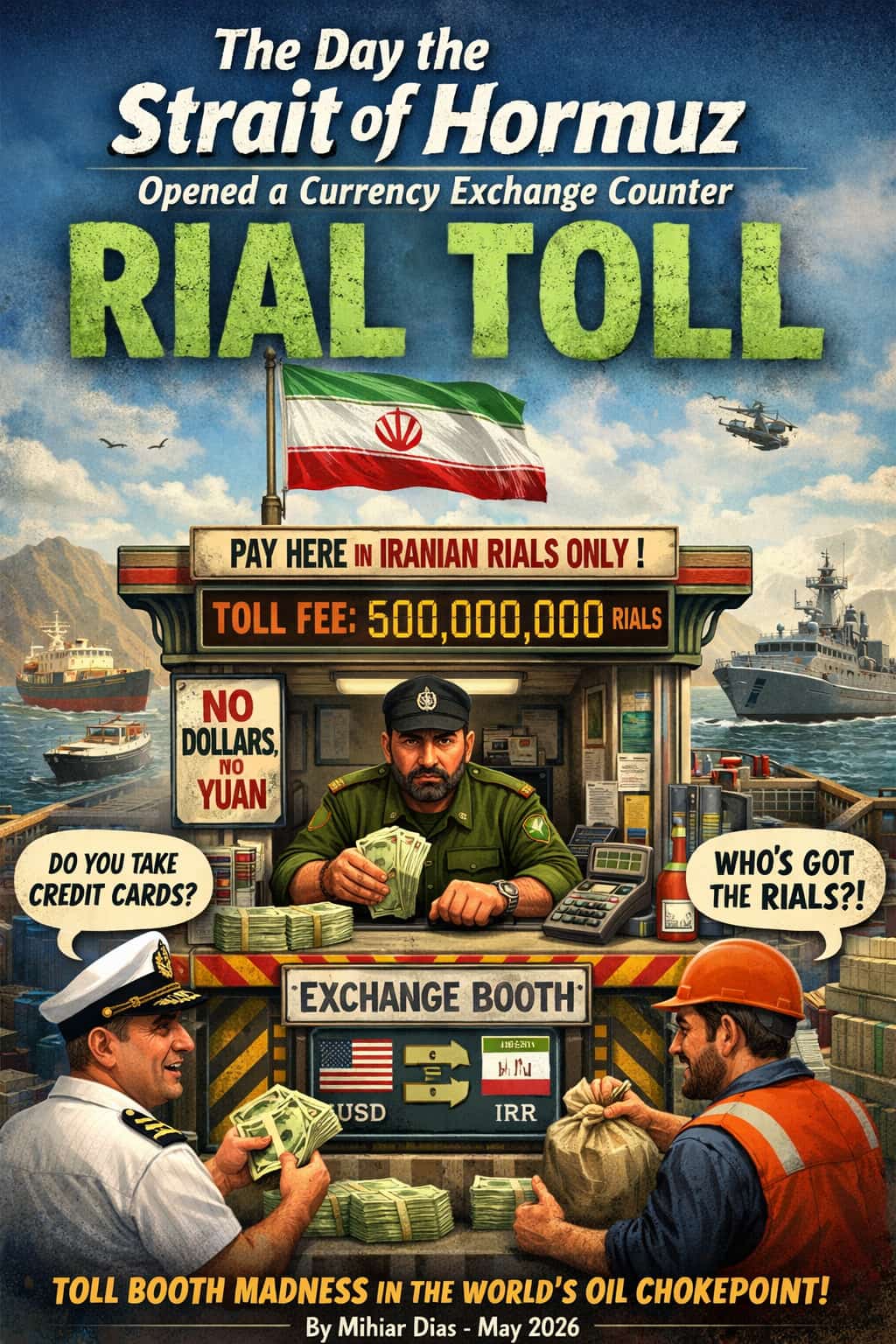
A Toll Booth Set Up by Iran to Collect Payment in Rials
By Mihar Dias May 2026
The latest reports suggest that Iran has decided vessels transiting the Strait of Hormuz must pay tolls not in US dollars, not in Chinese yuan, but only in Iranian rials. “No more dollars, no more yuan,” lawmakers reportedly declared, sounding less like a parliament and more like an irritated roadside parking attendant who has grown tired of tourists waving foreign currency. https://x.com/i/status/2052836087547228260
And just like that, the world’s most important oil chokepoint has become part maritime corridor, part central bank experiment, part geopolitical stand-up comedy.
For decades, the world economy revolved around the mighty petrodollar. Oil moved, dollars flowed, and everyone pretended this arrangement was as natural as gravity. Then came the era of sanctions, currency wars, frozen reserves, and countries discovering that dependence on someone else’s currency is rather inconvenient when that someone else occasionally dislikes your government.
So now Iran has essentially looked at Washington and Beijing and announced: “Thank you for your currencies. We shall use our own.”
The delicious irony is that this is not merely an attack on the dollar. It is also a small slap at China’s ambitions. Beijing spent years dreaming of internationalizing the yuan, positioning itself as the elegant alternative to American financial dominance. Then Tehran effectively replied, “Very nice. But for this toll gate, kindly queue with everyone else.”
One can almost hear exhausted shipping executives asking practical questions nobody in geopolitics seminars ever discusses.
Where exactly does one obtain several billion rials at three in the morning while drifting beside an armed patrol boat?
Will Bloomberg now add a “Hormuz Rial Index”?
Will tanker captains need money changers onboard beside life rafts?
And somewhere in Singapore or Dubai, a banker is already preparing a PowerPoint presentation titled: “Strategic Opportunities in Maritime Rial Liquidity Solutions.”
The ramifications, however, are serious beneath the absurdity.
About a fifth of the world’s oil passes through Hormuz. When the currency used for transit changes, even symbolically, it chips away at the invisible architecture underpinning global finance. Empires are not sustained merely by armies. They are sustained because everybody uses the empire’s money.
The Americans learned this after Bretton Woods.
The British learned it after sterling declined.
And now the world may be watching the early stages of what economists politely call “currency fragmentation,” which is a sophisticated phrase meaning: “Everybody no longer trusts everybody else.”
The consequences could be gloriously chaotic.
Insurance premiums rise.
Energy prices wobble.
Black-market currency traders suddenly become strategic geopolitical actors.
Small nations start wondering whether they too should demand payment in local currencies. One imagines future headlines:
“Panama Canal accepts only coconuts-backed digital tokens.”
“Malacca Strait tolls payable in ringgit and nasi lemak futures.”
“Port Klang introduces QR code diplomacy.”
And of course, speculators will feast. Somewhere a hedge fund manager is already rubbing his hands, thrilled that tanker routes now resemble a multiplayer video game designed by economists suffering nervous breakdowns.
International law will also become a theatre production. Critics argue such tolls violate long-standing maritime conventions regarding transit passage. Yet laws in geopolitics often function like speed limits in Kuala Lumpur — technically visible, selectively obeyed, and entirely dependent on who has the bigger vehicle.
The bigger question is this: if countries begin weaponizing geography and currency simultaneously, what exactly remains of globalization?
For thirty years the world was told borders mattered less, trade would civilize politics, and interconnected economies would ensure stability. Instead we received sanctions, proxy wars, semiconductor embargoes, frozen assets, and now apparently mandatory rial payments at sea.
Globalization did not end with a bang.
It ended with transaction fees.
Perhaps the most cynical lesson is that every major power now behaves like the very thing it once condemned. America sanctioned. China leveraged trade. Russia weaponized energy. Iran monetizes chokepoints. Everyone accuses everyone else of destabilizing the world while quietly printing invoices.
The modern international order increasingly resembles a dysfunctional condominium management committee where every resident controls one essential utility and periodically threatens to shut it off.
And ordinary people, naturally, will pay for it eventually through higher fuel prices, more expensive goods, weaker currencies and endless expert panels on television explaining why your groceries now cost the same as small pieces of industrial equipment.
Still, one must admire the audacity.
History may remember this not merely as a currency decision, but as the moment the world fully entered the age of transactional geopolitics — where strategic waterways became subscription services, sovereignty came with payment gateways, and the global economy discovered that even the sea now has a cashier.
Mihar Dias (mihardias@gmail.com) is a content creator under the Newswav Creator programme, where you get to express yourself, be a citizen journalist, and at the same time monetize your content & reach millions of users on Newswav. Log in to creator.newswav.com and become a Newswav Creator now!
The User Content (as defined on Newswav Terms of Use) above including the views expressed and media (pictures, videos, citations etc) were submitted & posted by the author. Newswav is solely an aggregation platform that hosts the User Content. If you have any questions about the content, copyright or other issues of the work, please contact creator@newswav.com.