
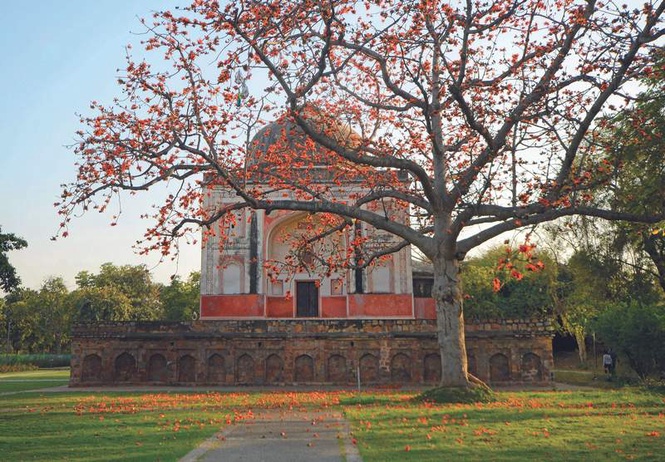
How did Delhi’s Sunder Nursery transform from a dusty, unkempt and far from sunder government nursery into the verdant space it is today? True, it was once part of a larger garden, replete with monuments and exotic trees, but that was relatively unknown to the public. The change began in 1997 when, at the invitation of the Archaeological Survey of India (ASI), the Aga Khan Trust for Culture (AKTC) undertook the restoration of Humayun’s Tomb.
It was a gift from the AKTC on India’s 50th anniversary of Independence. Today, the phenomenal increase in the visitors to Humayun’s Tomb testifies to the success of the scheme. Subsequently, in 2004, the AKTC, at the request of the Government of India, undertook the development of the surrounding area — some 500 acres of land with around 60 monuments, many of which had collapsed, or were in need of urgent repair. This was bounded by Azimganj Serai at the northern end, Rahim’s tomb to the south, with Nizammudin Basti and Nila Gambad to the west and east, respectively.
The story of Sunder Nursery has been dazzlingly — and I use the word deliberately — told in ‘Gardens Within A Garden: Sunder Nursery, New Delhi’, a collection of nine fascinating essays that explore Sunder Nursery’s concept, the process through which it came to its present avatar and its place in the urban environment of Delhi. The authors include Ratish Nanda, the CEO of AKTC, Gillian Wright, Hardeep Thakur, Gautam Bhatia and Mayank Austen Soofi.
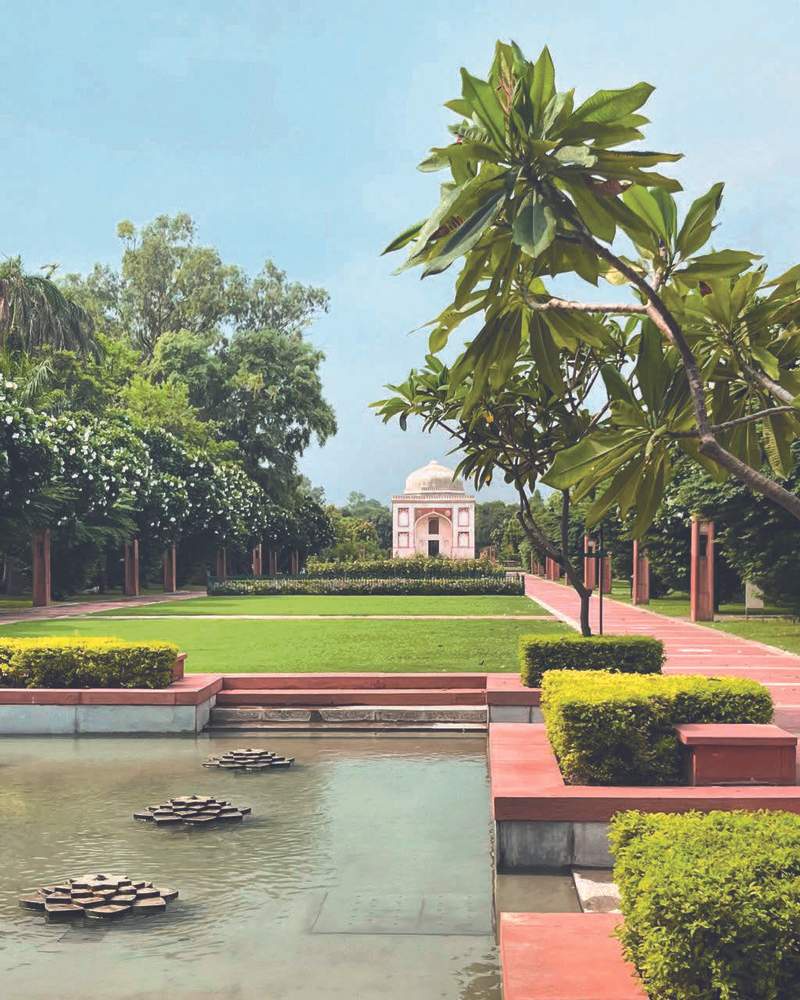
The Forecourt shares a common entrance to Sunder Nursery and Humayun’s Tomb through a cascade court, seen in the foreground. Credit: Aga Khan Trust for Culture. The Forecourt shares a common entrance to Sunder Nursery and Humayun’s Tomb through a cascade court, seen in the foreground. Credit: Aga Khan Trust for Culture. Image © The Alkazi Collection of Photography
The book has over 500 stunning photographs, maps and illustrations and is an invaluable insight into the history of this magical space. The area has been a sacred spot for nearly 700 years. In the 13th century, the great Sufi saint Nizamuddin Aulia chose to settle on what was then a deserted part of the Jamuna’s banks; after his death, a dargah or grave was built there. This became a venerated spot as not only did pilgrims come in droves, but courtiers and princes and even emperors chose to be buried there. This practice continued through the Tughlaq, Sayyid, Lodi and Sur dynasties of the Delhi Sultanate. The Mughals followed, with Emperor Humayan being the most prominent, besides the great warrior and poet Abdur Rahim Khan-i-Khanan, Akbar’s son-in-law Mirza Muzaffar Hassan and celebrated poets Amir Khusrau and Ghalib.
Many tombs were set within gardens in the famous Mughal charbagh layout, with their own wells, trees and flowers. The area was the personal property of the reigning Mughal emperor, who would come regularly to pay respect to his ancestors and contribute very generously to the upkeep of the tombs and gardens.
By all accounts, it was a beautiful space — a tranquil necropolis, verdant, blossoming, and meticulously tended. But as the Mughal rule declined, so did the area and by the last century, the structures were dilapidated; the gardens like overgrown scrub.
After 1911, when the shift of capital was announced, the need for plantation to shade the new city became urgent. Trees, shrubs, and creepers were sourced from all over the empire and parked in the area — which is how Sunder Nursery got its name.
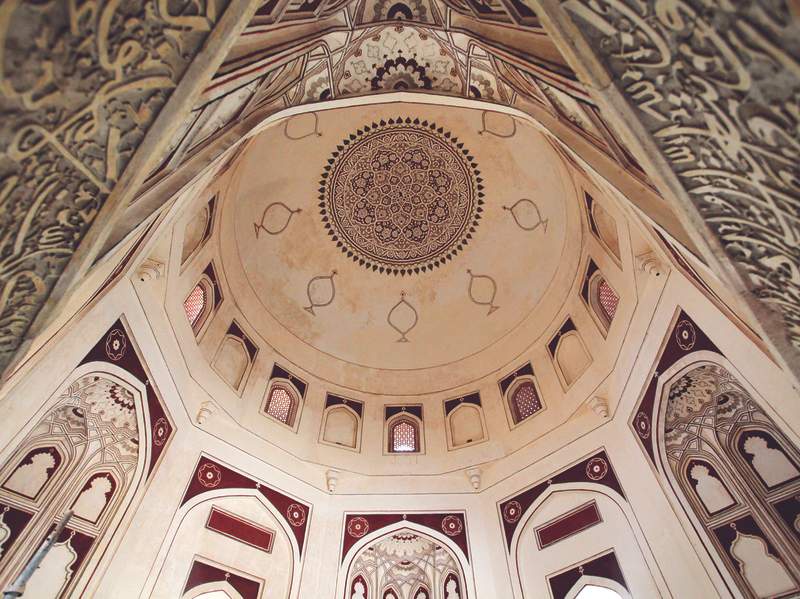
Lakkarwala Burj. Restored facade with intricately etched Quranic verses on the internal walls with incised plasterwork. Credit: Ram Rahman. Image © The Alkazi Collection of Photography
Alick Percy-Lancaster, the chief horticulturalist, decided in which avenues and roundabouts of the new capital they would go. Many were transplanted but many remained and were integrated into the plans for redevelopment.
The restoration of Humayun’s Tomb and the building of the Museum next to it led to a new awareness of the Sunder Nursery area. The Museum, considered one of the foremost in India today, is largely underground, and follows a design that drew on subterranean architecture inspired by baolis, as well as Persian and Mughal garden traditions.
Mohammad Shaheer’s design of the gardens is very sensitive to nature and takes in the cultural and environmental spirit of the place. It is a very consciously evolving landscape from the centre to the periphery, with a formal central vista which allows “excursions to little private gardens” on the margins. The Mughal monuments are the core elements in the scheme. Subz Burj, Lakkarwala Burj, the Mughal Pavilion and Muzzaffar Hassan’s tomb, among others, have been rescued from dire dilapidation with historically appropriate conservation through the use of age-old building techniques applied by trained master craftsmen.
Over 300 species of trees can be found here. Birds and butterflies abound, making it a nature lovers’ paradise. Unsurprisingly, therefore, in 2024 alone, Sunder Nursery had almost 1.12 crore visitors. This is important as it receives no government funds; presently, the AKTC takes responsibility for managing Sunder Nursery, Humayun’s Tomb and the Museum, and the plan is to eventually make it self-sustaining. To that end, the space is available for concerts, book conversations, farmers’ markets, art shows and other cultural and social events, as well as having popular food and beverage outlets.
Sunder Nursery’s enormous popularity is almost a bane, leading to traffic jams on approach roads, while within picnickers and selfie-clickers and walkers are packed like sardines, especially on its popular central vista stretch. Mayank Austen Soofi, contemporary Delhi’s chief chronicler, senses a certain chagrin among old Sunder Nursery loyalists directed at the swelling crowds of newbies at the hijacking of their secret garden. Yet it’s a democratic space, where (says Soofi) avocados and L’Opera sandwiches are consumed cheek by jowl with puri-aloo and biryani.
Undeniably, Sunder Nursery is more than a much-needed green lung. “Does an old Mughal garden,” asks Gautam Bhatia, “with its funerary tombs contribute to the life of such a turbulent city?” Yes. It helps congested, polluted, anarchic Delhi breathe; it contributes to the welfare of nearby places — Nizammudin Basti, for instance — by integrating the economy of the area with the gardens: what Prince Karin Aga Khan IVth described as the way “cultural heritage becomes a trampoline for economic benefit”.
Most importantly, it provides food for the souls of all us city dwellers. It links us to our history. “A delicate quiet,” Bhatia calls it, “an irreplaceable poetic silence. Just for that the city is grateful.”
— The writer is a literary agent