
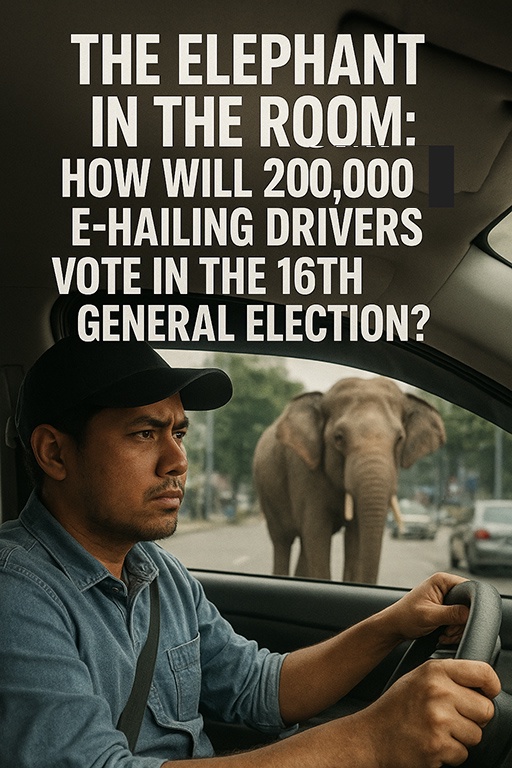
The current government is required to call for a general election within the next 24 months, by November 2027 at the latest. Following a disastrous defeat in the Sabah state elections—where Pakatan Harapan and DAP performed very poorly, with DAP losing all eight seats it contested—the political landscape has grown increasingly uncertain. https://www.channelnewsasia.com/asia/malaysia-sabah-election-grs-anwar-ph-dap-5498131?fast=true
One key question now is: how will the 200,000 e-hailing and p-hailing drivers vote in the 16th General Election? https://www.researchgate.net/publication/340297020_A_Review_and_Conceptual_Development_of_the_Factors_Influencing_Consumer_Intention_towards_E-Hailing_Service_in_Malaysia This is not a diffuse group. They represent a concentrated bloc of voters, predominantly located in the urban and suburban parliamentary seats of the Klang Valley, Kinta Valley, Penang, and Johor Bahru—the very heartlands that Pakatan Harapan, which includes DAP, must hold to retain power. Their political leanings are difficult to predict, but judging from the widespread dissatisfaction voiced across social media, the government may have reason to worry about how this group will respond at the ballot box.
Complicating matters further is the fact that the Minister of Transport, who oversees APAD—the agency regulating e-hailing companies and drivers—is from DAP. Many drivers feel the government has been unresponsive to their concerns, which may significantly influence their voting decisions.
For most e-hailing drivers, the core issue is simple: fares often do not match the distance, time, or effort required. Many feel the algorithm is stacked against them, and because companies do not reveal how fares are calculated, there is a deep sense of mistrust. The government’s refusal to set a minimum fare is also seen as a major setback. While a minimum fare might disadvantage e-hailing companies that charge higher commissions and those competing on the lowest possible fares to attract riders, this should not be used as an excuse to avoid establishing a basic level of income stability for drivers. E-hailing drivers deserve earnings that are fair and sustainable, regardless of which platform they work for.
Adding to this pressure is the fact that there are now 28 licensed companies operating e-hailing services. https://says.com/my/berita/apad-umum-28-senarai-rasmi-syarikat-e-hailing-berlesen-yang-kini-aktif-hingga-2027
This level of market saturation creates intense competition among platforms, and ultimately, it is the drivers who bear the consequences. As companies fight for passengers, fare structures become increasingly strained, leaving drivers feeling powerless and undervalued. They often face long pickups, distant drop-offs with no return fare, and routes that simply do not make economic sense.
This issue becomes even more complicated when foreign riders—who are not meant to benefit from subsidised fuel—end up paying the same low fares as locals. https://www.nst.com.my/news/nation/2025/11/1308107/budi95-tiered-scheme-quota-e-hailing-airport-taxi-drivers.
Compulsory e-hailing insurance premiums have also risen steeply over the years. https://www.thestar.com.my/news/nation/2025/11/26/hikes-in-insurance-premiums-pushing-e-hailing-drivers-out
What was RM615.00 for the year 2024/2025 has increased to RM1,710 for the year 2025/2026, marking an increase of over 150%. This e-hailing insurance is in addition to the normal motor vehicle insurance. In a survey conducted by Bolt in November this year, 67% of e-hailing drivers expressed dissatisfaction with the insurance hike. That is a very high number which the government cannot ignore.https://www.carsifu.my/news/bolt-malaysia-survey-e-hailing-is-main-income-for-71-of-drivers
Costs don’t end there. The service tax rate for vehicle repairs in Malaysia has also increased by 2 percentage points in the last two years, and the scope of taxable services has been expanded. Beyond regulated costs like fuel, insurance, puspakom inspections, e-hailing drivers face a silent, steep climb in operational expenses. Industry data from workshop federations and official inflation figures indicate that vehicle repair and maintenance costs have surged by an estimated 20% to 30% over the past two years. https://open.dosm.gov.my/dashboard/consumer-prices For a driver, this can mean an extra RM1,500 to RM2,500 per year leaving their pocket—a direct hit to their already squeezed take-home pay.
With all these issues looming, the government must act decisively now to deliver immediate, tangible relief. The solution lies not in one grand move, but in a coordinated package of targeted, immediate interventions that address each layer of the drivers’ financial squeeze.
First and foremost, the fare issue must be addressed. Any credible solution must begin where the driver’s frustration begins: with the fare. The government’s current posture of "studying the need for regulation" is seen as evasion https://www.thestar.com.my/news/nation/2025/07/24/govt-studying-if-e-hailing-fares-need-regulation-says-transport-ministry.
It must shift to brokering a binding, time-bound negotiation between drivers, platforms, and regulators to establish a transparent minimum fare formula. This formula must account for base distance, time, regional operating costs, and a guaranteed minimum earning per hour that reflects a decent livelihood—not just platform viability.
Foreigners—including both tourists and migrant workers—should be charged higher fares when using e-hailing services, similar to the differential pricing found at some tourist spots. Implementing a modest surcharge for rides booked by non-citizens is politically astute. It directly addresses the "subsidy leakage" complaint, puts more ringgit in drivers' pockets, and is harder for the domestic public to oppose. It frames the policy as ensuring foreigners pay fair value. The government could address this easily by requiring every rider to register with a verified identity card or passport with the e-hailing companies, instead of relying only on phone numbers or email accounts. Such a system would make it easier to identify passengers, provide added security for drivers, and allow e-hailing companies to apply different fare structures if needed.
The insurance crisis demands an emergency response. The Ministry of Transport, which mandated the e-hailing insurance requirements, must urgently convene with Bank Negara Malaysia and the insurance industry to negotiate a sustainable premium structure. A visible win here—such as a 20-30% rollback—would be a critical signal of support. Meanwhile, the government can also explore other options, such as having platform providers contribute a portion of their profits to a cooperative that can help drivers obtain insurance at a lower, negotiated rate.
Another option is to incorporate the insurance cost into the passenger fare. Some companies already allow passengers to opt in for an additional RM0.30 for extra insurance coverage. If the e-hailing insurance premium were added directly to the rider’s fare, it might increase the cost by only 20 to 50 sen for short trips, or about RM1 to RM2 for longer journeys. Drivers with a clean record for the year could also be rewarded with a no-claim-discount-style incentive, similar to that offered to regular motorists.
All in all, there is much the government can do without being caught in a policy trilemma. Acting decisively for drivers risks angering the much larger voting bloc of price-sensitive riders. Pleasing riders and platforms by maintaining low fares guarantees driver alienation. Finding a middle ground—where riders pay a fair price, drivers earn a sustainable income, and platforms operate with transparency—is the essential win-win.
The Gig Workers Act was an important milestone, and once implemented, it will certainly help many e-hailing drivers. However, it offers no immediate guarantee of fair fares. Under the Act, any fare adjustment must go through a process of agreement involving all stakeholders, and even then it requires the approval of the Minister of Transport.
There is a clear message in the air. Implementing fare reforms too close to an election risks public backlash. Making fair adjustments early allows the public time to adapt. It also reduces the likelihood of facing 200,000 frustrated drivers at the ballot box.
The government would do well to read the writing on the wall and act before it is too late.
Chris (protocall22@gmail.com) is a content creator under the Newswav Creator programme, where you get to express yourself, be a citizen journalist, and at the same time monetize your content & reach millions of users on Newswav. Log in to creator.newswav.com and become a Newswav Creator now!
The User Content (as defined on Newswav Terms of Use) above including the views expressed and media (pictures, videos, citations etc) were submitted & posted by the author. Newswav is solely an aggregation platform that hosts the User Content. If you have any questions about the content, copyright or other issues of the work, please contact creator@newswav.com.


