
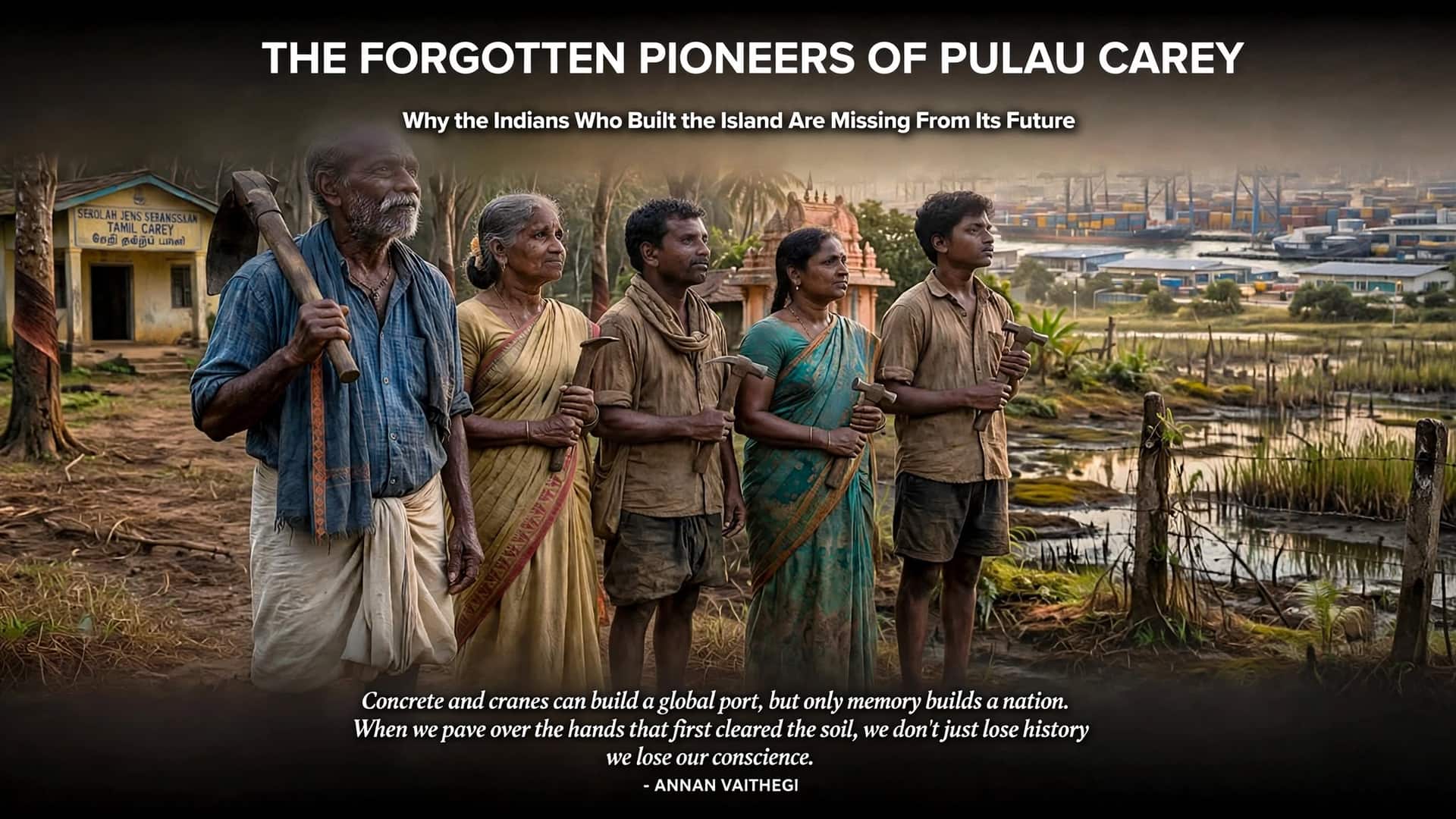
Pulau Carey is about to be reborn in steel, concrete, and global capital. With Putrajaya’s recent approval of the Carey Island Port Special Economic Zone and National Maritime Port City an ambitious 20-year mega-project engineered to add 42 million TEUs in container capacity, generate 115,000 jobs, and pump RM4.7 billion into Malaysia’s GDP by 2045 the 32,000-acre island is being aggressively marketed as the next frontier of Southeast Asian trade.
Yet, behind the glossy renderings of deep-sea terminals and logistics hubs lies an uncomfortable erasure. More than a century ago, Pulau Carey was an uninhabitable expanse of snake-infested mangrove and peat swamp until thousands of South Indian labourers were brought in to clear it with bare hands, axes, and changkols, paying for Malaya’s plantation wealth with their sweat and lives. Today, as land values prepare to soar and corporations position themselves for a multi-billion-ringgit windfall, the descendants of those pioneers hold not a single inch of title deed, no equity in the island’s future, and barely a footnote in its official history.
The Forgotten First Shift
Long before Carey Island became synonymous with corporate plantations and mega-port blueprints, it was Telok Gonjeng an unforgiving expanse of coastal swamp separated from the mainland by water.
In the official telling of the island’s history, two pillars stand prominently. The first is the Mah Meri, the indigenous Orang Asli custodians of the coast, whose woodcarving traditions and spiritual heritage are rightfully celebrated and protected within gazetted village reserves like Kampung Sungai Bumbun. The second is colonial and corporate enterprise beginning in 1905 when British planter Edward Valentine John Carey cleared the land for rubber, evolving through Golden Hope and Sime Darby into today’s SD Guthrie, which owns over 28,600 acres (roughly 80%) of the island. Even E.V. Carey’s colonial residence, Hatter’s Castle, stands preserved as a monument to the island’s past.
Missing from this national pantheon is the third pillar: the thousands of South Indian labourers brought over from 1907 onward to do what neither colonial capital nor machinery could do at the time.
Battling virulent malaria, isolation, and brutal working conditions, these men and women drained the swamps and planted the rubber trees that funded Malaya’s rise as a global economic powerhouse. They lived in cramped, company-owned estate quarters (lines), cut off from the mainland for decades without a bridge, raising generations in self-contained worlds anchored by small Tamil schools and estate Hindu temples.
A Failure of Leadership, or a Trap of Circumstance?
When examining why the descendants of Carey Island’s Indian pioneers hold no land, no equity, and virtually no formal recognition on the island today, it is tempting to point fingers in one of two directions: either blaming post-independence Indian political leaders for failing to secure their future, or questioning why a community numbering in the thousands did not organize to carve out a brighter destiny for itself.
The truth is that both forces were locked together in a system designed to prevent permanence.
To suggest that estate workers simply failed to "build a brighter future" ignores the ruthless architecture of the plantation system. Carey Island was a closed ecosystem. Workers were not treated as settlers; they were treated as disposable sojourners whose housing, water, healthcare, and children's schooling deliberately capped at primary level were wholly owned by the estate. Separated from mainland towns by ferry, workers had little access to higher education, capital, or outside networks. Speaking out against management did not merely mean losing a job; it meant losing your family's roof and being exiled from the only community you knew.
And when they did rise up, the state crushed them. During the historic 1941 Klang strikes in which workers from Carey Island’s Teluk Ganting Estate actively participated the British administration deployed troops, opened fire on strikers, and deported grassroots leaders. Between colonial bullets, the devastation of the Japanese Occupation, and the Emergency-era crackdown on militant unions, the boldest voices of the estate working class were silenced long before Merdeka.
Yet, if colonial design built the cage, post-independence leadership failed to unlock it.
After 1957, when British plantations were gradually bought over by Malaysian corporate entities, the legal status of the estate worker never changed. While traditional Malay kampungs held ancestral land and Chinese New Villages were granted individual land titles (geran), Indian estate workers remained categorized strictly as corporate employees living in tied housing. You need only look across the Langat River to see the divergence: traditional Malay communities in Sijangkang and Teluk Panglima Garang grew on protected ancestral holdings, while the nearby Chinese New Village of Jenjarom born out of Emergency-era resettlement secured individual leasehold titles that turned it into a thriving, self-owned commercial town. By contrast, the estates of Pulau Carey remained private corporate balance-sheet assets, leaving Indian workers without a single square foot to call their own.
For decades, mainstream Indian political representation and plantation unions focused on short-term survival negotiating modest wage increments or scrambling to save individual temples from eviction rather than fighting for a national land-settlement policy for retired workers. When plantations transitioned from labour-intensive rubber to kelapa sawit in the 1970s and 1980s, and later turned to cheaper foreign contract labour, the inevitable happened. Thousands of Indian workers who had spent forty years on Carey Island retired with meager EPF payouts and nowhere to live. Quietly, without headlines or compensation, an entire community packed its bags and migrated to low-cost flats and mainland towns across Banting, Teluk Panglima Garang, and Klang.
Progress Cannot Be Built on Erasure
You cannot turn back the clock on a century of landlessness, nor can you halt the economic tide turning Pulau Carey into a 21st-century maritime powerhouse. History moves forward, and ports will be built.
But a nation’s integrity is measured by whom it erases when the cranes arrive.
As SD Guthrie, Menteri Besar Selangor Incorporated (MBI), and federal planners finalize the zoning and master plans for the Carey Island Maritime City, corporate social responsibility cannot be treated as an optional afterthought. Honouring the Indian pioneers of Carey Island does not require rewriting property law it requires moral accountability and political spine:
- Legally Gazette Remaining Sacred and Cultural Spaces: Before bulldozers clear a single acre of oil palm for industrial zoning, every remaining estate Hindu temple, historic chapel, Tamil school, and burial ground on Carey Island must be permanently gazetted as religious and heritage reserves.
- Build a Carey Island Pioneer Heritage Gallery: Alongside the Mah Meri Cultural Village, developers and state authorities must fund a permanent museum and monument documenting the island’s plantation history naming the communities that cleared the swamps, honouring those who stood in the 1941 strikes, and preserving the physical memory of estate life.
- Ring-Fence Opportunity for Descendants: If the new port city is projected to generate 115,000 jobs and RM4.7 billion in GDP, a dedicated share of maritime scholarships, technical training programs, and vendor contracts must be ring-fenced for youth from former estate families across Kuala Langat and Klang.
Pulau Carey is preparing to welcome the world’s largest ships to its shores. Before Malaysia celebrates the billions that will flow through its new terminals, it owes a long-overdue debt of recognition to the hands that first made the island habitable. They may not hold the title deeds to Carey Island but their sweat is written into every acre of it, and their story refuses to be paved over.
"Concrete and cranes can build a global port, but only memory builds a nation. When we pave over the hands that first cleared the soil, we don’t just lose history we lose our conscience." - Annan Vaithegi
Annan Vaithegi (annanvaithegi@icloud.com) is a content creator under the Newswav Creator programme, where you get to express yourself, be a citizen journalist, and at the same time monetize your content & reach millions of users on Newswav. Log in to creator.newswav.com and become a Newswav Creator now!
The User Content (as defined on Newswav Terms of Use) above including the views expressed and media (pictures, videos, citations etc) were submitted & posted by the author. Newswav is solely an aggregation platform that hosts the User Content. If you have any questions about the content, copyright or other issues of the work, please contact creator@newswav.com.
