
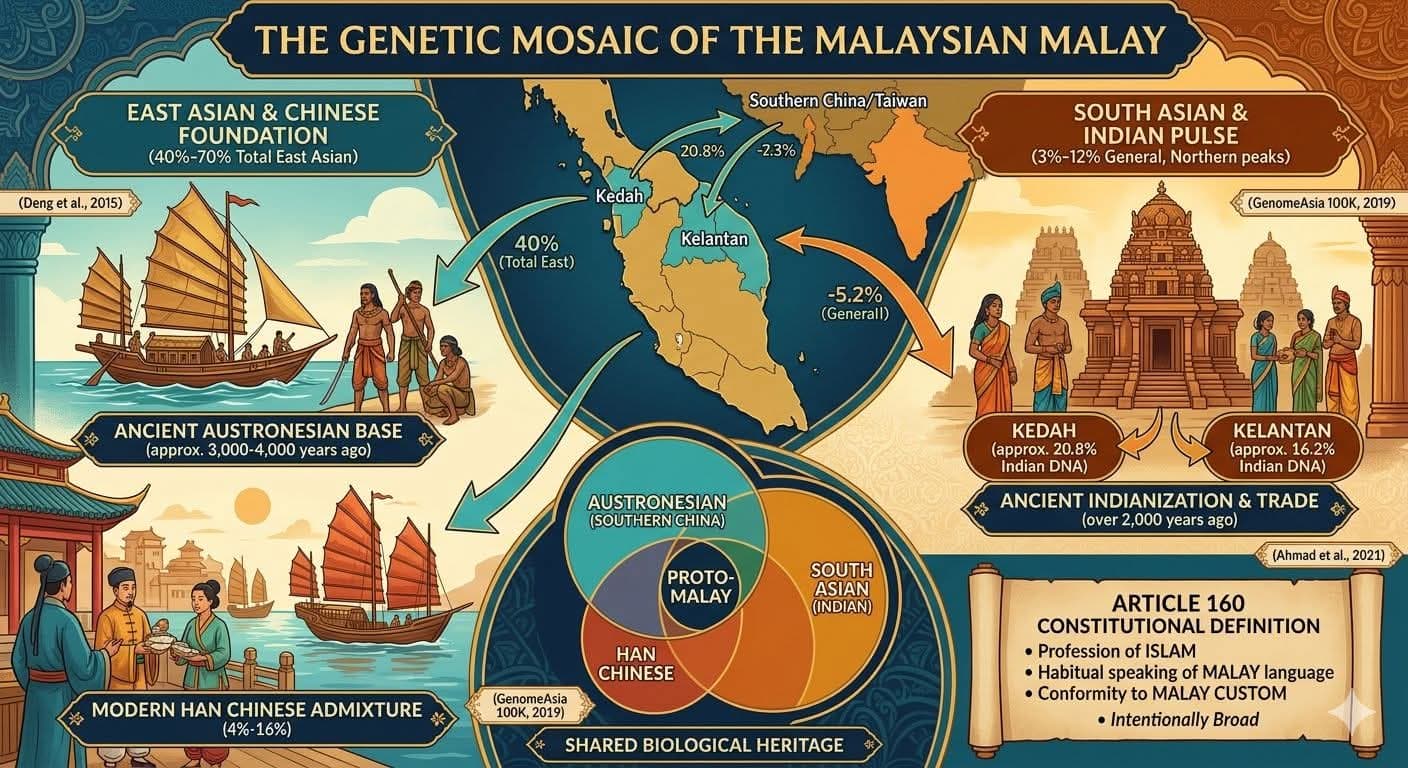
The concept of a "pure" or "homogenous" genetic lineage in the Malay Archipelago (Alam Nusantara) is increasingly being reshaped by the findings of modern genomic science. For centuries, the Malay Peninsula has served as the ultimate maritime crossroads—a geographical bridge connecting the Indian Ocean and the South China Sea. Recent large-scale DNA studies now provide biological proof of what history has long suggested: the Malaysian Malay genome is a rich, complex mosaic of ancient migrations.
The most dominant ancestral component in the majority of Malaysian Malay populations is East Asian. However, it is essential to distinguish between "ancient" and "modern" markers. Geneticists identify the primary "base" of the Nusantara population as originating from the Austronesian expansion. Approximately 3,000 to 4,000 years ago, groups from Southern China and Taiwan migrated southwards, carrying a genetic signature that remains the bedrock of the Malay identity today.
According to a pivotal study published in Scientific Reports by Deng et al. (2015), the East Asian genetic component in various Malay subgroups typically ranges from 40% to 70%. While a significant portion of this is attributed to the ancient Austronesian layers, Deng's research also confirms that modern Han Chinese admixture—resulting from centuries of trade and more recent historical migrations—contributes an additional 4% to 16% to the specific genetic markers found in Peninsular Malays. This data confirms that the majority of the "native" genetic code in the region is shared with populations from the East Asian mainland.
Perhaps the most striking revelation in Nusantara DNA research is the deep and pervasive "South Asian pulse." For over 2,000 years, the Malay Peninsula was the heart of "Greater India," home to powerful Hindu-Buddhist civilizations such as Kedah Tua (Kadaram) and Srivijaya. This era of "Indianization" was not merely cultural or religious; it was biological.
Research conducted by Hatin et al. (2011) and later expanded upon by the GenomeAsia 100K Project (2019) reveals that South Asian (Indian) DNA is present in almost all Malay sub-ethnic groups, though the percentages vary significantly by geography. In the general population, the Indian genetic component typically fluctuates between 3% and 12%.
However, in Northern Peninsular Malaysia—regions that served as the primary entry points for ancient Indian traders—the numbers rise sharply. As noted in the findings of Deng et al. (2015), the Indian genetic admixture in Kedah is recorded at approximately 20.8%, while in Kelantan, it sits at roughly 16.2%. In certain groups, such as the Sri Lankan Malays, the South Asian DNA peaks at a remarkable 34%, illustrating a heritage that is more than one-third Indian.
The data suggests that the "Alam Nusantara" DNA is essentially a four-way blend of Austronesian, Proto-Malay, East Asian, and South Asian lineages. Even the Melayu Minang, often considered a core "Nusantara" group, carry an average of 12.5% South Asian DNA, according to the findings of Ahmad et al. (2021) in the Journal of Human Genetics. This study further emphasizes a startling reality: more than 98% of certain Northern Malay haplotypes are actually shared with either modern Indian or Chinese populations.
This genetic reality stands in interesting contrast to the legal definition established during the drafting of the Federal Constitution. Under Article 160, a "Malay" is defined not by biological "purity," but by the profession of Islam, the habitual speaking of the Malay language, and conformity to Malay custom. As noted by Othman (1985) and researchers at the Centre for Asian Legal Studies (NUS), this definition was intentionally broad. It was designed by the Reid Commission (1957) to include various groups—such as Indian Muslims and Arabs—who had integrated into the Malay social fabric.
In conclusion, the genetic reality of the Malaysian Malay is one of profound inclusivity. The presence of up to 21% Indian DNA in northern states and a dominant 40% to 70% East Asian foundation proves that the Malay Archipelago has always been a melting pot. As highlighted by the GenomeAsia 100K Consortium (2019), this shared ancestry serves as a powerful reminder that the historical and biological identity of the region is inextricably linked to the broader migrations of Asia, challenging modern narratives of ethnic isolation.
Naresh M.Narendran (naresh.m.narendran@gmail.com) is a content creator under the Newswav Creator programme, where you get to express yourself, be a citizen journalist, and at the same time monetize your content & reach millions of users on Newswav. Log in to creator.newswav.com and become a Newswav Creator now!
The User Content (as defined on Newswav Terms of Use) above including the views expressed and media (pictures, videos, citations etc) were submitted & posted by the author. Newswav is solely an aggregation platform that hosts the User Content. If you have any questions about the content, copyright or other issues of the work, please contact creator@newswav.com.