By Dr Sajad Hussein Kamarally
This morning, I saw something that stayed with me.
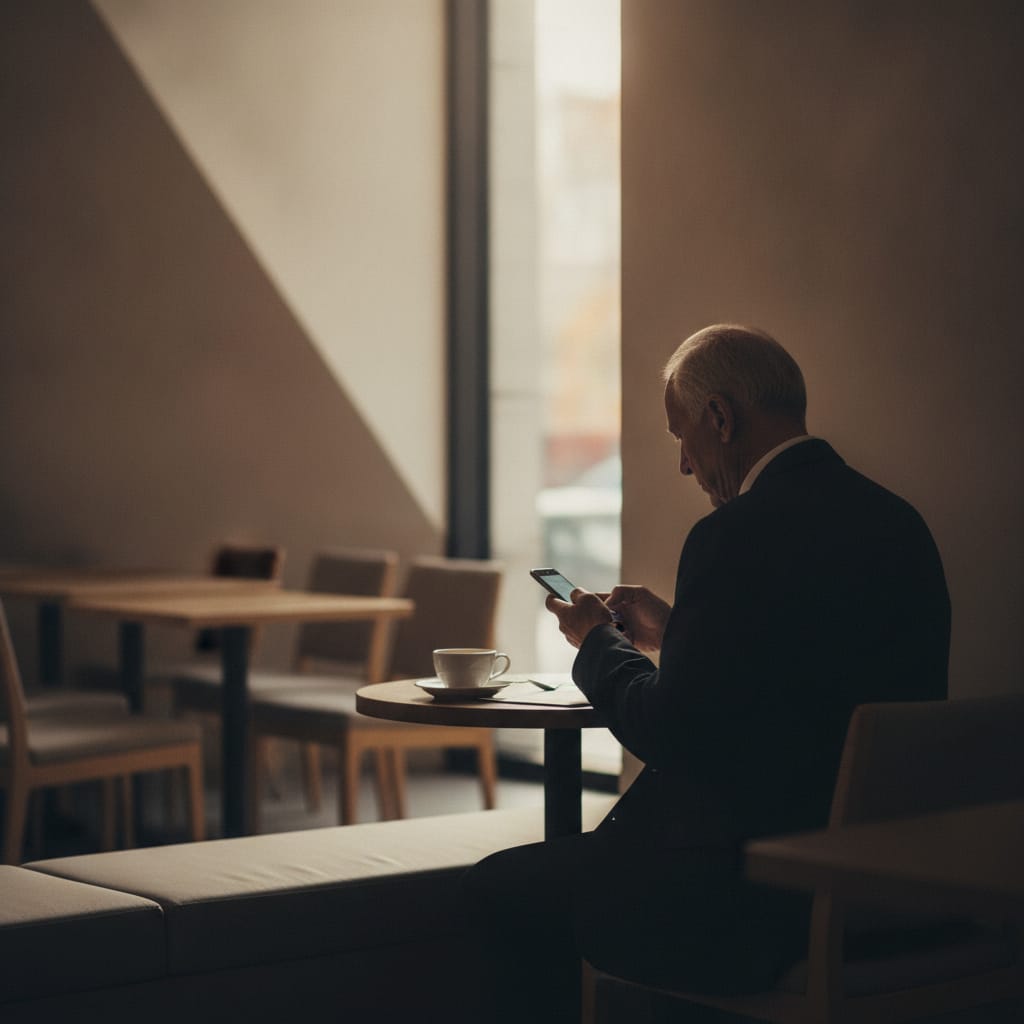
An old gentleman was sitting alone in the corner of an almost empty restaurant, staring quietly at his mobile phone.I wondered what he was thinking.Was he waiting for someone to join him for coffee?Was he simply passing the time? Or perhaps he had nowhere else to go.I don't know.
But there was something about his face that caught my attention. He looked a little lost. And it made me think about something many of us don't like to talk about. What happens to us when we grow old?
There comes a time when the world seems to move faster, while we move more slowly. Friends disappear. Children become busy with their own families. The workplace that once gave us purpose is behind us. Sometimes, without realising it, we find ourselves sitting alone in corners. Not necessarily because nobody loves us,but because nobody has thought to ask:"How are you today?"
So who is responsible?
Society
I believe society has a role to play.We need more places and activities where older people can meet, talk and feel useful.
Community centres. Kelab Warga Emas. Morning walking groups. Classes. Gotong-royong. Volunteer activities. Even something as simple as having coffee together.
The objective is not to keep elderly people "occupied".It is to give them a reason to participate.A reason to get dressed in the morning.A reason to meet someone.A reason to feel that they still matter, because growing older does not mean becoming irrelevant.
The Family
But the first line of support must always be the family.Children and grandchildren need to make time.It doesn't have to be hours.A ten-minute telephone call.A cup of coffee.A visit on Sunday.Or simply asking:"Dad, what do you think?"
Sometimes that question can mean more than we realise.Our elderly have spent decades making decisions for us. Perhaps now we should occasionally ask for their advice.We must never forget one simple truth:We cannot outsource love.
The Government
Government also has an important role.More day-care centres for seniors, community programmes, volunteer networks and support for families caring for elderly parents at home could make a real difference.
Perhaps there could even be greater incentives for families who choose to care for their elderly parents at home.This is not simply an economic issue.It is about the kind of society we want to become.In our Asian culture, we were traditionally taught to hormat our elders—to respect them, care for them and listen to them. Many families, fortunately including mine still live by these values.
But times are changing.Malaysia is moving towards becoming an negara warga emas, an ageing nation, and the demand for elderly care facilities is increasing.
Near my own home, I have noticed four old folks' homes opening within just a few years.That tells us something.Perhaps the question is not whether we need elderly care.We clearly do.
The bigger question is whether we are creating a society in which our elderly can age with dignity, companionship and purpose.
There is nothing wrong with an old folks' home when it provides good care, dignity and companionship. But we should be careful that institutional care does not become a substitute for family connection.
Where Do We Begin?
I have always believed that if we want to change society, we should begin with our children.Start in kindergarten.Teach children that grandparents are not simply old people who need looking after.They are people who have lived, worked, struggled, sacrificed and accumulated decades of experience.
Teach children to greet them.Listen to them.Help them.Sit with them.And most importantly, value them.
We also need a strong moral and religious foundation.
Across Malaysia's diverse religious traditions, respect for parents and elders is a deeply valued principle. If children grow up understanding that caring for those who came before them is a responsibility—not merely an obligation—they are more likely to carry that value into adulthood.
Because values taught early often stay with us for life.
That gentleman in the corner,I don't know who that gentleman was.I don't know his story.Perhaps he was perfectly happy sitting there, perhaps someone was coming to meet him,or he was simply enjoying his coffee and his phone.I may never know.
But his presence made me stop and think.We spend so much time talking about giving our children a better future.May be we should also spend a little more time asking: What kind of present are we giving our elderly?
Growing old is inevitable.Being forgotten is not. That is a choice. Let us choose not to forget, because one day, sooner than we think, that corner could be ours.
Dr Sajad H Kamarally (sajadhk05@gmail.com) is a content creator under the Newswav Creator programme, where you get to express yourself, be a citizen journalist, and at the same time monetize your content & reach millions of users on Newswav. Log in to creator.newswav.com and become a Newswav Creator now!
The User Content (as defined on Newswav Terms of Use) above including the views expressed and media (pictures, videos, citations etc) were submitted & posted by the author. Newswav is solely an aggregation platform that hosts the User Content. If you have any questions about the content, copyright or other issues of the work, please contact creator@newswav.com.