
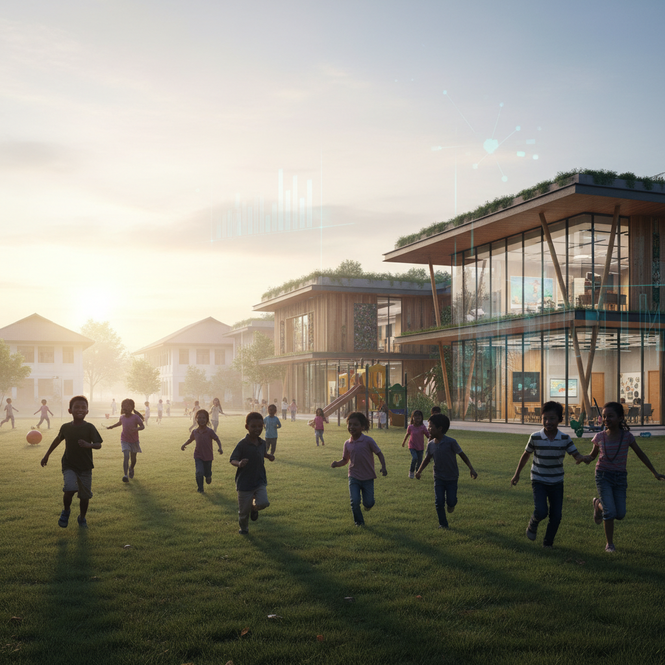
Malaysia is laying out its roadmap for the next decade of education, the Education Blueprint 2026–2035. There’s talk of targets, data, and outcomes. That’s necessary work. But before we get lost in the numbers, we need to ask a simple, human question. Who are we building this for?
https://share.google/8HZf2Z0OqqKaChfYF. The Star
Our classrooms aren’t filled with the students of 20 years ago. They’re alive with Generation Z and the rising Generation Alpha. We often label them as distracted, impatient, or "too sensitive." But what if we’re misreading them? These aren’t flaws, but survival skills adaptations to a world of digital immersion, endless information, and deep uncertainty. When a student tunes out, it’s not always a refusal to learn. Sometimes, it’s because the way we teach just doesn’t "connect" with how they experience the world.
The Blueprint’s focus on standards is important, but if all we do is double down on exams and rigid metrics, we might just widen the very gaps we’re trying to close.
We carry the world’s knowledge in our pockets. So what’s school for? It can’t just be about recalling facts. The real value now is in teaching kids how to think critically, make wise judgments, and navigate ethical dilemmas. Yet, so much of our system still rewards memorisation, one-size-fits-all pacing, and that suffocating pressure of a single high-stakes test, memorizing facts not making meaning.
Think about the student who struggles on paper but can troubleshoot any tech problem, teach themselves a skill from YouTube, or mediate a friend’s conflict. Their real-world intelligence is invisible to a Scantron sheet. If we truly want them future-ready, we need to measure understanding, not just the endurance to cram.
It’s a myth that these generations reject all discipline. What they reject are arbitrary rules that serve no clear purpose. They ask "why" not to be defiant, but because they’ve grown up in a world where authority from news sources to influencers has to explain itself to be believed. In their vocabulary respect need to earned not enforced.
Schools that run on "because I said so" will keep clashing with kids wired to question, compare, and verify. Today, respect isn’t handed out with a title; it’s built through consistency, transparency, and fairness. For any reform to stick, our educational leaders need to embody that.
We can’t talk about success without talking about our students’ mental and emotional health. They speak openly about stress and anxiety not because they’re fragile, but because they have the vocabulary for feelings earlier generations bottled up. Thus well-being is not a distraction but foundation.
Resilience isn’t forged by pressure alone. It grows when a student feels psychologically safe, faces meaningful challenges, and has a say in their own learning. Pushing well-being aside doesn’t create tougher kids; it creates disconnected ones.
For the true reform in the Blueprint to be more than words on paper, it has to answer some deep, practical questions.
Are we training teachers to be lecturers of content, or gardeners of curiosity?
Do our assessments capture the journey of learning, or just sort students into winners and losers?
Do we see students as empty vessels to fill, or as active partners in their own education?
The most important thing to remember is that today’s students are not the problem that needs fixing. They are the reality we need to design for.
If we craft this new Blueprint as if Google, AI, and a chaotic world don’t exist, we will keep mistaking a child’s adaptation for their failure. The true test of this decade-long plan won’t be how impressive it looks in a report. It will be whether it meets our children where they actually live—and lovingly equips them for a future that’s already at the door.
K.T.Maran Social, Environmental & Animal Activist
K.T. Maran (maran.kt@gmail.com) is a content creator under the Newswav Creator programme, where you get to express yourself, be a citizen journalist, and at the same time monetize your content & reach millions of users on Newswav. Log in to creator.newswav.com and become a Newswav Creator now!
The User Content (as defined on Newswav Terms of Use) above including the views expressed and media (pictures, videos, citations etc) were submitted & posted by the author. Newswav is solely an aggregation platform that hosts the User Content. If you have any questions about the content, copyright or other issues of the work, please contact creator@newswav.com.

