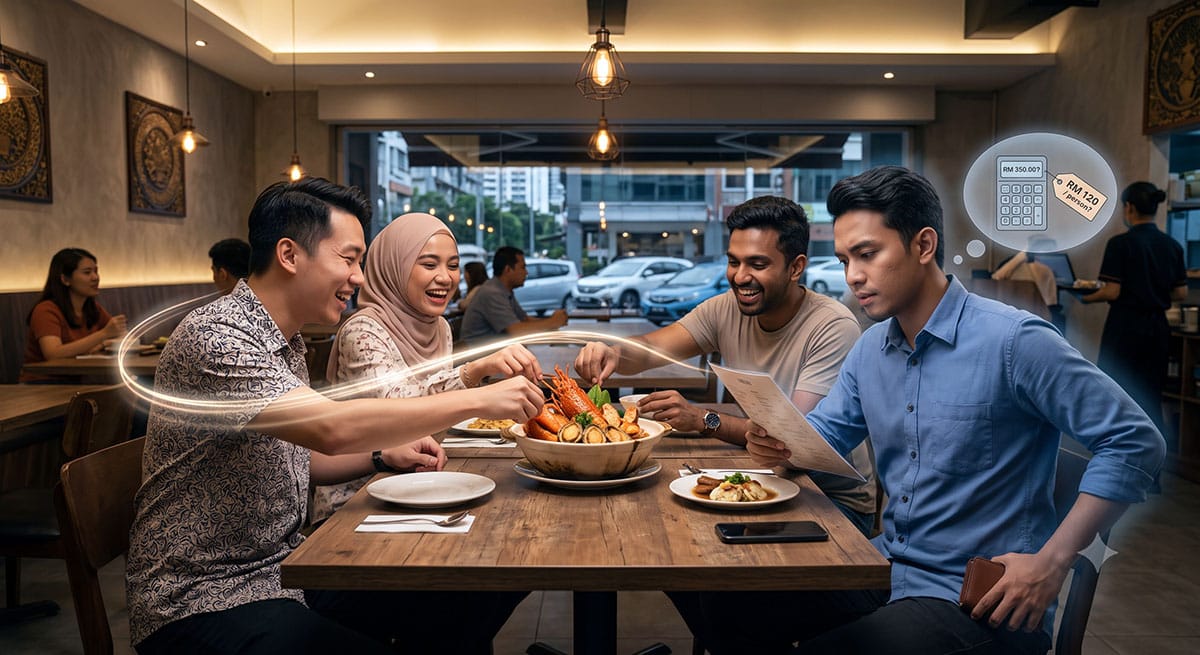
Nobody says the number out loud. Everyone at the table already knows it.
You notice it before anyone says a word. The friend who orders the cheapest item on the menu without being asked why. The one who suddenly needs the washroom right when the bill arrives. The one who insists on paying for everyone, loudly, every single time, at restaurants slightly too expensive for the occasion.
Nobody announces their salary at the table. Nobody has to. If you know how to read the room, the income gap is already visible in the ordering, the seating, the silences.
Malaysia's Income Gap Is Narrowing on Paper, Not at the Table
Officially, Malaysia's income inequality is at its best level in fifty years. The Gini coefficient fell to 0.39 in 2024, the lowest since records began in 1974. Median household income rose to RM7,017.
But statistics measure households, not friend groups. And perception has moved in the opposite direction of the official numbers. In 2013, half of Malaysians felt the income gap was wide or very wide. By 2023, that figure had climbed to 70%, across every ethnic and income bracket. People are not necessarily poorer. They simply feel further behind than they used to, and that feeling shows up most sharply in the company of people they grew up with, studied with, or consider close.
Wages have not helped close that emotional gap either. Between 2019 and 2024, wages rose by just 7% while food prices climbed 17%, a real erosion of purchasing power concentrated heavily among younger workers and new graduates. Meanwhile social mobility has stalled: researchers found that while three quarters of Malaysians born poor once managed to climb the income ladder, today only one in a hundred from the bottom 20% reaches the top earners.
That statistic alone explains a lot of quiet dinner tables.
The Psychology of Feeling Behind
There is a well-documented reason this specific kind of comparison stings more than most. Psychologists call it financial envy, the painful awareness of a gap between your situation and someone else's, and it is considered one of the most universally experienced emotional responses to money.
Money makes an unusually potent comparison target because it is highly visible, widely understood as a marker of status, and, unlike happiness or contentment, it comes with an actual number attached. Humans tend to compare upward far more than downward, toward those who appear to have more rather than those who have less, and upward comparison reliably produces dissatisfaction regardless of how much you actually earn.
Economists have given this pattern a name: expenditure cascades. When people at the top of an income group spend more, visible homes, cars, holidays, it shifts the reference point for everyone just below them, who then adjust their own spending to keep pace, cascading the pressure further down the chain. Nobody at any level ends up feeling ahead. Everyone just spends more trying to close a gap that keeps moving.
Left unaddressed, this kind of comparison does not stay quietly in the background. Research on financial envy links it to reduced life satisfaction independent of actual income, increased impulsive spending aimed at signalling status, and in cultures where wealth is treated as a stand-in for personal worth, genuine feelings of shame and inadequacy.
Why Malaysians Do Not Talk About It
Malaysian culture rarely discusses income directly. Asking someone's salary outright is considered rude in most social settings, closer to asking about someone's weight or marital problems than a neutral fact.
But silence does not mean the comparison disappears. It just moves underground, expressed through behaviour instead of words. Who picks the restaurant. Who orders confidently versus who scans the menu for the cheapest option and tries not to make it obvious. Who insists on paying, sometimes as generosity, sometimes as a quiet performance of status in front of an audience that did not ask to be impressed.
Among genuinely close friends, this usually resolves itself without anyone acknowledging the imbalance outright. The friend earning more simply picks up dinner without comment, treating it as a non-issue rather than a favour. That kind of quiet generosity, offered without making the other person feel small, is arguably the healthiest version of how income gaps get handled inside real friendships.
The unhealthy version looks different: someone repeatedly choosing venues just beyond a friend's comfortable budget, then covering the bill in a way designed to be noticed rather than to help.
My Take
In my twenties, I felt this constantly. My closest friends earned significantly more than I did, and they often ended up covering meals without making a thing of it. I felt the gap. I will not pretend otherwise. There was a version of inferiority sitting underneath those dinners, even when nobody said anything unkind.
What changed was not my income. It was what I decided the money was actually for. These days, as long as my family is fed and looked after, I consider myself doing fine. I have stopped measuring myself against what my friends make, and honestly, I do not feel behind anymore. It genuinely is not a race, and the people who understand that tend to be the same people who never made you feel small for ordering the cheaper dish in the first place.
I have also watched the other version up close: a friend who only wants to dine somewhere expensive specifically because he can afford it, who invites others along and pays with visible pride, positioning himself at the centre of the table. I have noticed something about that pattern. The people who are actually the most comfortable financially tend to say the least about it. They eat where they want, quietly, often with just their own family, without needing an audience to confirm their position. The loudest spending is rarely coming from the people with the most to prove nothing to.
If a friend told me they felt ashamed about earning less than me, here is what I would tell them: money is something you can always go out and work for again. What you have today is not a life sentence. Put in the effort, stay consistent, and comfort tends to arrive eventually. It does not arrive on anyone else's schedule, and it definitely does not arrive faster because you felt ashamed while waiting for it.
Kamarul Azwan (k.azwan@gmail.com) is a content creator under the Newswav Creator programme, where you get to express yourself, be a citizen journalist, and at the same time monetize your content & reach millions of users on Newswav. Log in to creator.newswav.com and become a Newswav Creator now!
The User Content (as defined on Newswav Terms of Use) above including the views expressed and media (pictures, videos, citations etc) were submitted & posted by the author. Newswav is solely an aggregation platform that hosts the User Content. If you have any questions about the content, copyright or other issues of the work, please contact creator@newswav.com.