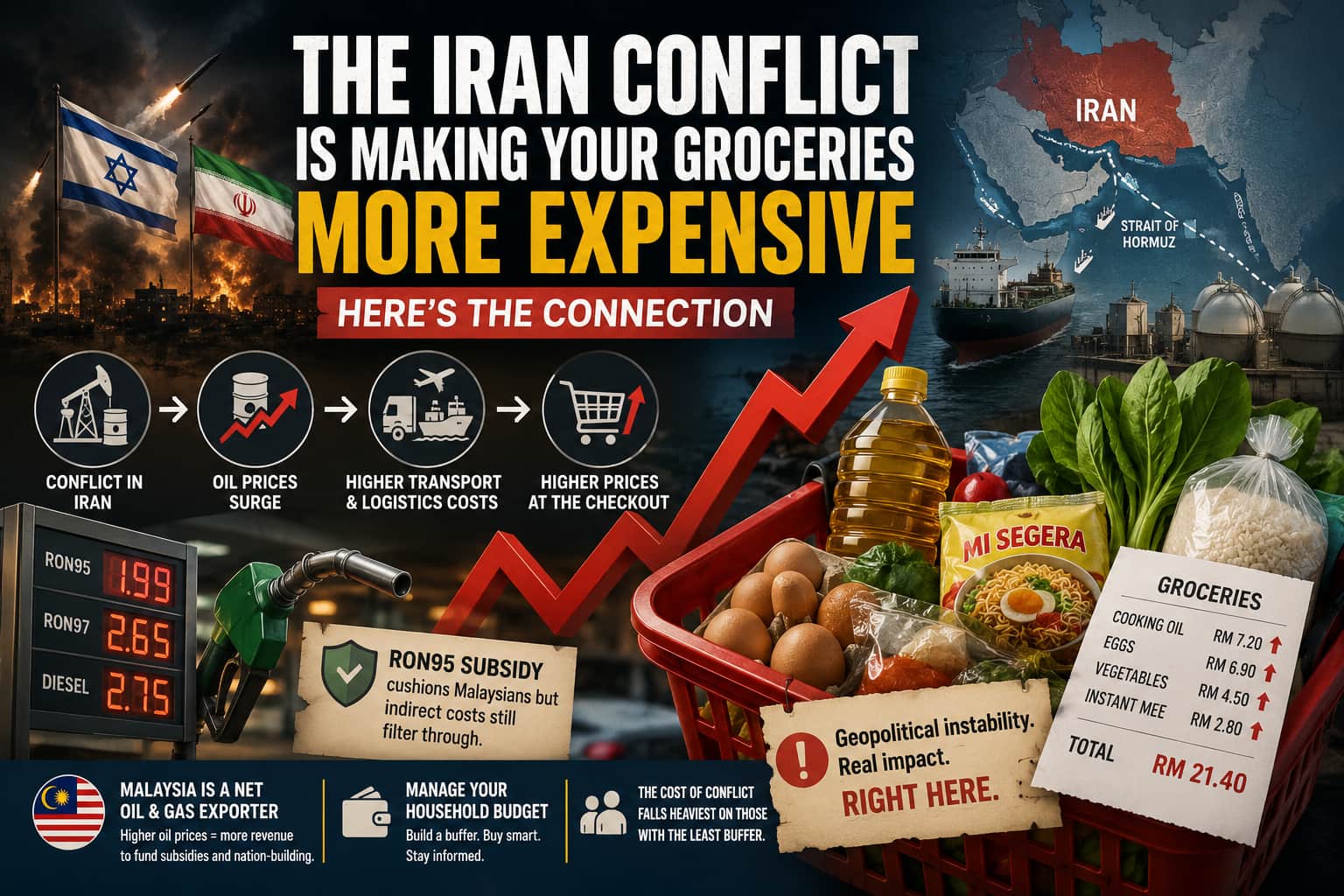
You might be wondering what a war thousands of kilometres away in the Middle East has to do with the price of your weekly pasar raya run. More than you'd think. And understanding the connection will at least make the shock at the checkout a little more manageable, even if it can't make it smaller.
Here's the chain. Oil prices are driven by a combination of supply, demand, and geopolitical risk. When the US and Israel launched coordinated airstrikes on Iran on February 28, 2026, the Strait of Hormuz, the narrow waterway between Iran and Oman that carries roughly 20% of the world's oil and a large share of its LNG, became a flashpoint overnight. Iran moved to block tanker traffic, energy markets went into shock, and Brent crude surged from around USD$70 to past USD$100 per barrel within ten days. Markets react immediately to even the threat of supply disruption, and this was far more than a threat.
When oil prices rise, transport and logistics costs rise with them. Every single product in every supermarket, wet market, and convenience store in Malaysia arrived there on a lorry, a ship, or a plane. All of those vehicles run on fuel. When fuel costs go up, delivery costs go up. When delivery costs go up, suppliers and retailers pass those increases to the price tag. Which means you pay more for your eggs, your cooking oil, your vegetables, and yes, your packet of instant mee.
Malaysia's own energy mix and subsidy structure provides some cushion. The RON95 subsidy, now under the targeted BUDI MADANI framework, shields most ordinary Malaysians from the full brunt of global fuel price swings. But it can't absorb everything, and the indirect costs through goods and services still filter through.
Oil prices are expected to remain volatile throughout 2026, and the situation in the Middle East shows no signs of swift resolution. The government has held the subsidised RON95 pump price at RM1.99 per litre to cushion the blow, but unsubsidised RON97 and diesel prices have already climbed significantly. The advice to Malaysians managing household budgets isn't glamorous: build a small buffer, buy staples in bulk when prices are stable, and try not to make major financial decisions based on panic driven by daily news cycles.
Here's something worth keeping in mind. Malaysia is actually a net oil and gas exporter. Higher global oil prices don't only hurt us. They also mean more revenue for Petronas, which flows back into the national budget and helps fund the very subsidies that protect ordinary Malaysians. It's a double-edged relationship, and it's more nuanced than "oil prices bad."
The cost of geopolitical instability is never borne equally. It falls heaviest on those with the least buffer. That's true globally, and it's true here. Keep informed. Keep your household budget honest. And the next time a news anchor reports on the latest development in the Iran conflict, know that yes, it's your grocery bill they're affecting too.
Ronny M (ronny76netstuff@gmail.com) is a content creator under the Newswav Creator programme, where you get to express yourself, be a citizen journalist, and at the same time monetize your content & reach millions of users on Newswav. Log in to creator.newswav.com and become a Newswav Creator now!
The User Content (as defined on Newswav Terms of Use) above including the views expressed and media (pictures, videos, citations etc) were submitted & posted by the author. Newswav is solely an aggregation platform that hosts the User Content. If you have any questions about the content, copyright or other issues of the work, please contact creator@newswav.com.