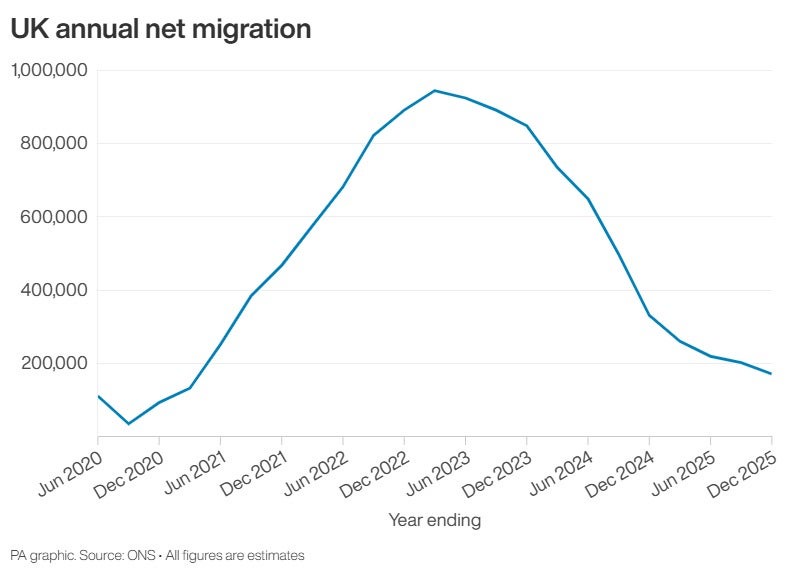
UK net migration has fallen to its lowest level since 1997, excluding the Covid-19 pandemic years, and is currently 92 per cent lower than the 2023 peak.
The continued fall in net migration – the difference between the number of people moving long-term to the UK and the number of people leaving the country – is being driven by fewer people from outside the EU arriving in the UK to work or study, the Office for National Statistics said.
These key figures from the recent data, alongside immigration policy adjustments, help to explain the significant overall decline.
What is the latest estimate of net migration?
The figure is down nearly two-thirds, or 62 per cent, from 204,000 in the previous 12 months.
It also represents a fall of 92 per cent from the record high of 944,000, which was recorded in the year to March 2023.
Some 738,000 people are estimated to have immigrated in the year to June, while 661,000 emigrated.
The sharp fall in the latest numbers forms part of a downward trend that has been underway since 2023.
Two factors have driven that trend: fewer people are moving long-term to the UK, and more people are leaving the country.
More people are still arriving than departing, which is why net migration remains positive, but the gap has narrowed in recent years.
Why has net migration fallen so sharply?
The 738,000 who came to the UK in the year to June is down by 731,000, nearly 50 per cent, from a peak of 1.47 million in the year to March 2023.
Most of that 731,000 drop reflects a fall in the number of non-EU nationals moving to the country, which is down by 620,000 over this period.
There were much smaller falls for people from "EU-plus" countries, at 54,000, and for British nationals, at 57,000.
"EU-plus" covers the 27 members of the European Union plus Norway, Iceland, Liechtenstein and Switzerland.
Alongside the large drop in arrivals, there has been a parallel but smaller rise in the number of people leaving the UK, though this looks to have come to a halt in the latest figures.
The 661,000 who left in the year to June is slightly down on the previous 12 months, when the total was 689,000.
It remains higher than in the years to June 2024, when it stood at 650,000, June 2023, at 543,000, and June 2022, at 486,000.
Has there been a fall in all types of non-EU immigration to the UK?
Every type of non-EU immigration to the UK has fallen.
The number of non-EU people coming to the UK for work dropped by 25 per cent in the year to June and by 65 per cent over the past three years.
Immigration for study fell 11 per cent in the 12 months to June and 46 per cent in three years.
Numbers immigrating for family reasons were down 30 per cent in the year to June and 51 per cent in the past three years.
Humanitarian immigration fell by 28 per cent and 78 per cent respectively, while immigration for asylum dropped by 22 per cent and 14 per cent respectively.
What policy has caused the drop in people coming to work and study?
Policy changes introduced by both the previous Conservative government and the current Labour administration have contributed to the fall in people coming to this country to work and study.
The changes began in January 2024 under the Tory government, when most overseas students were no longer able to bring family members to the UK.
From March 2024, care workers could no longer bring family members with them to the country.
From April 2024, the salary threshold was raised for people wanting to come to the UK on a skilled worker visa, along with the income threshold for a family visa.
In July 2025, the Labour Government brought in further changes, including ending overseas recruitment for care workers and raising the skilled worker salary threshold again.
A pause on all refugee family reunion visas followed in September.
In January 2026, English language requirements for skilled workers were raised.
Why are fewer people coming for humanitarian reasons?
Humanitarian immigration spiked when the Government launched its resettlement schemes for British nationals in Hong Kong and individuals fleeing the war in Ukraine.
Those schemes began in 2021 and 2022, respectively, and contributed to the jump in net migration in the early years of this decade.
Applications to the schemes have fallen since.
Why are people leaving the UK?
More non-British citizens have been leaving the country in recent years after completing their studies at universities, or having initially migrated for work reasons and no longer being eligible to remain.
Many of these people are likely to have arrived in the UK when the post-Brexit immigration system was first introduced.
The number of non-EU citizens emigrating stood at 50,000 in the year to June 2022.
It rose to 91,000 the following year, then climbed further to 142,000 in the year to June 2024 and 168,000 in the year to June 2025, before falling slightly to 155,000 in the 12 months to June 2026.
Are more British people leaving the country than before?
No.
An estimated 245,000 British nationals emigrated in the year to June, down slightly from 251,000 in the previous 12 months and 257,000 in the year to June 2024.
The number of British people moving long-term into the UK has also dropped, from 142,000 in the 12 months to June 2024 to 127,000 in the year to June 2025, and 109,000 in the year to June 2026.
Historically, more British nationals have left the UK than arrived in every year since 1985.
Will migration continue to fall?
Migration is expected to fall further in the future.
The changes to migration rules introduced from 2024 onwards are likely to carry on having an impact on people moving to the UK.
Separate figures published on Thursday by the Home Office show the number of visas granted in the third quarter of this year for people to come to the country has continued to decline.
The number of people leaving the UK could also rise further, particularly among those who came to the country for study reasons and who will come to the end of their education.
Dr Ben Brindle, senior researcher at the Migration Observatory at the University of Oxford, said: "We are entering an unusual period where immigration has come down and may still have further to fall, but we still have relatively high emigration, at least for the time being.
"Most of those emigrants are non-citizens, including people who arrived a few years ago when immigration was very high.
“That could push the net migration figures down even further next year, but the downwards blip is unlikely to last forever.”
How does 2026 migration compare with 1997?
The contrast between 2026 and 1997 is stark.
In 1997, movement from inside and outside the EU made a positive contribution to net migration, partially offset by more British people leaving than arriving.
In 2026, by contrast, non-EU citizens are the only group driving positive net migration.
“EU nationals are leaving in greater numbers than are arriving, as is the case with British nationals,” according to Sarah Crofts, ONS deputy director of migration statistics.
"There are also larger flows of people in 2026, with more than double the number of people leaving and arriving compared with 1997.
"In that year, there were 327,000 arriving compared with 738,000 immigrants in the year ending June 2026, and 279,000 emigrating in 1997 versus 661,000 emigrants now.
“This reflects greater global mobility in 2026 than there was 30 years ago.”
During the pandemic, travel restrictions briefly pushed net migration as low as 35,000.
Read MoreNHS set for busiest winter on record as resources are ‘stretched to the limit’
Antisemitism adviser to launch investigation of BBC ‘hostile work environment’
Every Labour MP who has backed rejoining EU - and those say UK should stay out
William responds as Diana’s legacy charity enters administration
‘AI slop’ has infiltrated UK Christmas markets – and people have had enough
Government responds to calls for bank holiday on England’s anniversary