
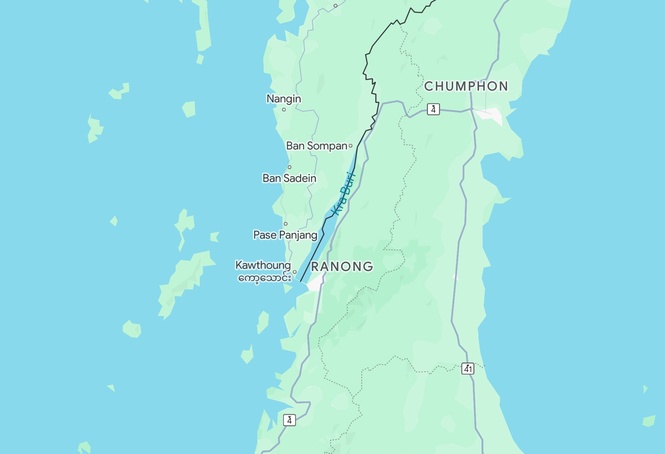
During the recent Asia Pacific Economic Cooperation (APEC) summit in San Francisco, the United States, Thai Prime Minister Srettha Thavisin pitched his ambitious plan of building a land bridge across the Kra Isthmus to the audience. If he succeeds, the land bridge will cut travel time from the South Indian Ocean to the South China Sea by four days.
A Thai Vision
Mr. Srettha was not the first Thai leader to want to build a massive infrastructure connecting both bodies of water. In 1677, Thai King Narai queried de Lamar, a French engineer under his employ, about possibly building a canal from Songkhla to Burma. The then-impossible task remained on the minds of Thai leadership.
The new generation of Thai leaders would revive the idea every few years. However, it never came to fruition due to the exorbitant cost, technological not feasible, or the perceived threat that the predominantly Malay southern Thai provinces would take advantage of the infrastructure to declare their secession from Thailand.
Financing
The biggest elephant in the room would be financing such a mega-project. Mr Srettha estimated the cost of the land bridge at USD35.6b, while the Hong Kong-based South China Morning Post (SCMP) gave a lower estimate of USD27.7b.
Before the APEC Summit, China looked like the most likely financier for the project; the reduction of four days of the journey would be a boon to China's export-oriented manufacturers and reduce its reliance on the Malacca Straits traffic. However, the SCMP noted that the offer had received lukewarm support from China as they already invested in a Kunming - KL railway line and other projects that gave China access to the South Indian Ocean.
China is already participating as a key partner to Malaysia's ECRL project. Conceptually, the proposed land bridge that cuts through Thailand is similar to the ECRL that starts in Kuantan and ends at Port Kelang. Thus, it made little sense to support another project of similar nature.
The lukewarm support from China could be why Mr. Srettha decided to table his offer to the APEC Summit. Even so, he might find getting support from other major Asia Pacific powerhouses challenging, especially since the world is getting more polarised and returning to the Cold War norms, which we will discuss further.
Geopolitical Challenge
The Thai government will be walking on a geopolitical minefield if they decide to build the proposed infrastructure.
Malaysia and Singapore
Malaysia's East ECRL and ports along the Malacca Strait would become a moot point, and Singapore Port might lose its position as the second busiest port in the world.
As mentioned earlier, the proposed land bridge has a similar concept to the ECRL. With the shipping lane approaching the Malacca Strait reaching the Thai land bridge first, they would have a higher chance of catching the traffic, similar to how shop lots at the lower floors of a shopping complex get better foot traffic, thus garnering a premium rental.
On the other hand, the potential market for this land bridge is massive, i.e., the ships traversing through the Malacca Strait. The strait is already the world's second busiest shipping lane, with approximately 70,000 ships passing each year. Even with the envisioned land bridge offering a shorter route, shippers might still serve Malaysia and Singapore to bypass the expected gridlock.
Heavy tankers carrying crude oil will still likely go through Malacca Strait as Singapore and Johor host two major oil refineries: one in Sembawang, Singapore and another in Pengerang, Johor.
As mentioned earlier, there is also a fear in Bangkok that such infrastructure cutting through the land would create a geographic barrier for Bangkok to exert its political will over the predominantly Malay provinces in Southern Thailand. Some insurgent groups have, in the past, flown Malaysian flags to rally Malaysia to support their cause. Hence, Bangkok will have this in mind when finalising the design for the infrastructure. The decision to have a land bridge instead of a canal they had envisioned for centuries reflects their concern.
China
Earlier, we explored China's lukewarm approach to the project despite probably being the project's primary benefactor from an economic and financing perspective. However, the geopolitical aspect of the project also needs to be considered.
China President Xi Jinping's One Belt, One Road Vision is China's attempt to break out of a possible Western encirclement of China. China has largely achieved this vision with access to the South Indian Ocean via Myanmar and Pakistan.
The ECRL project, once completed, will also mitigate the impact of having the Malacca Strait blocked. This, too, is part of the One Belt, One Road initiative.
China's heavy-handed approach to the South China Sea, pushing their Nine-Dash-Line agenda, now increased to Eleven-Dash-Line, has already irked a swath of the Malaysian public. Therefore, financing the project may push Malaysia towards being Western-friendly in the long run, notwithstanding Prime Minister Datuk Seri Anwar Ibrahim's assurance that the project would also benefit Malaysia.
On the other hand, China too sorely requires Thai support. Sino - Thai relationship became strong when China stood by Bangkok when the country faced the Colour Revolution that ended with the military reining in what they believed were Western-backed protestors—the strengthened relationship culminated in the Royal Thai Navy procuring three Yuan-class submarines from China. However, the troubled procurement plaguing the three Yuan-class submarines is becoming an unwanted spectacle to the cooling relationship.
China's secure access to the South Indian Ocean is currently under security threat. Militant groups in Pakistan had targeted Chinese workers as retaliation against Chinese treatment of Uyghur Muslims, while Myanmar has plunged into a two-year civil war. The Chinese-friendly junta is reeling from several disastrous losses. At the same time, the so-called pro-democracy resistance forces expanded their attacks to the whole nation after succeeding in taking over six towns, including two towns that were vital to Chinese access.
Armed Sea Robbery and Piracy
The region is one of the global hotspots for armed sea robbery and piracy. For context, armed sea robberies occur within a country's territorial waters, while piracy occurs in international waters.
The region faces armed robbery and piracy primarily from three areas, i.e., along the Malacca Strait, off the Singapore Strait, and the Sulu Strait. In May this year, The Diplomat, a widely-read international affairs magazine, highlighted a report from ReCAAP (Regional Cooperation Agreement on Combating Piracy and Armed Robbery against Ships in Asia Pacific) on the armed robberies and piracy trend in the first quarter of 2023. Nineteen sea robberies occurred in Malacca Strait and 18 in Singapore Straits during the year's first three months.
The land bridge would reduce the threats from pirates and robbers from the Malacca Strait, should it be able to divert traffic away from the strait.
But even with the land bridge, it would not reduce the threats from armed robbers and pirates that operate east and north of Singapore Strait; these armed robbers and pirates can easily operate from the Indonesian Natuna group of islands, Cambodia, or from any littoral position across the Gulf of Thailand. With new incoming traffic from the land bridge, the increased number of targets will invigorate these criminal groups until the littoral nations along the path get together to fight the scourge.
High-Risk High Return?
The project will be a significant undertaking for Thailand at a price tag between USD27.7b and USD35.6b. The project would achieve this three-century-old vision. But how feasible it would be remains to be seen. After all, the phrase white elephant came from the same Kingdom.
Danny Liew is a content creator under the Newswav Creator programme, where you get to express yourself, be a citizen journalist, and at the same time monetize your content & reach millions of users on Newswav. Log in to creator.newswav.com and become a Newswav Creator now!
The User Content (as defined on Newswav Terms of Use) above including the views expressed and media (pictures, videos, citations etc) were submitted & posted by the author. Newswav is solely an aggregation platform that hosts the User Content. If you have any questions about the content, copyright or other issues of the work, please contact Newswav.
