
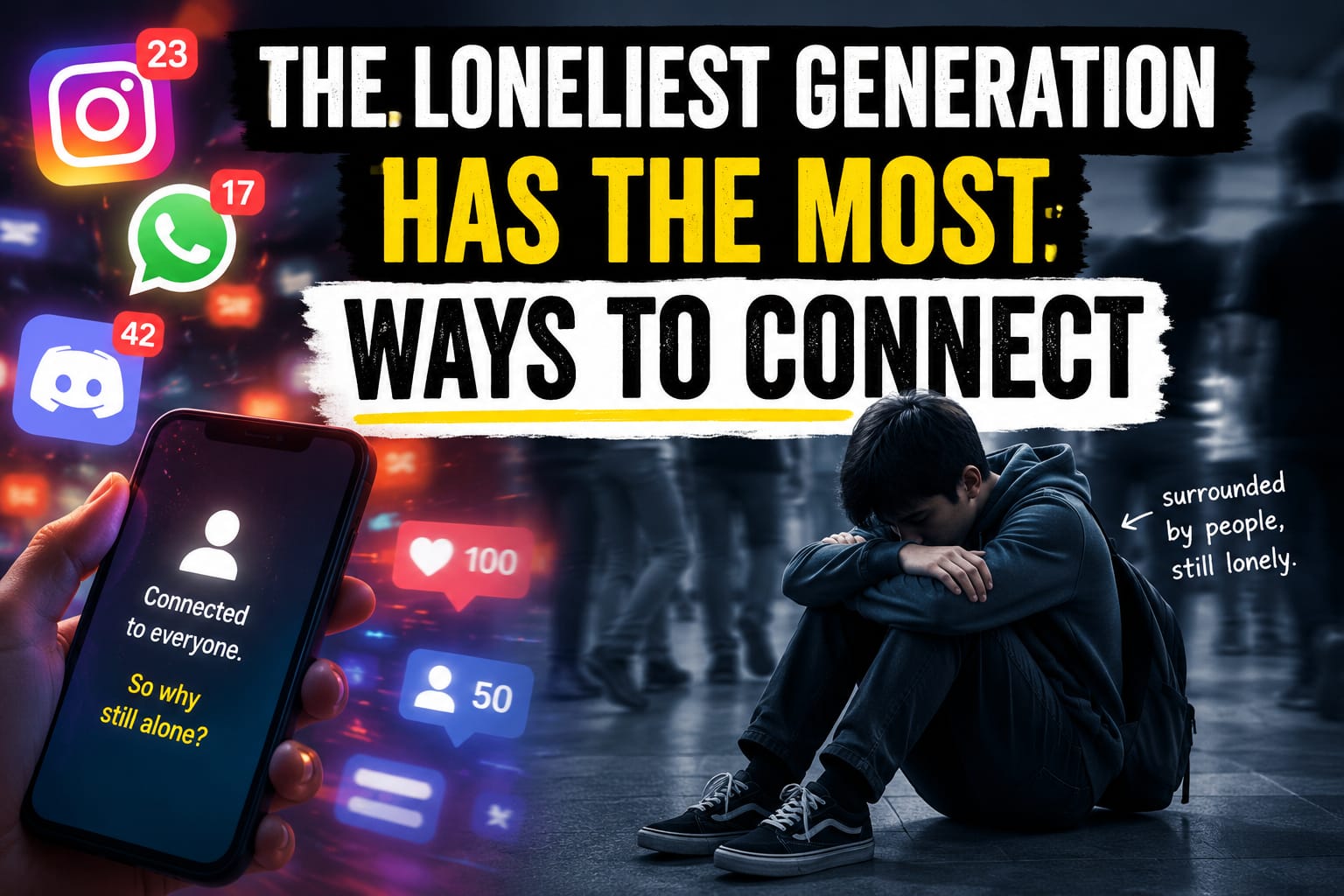
Instagram, WhatsApp, Discord… so why do surveys keep showing rising loneliness?
Picture this: a 16-year-old teenager returns from one of the busiest schools in Malaysia. He's spent the entire day surrounded by people, talking, laughing and studying. Yet somehow, he still feels lonely.
The Cigna Group's 2025 Loneliness in America report found that 67% of Gen Z adults surveyed in the United States were classified as lonely, the highest proportion of any generation. According to a report by Sarvada Chandra Tiwari, the definition of loneliness is often related to the “perception of being alone and isolated”, instead of actually being physically alone. Many metaphors have surfaced online, such as “feeling lonely in a crowded room” which largely encapsulates the feeling of social isolation many Generation Z people face today.
To make things worse, loneliness isn't just an abstract mindset thinking, it actually impacts an affected person's wellbeing by influencing their memory as it is associated to dementia and other cognitive impairments. It can also affect their physical body as well, even though the entire thing seems tied to our mental health,but it is also associated with premature death.
But why? The adaptation of social media into our lives has just made it ten times easier for people to connect, and yet people are still feeling lonely. Well to be frank, the introduction of social media is merely a double-edged sword.
First of all, short-form platforms are designed around rapid, unpredictable streams of content, making it easy to continue consuming one video after another. Research has linked problematic and passive short-form-video use with reward-related processes and difficulty disengaging. This is especially worsened by the fact that scrolling takes almost no effort, essentially limiting the movement to one swipe of a finger.
Another thing to point out is the lack of dependency on others, or should I say, the dependency shift. This shift essentially says that nowadays all information is decentralised, which is a good thing in on its own. People from all over the world has quick access to basically any knowledge they would like to know, just by a quick Google search. However not all that glitters is gold, and perhaps the decentralisation of information has actually lessened people's dependency on others. For instance, in the past if you were lost on your way to work, the easiest and oftentimes the only method of getting out of that predicament is to ask a nearby stranger for help. Moreover, with the rapid development of modern technology, you don't need to knock on your neighbour's door to ask him for help with a clogged pipeline, just search the reasons why a pipeline could be clogged and you should be good to go.
That may sound like a good thing. After all, why should we need to bother someone else when we can solve our own problems? But perhaps that is exactly where the problem begins. Human relationships have always been built partly on mutual dependence. We ask our neighbours for help. We borrow things. We ask a friend for advice. We complain to the person sitting next to us. We make small talk with the cashier. We ask a stranger for directions.
Most of these interactions are insignificant. We probably forget them within a few days. But collectively, they make us feel like we are part of something. Research by Charles E Drebing, Edward J Federman , and James Graham suggests that these everyday interactions can contribute to positive feelings of self-worth and belonging.
Whereas nowadays, people can know your story without actually talking to you. Instagram stories, WhatsApp status, all allow us to peek into the lives of others without actually knowing each other from a more personal perspective.
Although passive and constant scrolling are linked to lower levels of happiness and well-being, I wouldn't say that social media is inherently bad for us.
Social media actually helped us stay connected with people from all over the world, not just in our own tiny city that we live in. We get to learn, hear, see other people's experiences and life advice. What matters, then, may be how we use it, how often we use it, and whether we still make room for meaningful interaction beyond the screen.
All in all, if Gen Z has been given the label of “the loneliest generation”, perhaps we should treat that label not as an identity, but as a call to action. Not immediate removal of all social media platforms, not going out of their way to talk to every stranger they know, But to slowly share and be curious about other people. Ask someone about their day, say hi to a stranger waiting in line in front of you. Perhaps the cure for loneliness isn't always finding more people. Sometimes, it's simply choosing to talk to the people already around us.
Jaden W (wmjaden3@gmail.com) is a content creator under the Newswav Creator programme, where you get to express yourself, be a citizen journalist, and at the same time monetize your content & reach millions of users on Newswav. Log in to creator.newswav.com and become a Newswav Creator now!
The User Content (as defined on Newswav Terms of Use) above including the views expressed and media (pictures, videos, citations etc) were submitted & posted by the author. Newswav is solely an aggregation platform that hosts the User Content. If you have any questions about the content, copyright or other issues of the work, please contact creator@newswav.com.