The food gets fancier every year. The table gets quieter every year too.
Masak lemak cili api on spaghetti. I have seen it. It tastes fine, even good. But something about it also feels like watching your grandmother's kebaya turned into a fashion runway piece. Recognisable, dressed up, and somehow not quite itself anymore.
That small dish is a symptom of something bigger happening to how Malaysians eat. And it is not really about the food. It is about what eating together used to mean, and what it has quietly become.
When Traditional Becomes "Elevated"
Malaysian food has always evolved. Nobody serious would argue otherwise. Our entire cuisine is the product of centuries of Malay, Chinese, Indian, and Peranakan influence blending into something distinctly local. Fusion is baked into our culinary DNA.
But there is a difference between organic evolution over generations and the current wave of "newstalgia" reinterpretation happening in restaurants right now. Traditional kuih dressed up with high-end ingredients and gourmet presentation. Nasi lemak and laksa reimagined with international flavour influences. Even teh tarik and bandung are getting the artisanal treatment, transformed into drinks that barely resemble what they started as.
None of this is inherently wrong. Chefs are creative people and reinvention keeps a cuisine alive. But there is a cost when the original version starts disappearing from menus altogether, replaced by a version optimised for Instagram rather than for the dish itself. Ask for a simple, unfussy plate of masak lemak cili api cooked with beef, served with rice, the way it was meant to be eaten, and increasingly you will need to seek it out specifically rather than find it everywhere.
Sirap and Teh Ais Have Competition Now
The drinks tell the same story. Walk into a traditional Malay restaurant today and the menu no longer stops at teh ais, sirap bandung, and air kosong. You will find milkshakes, fruit punches, and elaborate fusion beverages sitting right next to the traditional options, often outselling them.
There is nothing wrong with variety. But something has shifted in what the drink is meant to do at the table. Sirap and teh ais were never the main event. They were simple, unobtrusive companions to the meal, quenching thirst without competing for attention. The new generation of drinks are designed to be the highlight, the thing photographed and posted before the food even arrives.
That shift mirrors something happening at the table itself.
The Quietest Tables in Malaysian History
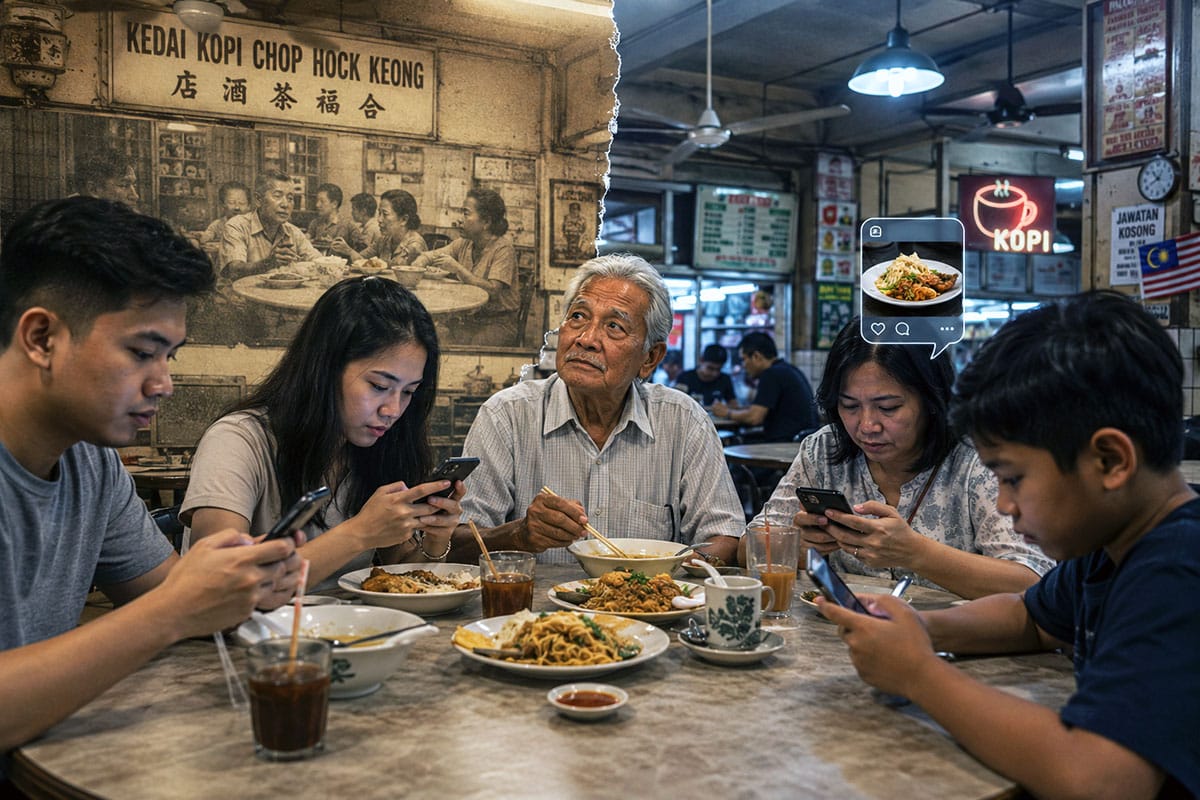
Walk past any restaurant in the Klang Valley on a weekend and you will see families seated together, plates in front of them, and almost total silence. Heads down. Phones out. The food arrives, gets photographed from three angles for a social media post, and only then does anyone start eating.
This is not unique to Malaysia. Food photography as a global ritual, sometimes called "camera eats first" in parts of Asia, has become so normalised that eating before photographing can feel like a small social violation. But the effect on Malaysian family dining specifically cuts deeper, because eating together was never just about nutrition here. It was the primary venue for connection. Sunday lunches at grandma's house. Weeknight dinners where the day's events got discussed over rice. Conversations that happened nowhere else because everyone was seated, unhurried, and present.
When the phone comes out before the fork does, that function quietly disappears. The meal still happens. The connection increasingly does not.
The Kopitiam That Time Is Catching Up With
Then there is what is happening to the physical spaces themselves.
The classic Malaysian kopitiam, loud, unpretentious, run by an owner who remembers your order and where you sit without being told, is facing a slow erosion. Many of these stalls were built by first-generation hawkers who worked impossibly long hours for thin margins, often intentionally steering their children toward office careers instead of the family stall. The unintended consequence is that when these owners retire, the recipes and the specific version of a dish that made a stall special often retire with them.
Some heritage stalls have managed to pass the torch. A Bib Gourmand-winning beef noodle stall in Kuala Lumpur, running since 1949, is now on its third generation, with the current owner deliberately preserving his grandfather's exact flavour rather than modernising it. A century-old apom manis stall in Penang has followed the same philosophy. These are the exceptions worth celebrating precisely because they are exceptions.
For every stall that survives intact, there are others that either close permanently or get replaced by a version of themselves designed for a mall food court, cleaner, more consistent, and missing whatever it was that made the original feel like a piece of your neighbourhood.
Food Trucks Lost the Plot Somewhere
There is a smaller but equally telling shift worth mentioning: food trucks. They were supposed to be the antidote to expensive dining, quick, affordable, honest food served fast and cheap from a mobile kitchen. Somewhere along the way, a segment of that scene decided to chase a premium aesthetic instead. Prices climbed toward restaurant territory while portions and quality often did not follow. The value proposition that made food trucks appealing in the first place has, for a chunk of the scene, quietly evaporated.
It is a small example of a pattern showing up everywhere in Malaysian food culture right now: the packaging improves while the substance underneath gets thinner.
My Take
The kopitiam I grew up eating at is still standing. I still go back occasionally, and every time I do, that specific feeling arrives, the one only nostalgia produces. The smell, the plastic chairs, the way the uncle behind the counter still moves like he has done this ten thousand times because he has. To me, it is not just food. It is a small piece of my own history that I can still physically walk into.
My kids do not feel that. To them, it is just a place that serves food. And I do not think that is a failure on their part. It is simply what happens when a memory has not had time to form yet. Nostalgia needs years to accumulate. They will build their own eventually, just attached to different places and different dishes.
What worries me more is not the fusion food or the fancy drinks. Evolution in cuisine is fine, even good. What worries me is watching families sit together and stay separate, phones up, food photographed before it is tasted, conversation replaced by scrolling. That is the part of our food culture actually at risk of disappearing, and it has nothing to do with the recipe.
If there is one thing I want to protect and pass down to my children, it is this: put the phone away, sit at the table, taste the food slowly, and talk to the people sitting across from you. That is what a Malaysian meal was always supposed to be. Everything else, the fusion pasta, the artisanal teh tarik, the fancy plating, is just decoration around the one thing that actually matters.
Kamarul Azwan (k.azwan@gmail.com) is a content creator under the Newswav Creator programme, where you get to express yourself, be a citizen journalist, and at the same time monetize your content & reach millions of users on Newswav. Log in to creator.newswav.com and become a Newswav Creator now!
The User Content (as defined on Newswav Terms of Use) above including the views expressed and media (pictures, videos, citations etc) were submitted & posted by the author. Newswav is solely an aggregation platform that hosts the User Content. If you have any questions about the content, copyright or other issues of the work, please contact creator@newswav.com.