“The noodle that pulled the crowd away”
In Malaysia, the mamak shop—traditionally run by Indian Muslims—has long been more than just a place to eat. It is a cultural lighthouse, and harbour where Malaysians of all races drop anchor for roti canai, maggi goreng, and teh tarik. For decades, mamak outlets enjoyed a near-monopoly on affordable, Muslim-friendly dining, their open-air tables acting as the nation’s living room. However, the tide is turning. A new fleet of competitors has sailed into view with quiet force: Halal restaurants run by Hui Chinese Muslims, particularly those specialising in Lanzhou lamian (hand-pulled noodles). This competition is not a wrecking ball but a refreshing gust of wind, shaking the old leaves off a beloved tree and offering Malaysian Muslims unprecedented culinary variety, better ambience, and genuine alternatives to the late-night mamak ritual.
The rise of Hui Chinese Muslim restaurants is one of the most striking new colours on Malaysia’s culinary canvas. The Hui are ethnically Chinese but practice Islam, and their cooking is a bridge between Central Asian noodle-making traditions and Chinese stir-fry techniques. In cities like Kuala Lumpur, Penang, and Johor Bahru, eateries bearing halal certifications—displayed like a royal seal—have begun to bloom. These establishments cater directly to Malaysia’s Muslim majority, offering dishes like beef noodle soup, cumin-spiced lamb skewers, and the gravitational centrepiece: Lanzhou lamian (Ramen). For many Malay Muslims who had never tasted authentic Chinese food prepared strictly according to Islamic law, this is a key turning a new lock. The halal assurance, often more meticulously displayed than in some mamak shops, removes religious hesitation and flings open a door to an entirely new flavour universe.
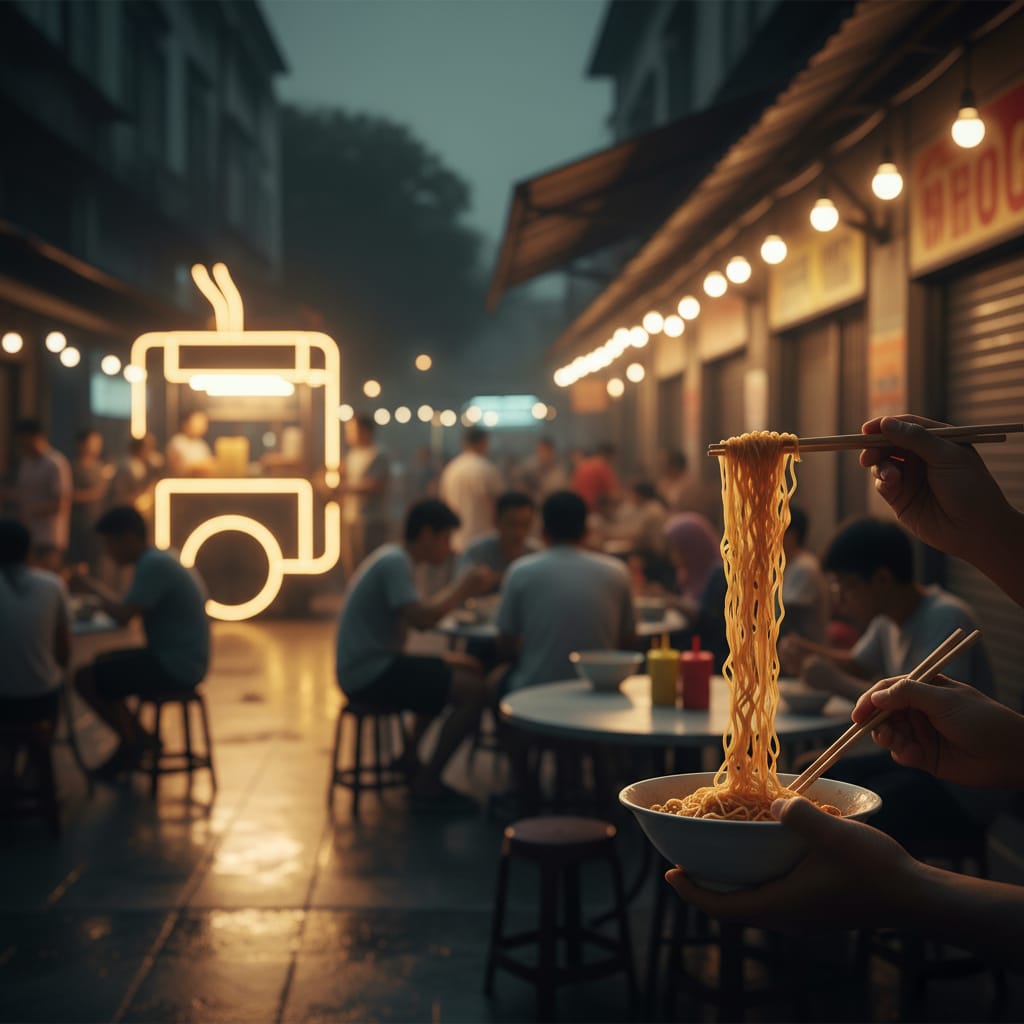
One of the sharpest dividing lines is the dining environment. Mamak shops, beloved for their loud, open-air, almost chaotic charm, are the street musicians of the food world—lively, unpredictable, and real. Plastic chairs, communal tables, and the occasional stray cat weaving between ankles are part of the symphony. In contrast, Hui Chinese Muslim restaurants are the quiet libraries of dining. They typically invest in sleek interiors, full air-conditioning, and uniformed staff. Lamian houses often feature open kitchens where diners can watch the chef perform a rhythmic, almost hypnotic dance—pulling, folding, and snapping dough into hundreds of silky noodles, like a magician unspooling a scarf. While a typical mamak meal might cost RM6 to RM10 (a modest song), a bowl of Lanzhou lamian with beef brisket and a side of fried dumplings can reach RM18 to RM25. For many, the higher price is a fair trade for cleanliness, comfort, and the novelty of the cuisine—a glass of clean water offered to someone tired of lemonade.
The main battleground, however, is not price or décor—it is the tongue’s allegiance. And here, Lanzhou lamian has proven to be a formidable duelist to mamak staples. The clear, beef-based broth, simmered for hours with radish, ginger, and a constellation of spices, is light yet deeply savoury—a warm blanket instead of a heavy coat. The noodles, springy and hand-pulled to order, offer a texture no machine can counterfeit. For Malaysian Muslims accustomed to the heavy, curry-laden, or fried fare of mamak outlets, a hot bowl of lamian is a welcome monsoon after a long dry season. It is hearty without being greasy, satisfying without inducing lethargy. Many young Malay professionals now debate online like boxers weighing gloves: “Mamak maggi or Lanzhou lamian tonight?” The noodle has become a serious contender for the crown.
Yet it would be foolish to write an obituary for the mamak shop. Mamak outlets retain key advantages: they are the streetlamps that never go out—24-hour operations, ubiquity in suburban and rural areas, and a price point accessible to students and low-income workers. Hui Chinese restaurants are typically urban orchids, concentrated in cities and closing by 10 or 11 PM. Moreover, mamak culture is social and nocturnal—watching football matches at 2 AM, debating politics over teh tarik, or breaking fast during Ramadan. The lamian house, with its air-conditioned calm, is a cathedral, not a night market.
Still, the competition is a rising tide that floats all boats. Mamak operators are now renovating outlets, installing air-conditioned sections, and even adding noodle dishes to their menus. For Malaysian Muslim consumers, the result is a rich buffet of choices. The Hui Chinese Muslim restaurateur, in turn, has found a welcoming market that values both halal integrity and culinary adventure. In the end, Malaysia’s food scene grows not by replacing the old oak with a new sapling, but by letting both trees spread their branches side by side—each offering its own shade on a hot afternoon.
moykokming@gmail.com
Moy Kok Ming (moykokming@gmail.com) is a content creator under the Newswav Creator programme, where you get to express yourself, be a citizen journalist, and at the same time monetize your content & reach millions of users on Newswav. Log in to creator.newswav.com and become a Newswav Creator now!
The User Content (as defined on Newswav Terms of Use) above including the views expressed and media (pictures, videos, citations etc) were submitted & posted by the author. Newswav is solely an aggregation platform that hosts the User Content. If you have any questions about the content, copyright or other issues of the work, please contact creator@newswav.com.