.jpg)
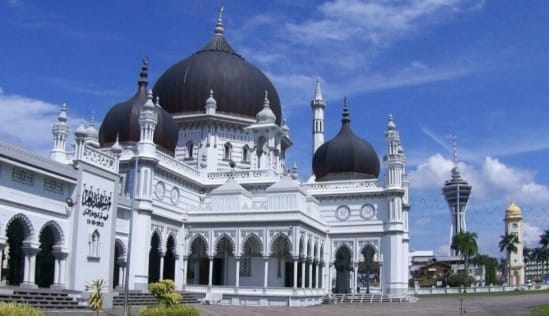
The Man They Forgot to Credit, and the Grandson Who Never Did
By Mihar Dias July 2026
There is a particular kind of Malaysian silence reserved for the people who actually built things. Not the ones who cut ribbons, not the ones whose names get engraved on plaques facing the road — but the ones who bent over the drafting table at midnight, pencil in hand, making sure the dome would sit where it was told to sit. My grandfather was one of those men.
In Alor Setar, if you asked anyone of a certain generation who "Tok Din Plan" was, they would not hesitate. They would point you toward Masjid Zahir, the grand old mosque by the river, and tell you — with the casual certainty of people repeating something they'd always known — that Tok Din was the man who drew it. Not designed it in the ceremonial sense that gets you a British knighthood and a line in the colonial ledger, but drew it. Every wall, every proportion, every quiet mathematical decision that keeps a century-old building from falling into the Kedah mud.
I was ten when he passed. Ten is an age at which you don't yet understand what a legacy is, but you understand a nickname. And in our neighbourhood, that nickname followed me before I'd earned a single thing myself. I was "the grandson of Tok Din Plan." Not Rahim. Not even Mihar, decades before that pen name existed. Just: his blood. My father made sure of that. Every time we walked past the mosque — and in a town like ours, you walk past it often, because everything eventually orbits back to the river and the minaret — he would remind me, half quietly, half like a man defending a title deed: your grandfather made this.
History, as it's formally written, tends to agree with my father, though it hedges its bets the way institutions always do. Academic accounts of Masjid Zahir's construction — including research housed at the International Islamic University Malaysia — record that the design credited to James Gorman, the British Public Works Department's State Engineer for Kedah, was in fact a joint effort. (irep.iium.edu.my).
A local Malay draftsman, remembered as Pak Din, is named alongside him as the man tasked with translating intention into blueprint. A second draftsman, Ahmad Lebai Tambi, is also recorded as part of that same working team, according to an interview with a Kedah historian cited in the same research. Together, the record says, they delivered a mosque built in a Moorish and Moghul style — a phrase that always struck me as slightly funny, given how thoroughly Kedah the whole enterprise actually was.
Pak Din. Tok Din. The kampung has never been especially precise about honorifics, and I suspect it never needed to be, because everyone already knew exactly who was meant. That's the thing about oral history in small Malaysian towns — it doesn't footnote itself, because it assumes you're already listening at the dinner table, which I was.
There is a detail my father used to add that you will not find in any archive, and I offer it here as family lore rather than settled fact, in the spirit of everything else that survives only because someone kept repeating it. According to him, my grandfather made repeated trips across the strait to Acheh, sent at the Sultan's own request, to study a mosque (built in 1881) there whose form the Sultan had apparently taken a liking to and wanted echoed in Alor Setar.
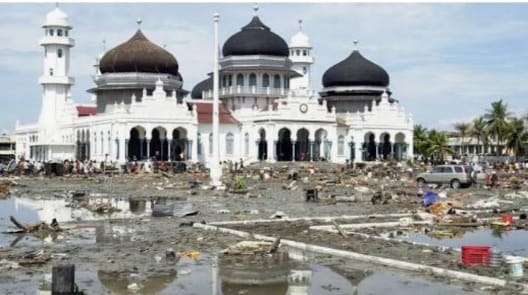
Whether that means the Sultan issued a formal brief or simply a strong hint and a travel allowance, I couldn't tell you — the story was never told with that level of administrative precision.
But it fits the shape of everything else we know about how these things got built in that era: not by grand unified vision, but by a ruler's taste, a British engineer's authority, and a local draftsman quietly doing the actual work of translating one man's fondness for a building in another city into something that would stand for a hundred years by a Kedah river.
There is something almost too tidy about the metaphor here, the kind I'd normally distrust in my own writing: a colonial-era building whose formal credit drifted quietly upward to the man with the title, while the man who actually drafted it survived mostly as a nickname passed down through grandsons.
But I didn't invent this pattern. Malaysia has been rehearsing it for a hundred years, in architecture and in politics alike — the engineer gets the plaque, the draftsman gets a kampung nickname, and somewhere three generations later, a columnist writes it up hoping someone remembers.
I don't say any of this to relitigate who deserves a heritage board outside Masjid Zahir. The mosque still stands, does its work — five prayers a day, weddings, funerals, the gotong-royong, sheltering whoever needs sheltering — entirely indifferent to whose name history prefers. That indifference, I've come to think, is the most honest thing about it.
But I was ten years old once, walking past a river-facing mosque with my father's hand occasionally landing on my shoulder to make a point he'd already made a hundred times. And somewhere in Alor Setar, if you ask the right elderly uncle, he will still tell you, without checking a single archive: Tok Din Plan drew that mosque, you know.
He did. I was just lucky enough to be told so before I was old enough to doubt it.
Mihar Dias (mihardias@gmail.com) is a content creator under the Newswav Creator programme, where you get to express yourself, be a citizen journalist, and at the same time monetize your content & reach millions of users on Newswav. Log in to creator.newswav.com and become a Newswav Creator now!
The User Content (as defined on Newswav Terms of Use) above including the views expressed and media (pictures, videos, citations etc) were submitted & posted by the author. Newswav is solely an aggregation platform that hosts the User Content. If you have any questions about the content, copyright or other issues of the work, please contact creator@newswav.com.