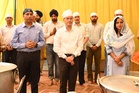
Every year on 9 July, Bahá’ís around the world commemorate the martyrdom of the Báb in 1850—an event that stands not only as a moment of religious history but as a profound moral turning point for humanity.
Beyond its spiritual meaning, it raises urgent questions for our age: how do societies respond to truth that challenges entrenched systems, and how can unity be built in a world increasingly divided by identity, ideology, and fear?
The Báb, born Siyyid ‘Alí-Muhammad in Shiraz, Persia (modern Iran), declared His mission in 1844 at the age of 25. He proclaimed the dawn of a new spiritual era and prepared humanity for the coming of a universal Messenger of God, whom Bahá’ís believe was fulfilled in Bahá’u’lláh. His message emphasised moral renewal, justice, education, and the spiritual transformation of society.
His declaration was radical for its time. Within six years, His teachings spread rapidly across Persia, attracting thousands of followers from all social backgrounds. This rapid expansion alarmed both religious authorities and political leaders, who saw His influence as a threat to established order. He was arrested, imprisoned in remote fortresses such as Maku and Chehriq, and subjected to harsh confinement.
Despite imprisonment, His influence continued to grow. By 1850, the authorities resolved to silence Him permanently.
The Martyrdom in Tabriz
In Tabriz, the Báb and His devoted companion Anís were suspended before a firing squad. Historical accounts describe an extraordinary moment: the first volley of bullets reportedly severed the ropes without killing Him, allowing a brief continuation of His final instructions. A second firing squad then carried out the execution.
Whether understood through faith or historical interpretation, the symbolic meaning is powerful: truth rooted in conviction cannot be extinguished by force.
Bahá’u’lláh later reflected on the spiritual significance of such sacrifice, stating:
“The Báb… was the Herald of the Most Great Name, and the Forerunner of the Ancient Beauty.”
(Bahá’u’lláh, Tablets of Bahá’u’lláh Revealed after the Kitáb-i-Aqdas)
A message that outlived violence, the martyrdom of the Báb did not end His influence—it transformed it. His teachings became the foundation for the emergence of the Bahá’í Faith under Bahá’u’lláh, and today His remains rest at the Shrine of the Báb on Mount Carmel, a global place of pilgrimage and reflection.
‘Abdu’l-Bahá, the son of Bahá’u’lláh and authorised interpreter of His teachings, described this continuity of influence:
“Consider how, throughout history, the blood of the righteous has been the seed of divine civilization.”
(‘Abdu’l-Bahá, Some Answered Questions, paraphrased thematic teaching)
For Bahá’ís, the Báb’s martyrdom represents unwavering steadfastness in truth under persecution. Yet its significance extends beyond religion. It raises a universal ethical question: what happens when fear is allowed to suppress moral courage, reform, or unfamiliar ideas?
Malaysia is widely recognised for its cultural and religious diversity, comprising Malays, Chinese, Indians, Indigenous peoples, and many others who together form its national identity. This diversity is often celebrated as a strength. Yet in practice, Malaysians are also familiar with persistent challenges—racial suspicion, religious misunderstanding, and political narratives that sometimes reinforce division.
At times, public discourse risks framing identity as competition rather than cooperation. While institutions manage diversity administratively, the deeper challenge remains: building genuine trust between communities. The Bahá’í writings offer a direct perspective on this issue:
“The earth is but one country, and mankind its citizens.”
(Bahá’u’lláh, Gleanings from the Writings of Bahá’u’lláh)
And again:
“So powerful is the light of unity that it can illuminate the whole earth.”
(Bahá’u’lláh, Tablets of Bahá’u’lláh)
These principles are not merely theological ideals; they offer a framework for social cohesion in plural societies like Malaysia.
Unity as a Developmental Necessity
Malaysia’s future stability and prosperity will depend not only on economic growth or technological advancement, but on the strength of its social cohesion. No nation can sustain innovation or progress if its citizens are divided by mistrust.
The Bahá’í approach to social development emphasises capacity-building, education, and consultation rather than confrontation. Bahá’u’lláh wrote:
“Consultation bestoweth greater awareness and transmuteth conjecture into certitude.”
(Bahá’u’lláh, Tablets of Bahá’u’lláh)
In practical terms, this principle highlights the importance of dialogue over division, and cooperation over competition in addressing social challenges.
Globally, Bahá’í communities work alongside others to promote education, youth empowerment, moral development, and community cohesion—efforts that are deliberately non-partisan and focused on building unity from the grassroots.
The Deeper Lesson of Sacrifice
The martyrdom of the Báb carries a paradox: a life ended in violence became a source of enduring spiritual momentum. His execution did not extinguish His message; it amplified it across continents and generations.
‘Abdu’l-Bahá emphasised the enduring power of such sacrifice:
“The darkness of the world is passing away, and the light of divine guidance is shining.”
(‘Abdu’l-Bahá, Paris Talks)
The deeper lesson is not suffering itself, but the resilience of truth and the transformative power of moral conviction. Societies that attempt to suppress conscience or diversity eventually discover that ideas rooted in justice and integrity cannot be permanently contained.
A Mirror for Our Time
The martyrdom of the Báb in 1850 may appear distant in both geography and history, yet its message remains sharply contemporary. It challenges societies to reconsider how they respond to difference, and whether fear or unity will define their future.
For Malaysia, this story serves as a mirror. It asks whether diversity will remain a managed complexity or become the foundation of a more mature national identity grounded in mutual respect and shared purpose.
As Bahá’u’lláh wrote:
“The well-being of mankind, its peace and security, are unattainable unless and until its unity is firmly established.”
(Bahá’u’lláh, Gleanings from the Writings of Bahá’u’lláh)
In remembering the Báb, we are reminded of a simple but demanding truth: societies endure not through uniformity, but through their capacity to recognise the oneness of humanity while honouring its diversity.
K.T.Maran Social, Environmental & Animal Activist
K.T. Maran (maran.kt@gmail.com) is a content creator under the Newswav Creator programme, where you get to express yourself, be a citizen journalist, and at the same time monetize your content & reach millions of users on Newswav. Log in to creator.newswav.com and become a Newswav Creator now!
The User Content (as defined on Newswav Terms of Use) above including the views expressed and media (pictures, videos, citations etc) were submitted & posted by the author. Newswav is solely an aggregation platform that hosts the User Content. If you have any questions about the content, copyright or other issues of the work, please contact creator@newswav.com.