
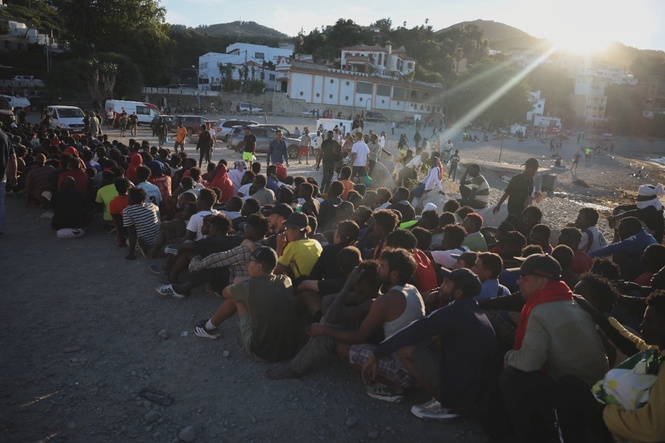
Why the Moroccan migration surge won’t end: Examining demographics, conflict, climate change and politics shaping global migration trends.
IMAGES and coverage of Moroccan would-be migrants pouring into Ceuta in a bid to reach Spain made headlines around the world, especially in the West, displacing news on the United States war against Iran.
While geopolitical crises dominates news cycles, the phenomenon of international migration, which provides the explanatory backdrop for the dramatic photos and videos of Ceuta, is the more significant existential challenge shaping the political and socioeconomic landscapes of host nations across the West – primarily in North America and Western Europe and also in parts of Asia.
This global reality is likely to remain a defining one for the 21st century and possibly beyond.
Migration flows have characterised human societies since our earliest days but today’s migration flows are different. The latest activity is marked by irregular and illegal migration. Comprising unauthorised border crossings, visa overstays and asylum-seeking backlogs, it has intensified, reshaping the political landscapes of destination countries.
The attention that the Moroccan mass migration episode has received will subside. However, this newest occurrence of people movement is not only unlikely to diminish; it may spike much more.
Statistical overview of the past decade (2015 to 2025)
Data from the United Nations Department of Economic and Social Affairs (UN Desa), the UN High Commissioner for Refugees (UNHCR) and the Organisation for Economic Cooperation and Development outline the volume and trajectory of these population movements.
Total migrant stock: The global population of international migrants reached approximately 304 million, up from roughly 275 million in 2020 and 246 million in 2015. Migrants now account for about 3.7% of the global population.
Concentration in the West: Europe and Northern America remain the primary destinations, jointly hosting 155 million international migrants, or roughly 51% of the global total. The US alone hosts over 52 million while major Western European economies (such as Germany, the UK, France and Spain) accommodate tens of millions more.
Surge in irregular migration and asylum claims: Forced displacement worldwide escalated sharply over the past decade, reaching 117.8 million people by the end of 2025, driven by protracted conflicts in the Middle East, Sub-Saharan Africa and South Asia.
Asylum applications in Western countries broke historical records between 2022 and 2025. UNHCR data highlights that global asylum-seekers pending final decisions hovered around nine million, with a substantial proportion lodging claims after irregular entry into the European Union and the US.
Unauthorised southern border crossings in the US routinely hit multi-decade highs during the early-to-mid 2020s, averaging over two million encounters annually before subsequent policy shifts.
Similarly, Mediterranean and Balkan irregular entry routes into the EU recorded hundreds of thousands of unauthorised crossings annually.
Projections for the next decade (2026 to 2035)
Demographic, economic and climatic modeling by international agencies points to compounding pressures for the upcoming decade.
0 Widening the demographic and economic asymmetries: Sub-Saharan Africa and parts of South Asia are experiencing rapid youth population growth while Western nations face accelerating workforce ageing and shrinking domestic labour pools. According to UN population projections, the global South will supply virtually all net additions to the global working-age population through 2035.
0 Climate-induced displacement: The Internal Displacement Monitoring Centre (IDMC) and climate security models project that environmental degradation, water scarcity and extreme weather events in developing regions will displace tens of millions internally, a fraction of whom will cross international borders towards Western states.
0 Institutional and policy convergence towards deterrence: Given fiscal and political strains, destination countries are projected to implement stricter border enforcement, externalised asylum processing centres and bilateral containment pacts with transit countries through the mid-2030s. Consequently, irregular migration will likely shift towards riskier, more subterranean pathways unless legal, especially labour frameworks, are drastically restructured.
Impact on Western national politics
The intersection of legal and irregular migration has increasingly transformed from a socioeconomic policy issue to one intruding into the central axis of Western electoral politics.
Polarisation and the rise of ‘the right’: Perceptions of uncontrolled borders and overburdened municipal social services have fuelled the electoral fortunes of right-wing and nationalist political parties across Europe (for example, in France, Germany, the Netherlands, Italy and Spain) and the Americas. Immigration control has frequently eclipsed traditional economic debates, redefining traditional party alliances.
Erosion of centre-left consensus: Mainstream centre-left parties, historically more accommodating on migration, have faced severe political costs, prompting a widespread bipartisan shift towards stricter border management, accelerated deportations and tighter caps on asylum eligibility across traditional Western democracies.
Strain on public infrastructure and social cohesion: Rapid influxes into major urban centres have created acute pressures on public school systems, low-cost housing markets and universal healthcare networks (such as Europe’s public health systems and North American local governments). This has intensified domestic debates regarding social integration, cultural assimilation and national identity.
Foreign policy and development aid subordination: Western foreign policies towards developing countries are increasingly subordinated to migration management. Aid disbursements, trade preferences and diplomatic cooperation are routinely leveraged to compel developing nations of origin and transit to stem irregular outflows.
The visible hand of recent history
The omission of Western colonial and post-colonial foreign interventions’ systemic role in global mainstream migration points to a fundamental blind spot in how Western media and policy circles frame border and migration crises and are dealing with them.
By treating mass migration primarily as a localised law-enforcement problem or a sudden failure of border management, conventional coverage detaches the phenomenon from its structural and historical roots.
The flow of migrants from developing countries is partially explained by historical colonial ties and more recent geopolitical conflict dynamics precipitated by the world order managed by Western powers.
Colonial labour corridors: Historical administrative links established by European powers heavily shaped early migration tracks, dictating why Asia, Africa, Latin America and the Pacific historically fed labour streams into countries, including Britain, France, the Netherlands and Belgium.
Post-colonial transitions: Modern mobility patterns – legal and illegal – are deeply tied to the “legacy of empire” which continues to shape its magnitude and direction, especially related to South Asian and Africa countries.
The vacuum of regime change: The destabilisation or violent overthrow of sovereign governments across Asia, Africa and the Middle East – whether through direct military intervention, proxy warfare or extensive covert operations – dismantled the state apparatuses that previously acted as internal anchors of stability and regional security buffers.
The wars that the US launched after World War II in Southeast Asia created a massive regional refugee crisis, uprooting more than three million people between 1975 and 1995. Over 2.5 million of these individuals are estimated to have resettled globally, with more than one million in the US.
According to comprehensive data compiled by Brown University’s Costs of War Project, the post-9/11 wars launched or participated in by the US have forcibly displaced at least 38 million people. This total represents the largest displacement wave of any conflict since 1900, with the sole exception of World War II.
0Destruction of local, national and regional livelihoods: Economic blockades, sanctions and protracted conflicts engineered or heavily backed by Western powers have degraded local economies, destroyed critical civilian infrastructure and eliminated sustainable livelihoods, turning viable societies into zones of chronic insecurity and compounding the drivers of flight.
Conclusion
In the foreseeable future, Western nations will increasingly rely on bilateral agreements and financial incentives to compensate for the imprint of their colonial and post-colonial dominance.
This, they hope, will shift the pressure points of a continental or global crisis onto specific geopolitical fault lines, weaponising migration flows as tools of regional leverage and statecraft rather than addressing the root causes generated by the latest round of interventionist foreign policies and other demographic and economic pressure forces.
In the case of Africa, as has been the lesson from the rest of the developing world, ultimately it will be the independent and sustainable development of the migrant exporting countries that can make a difference to irregular migratory movement.
Europe’s and the EU’s assistance on this has not only been far from positive.
It is a miniscule of that necessary to make up for its rapacious record in Africa.
Lim Teck Ghee’s Another Take is aimed at demystifying social orthodoxy. Comments: letters@thesundaily.com