.jpg)
By Mihar Dias April 2026
Somewhere along Lebuh Bukit Jambul, a man decided—quite literally—to strip life down to its essentials. https://newswav.com/A2604_1nvXA3?s=A_tR6wTP8&language=en
No uniform.
No authority.
No patience left.
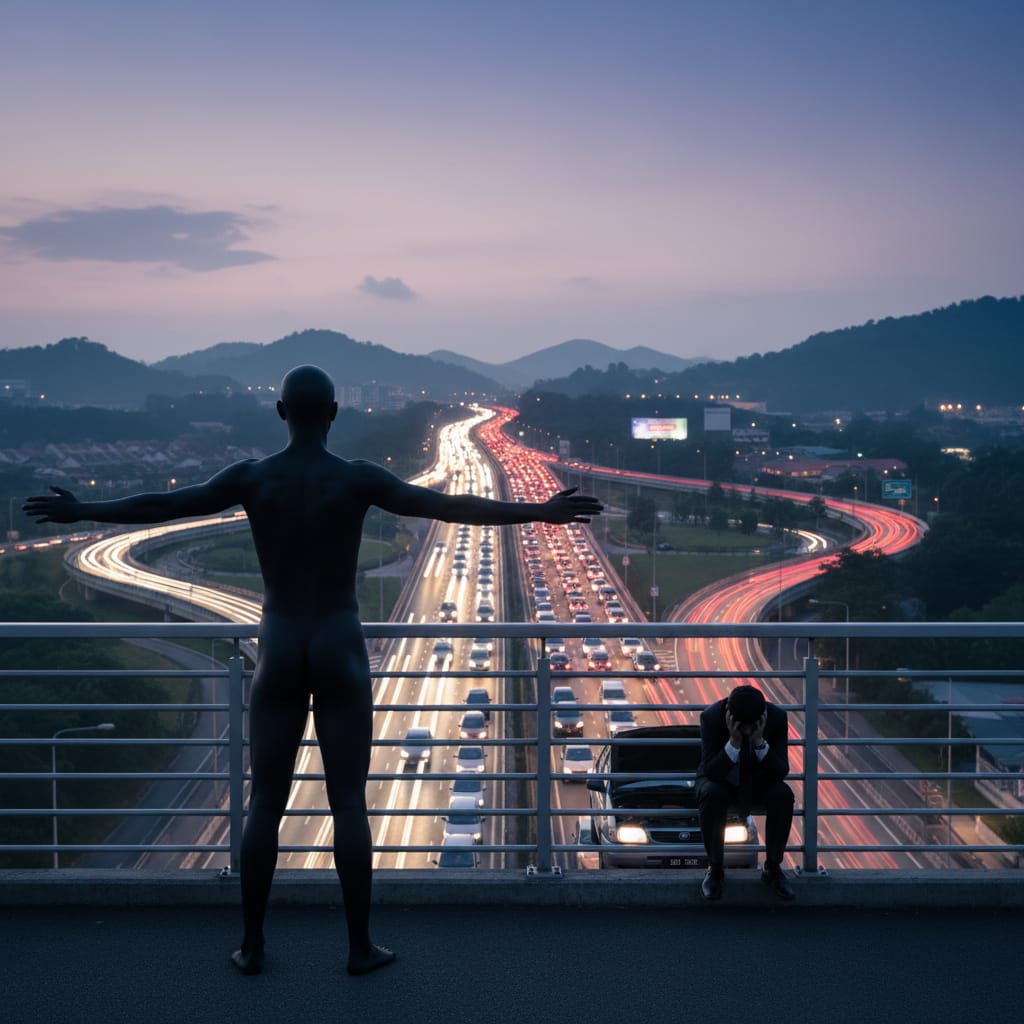
Just a naked Malaysian standing in the middle of traffic, doing a better job directing cars than half the signage approved by local councils.
Predictably, the video went viral. Malaysians, a people united by nasi lemak, roti canai and notifications, watched, laughed nervously, forwarded it to ten WhatsApp groups, and then waited for the official explanation to arrive—like a government press release after a flood.
Right on cue, Royal Malaysia Police stepped in, gently informing us that the man was “believed to be suffering from a mental health condition” and has since been admitted to Penang Hospital. https://newswav.com/A2604_1nvXA3?s=A_tR6wTP8&language=en
Case closed. File neatly labelled. Humanity restored.
Or so we tell ourselves.
Because here’s the uncomfortable truth: the man in Penang may just be the most honest Malaysian of the week.
The rest of us are also standing in the middle of chaotic traffic—except we’re fully clothed, highly educated, gainfully employed, and quietly losing our minds in instalments.
We don’t go viral because we still show up to work.
The numbers, as always, are less entertaining than a naked man but far more disturbing. The National Health and Morbidity Survey has been politely documenting what we prefer not to discuss at family dinners: mental health issues have nearly tripled over two decades.
From 10.7% in 1996 to 29.2% in 2015. https://newswav.com/A2604_1nvXA3?s=A_tR6wTP8&language=en
That’s not a trend. That’s a national mood.
Post-pandemic, the numbers have likely climbed even higher, but we’ve collectively decided not to look too closely—like ignoring a crack in the ceiling and hoping it develops character instead of collapsing.
We like to imagine mental breakdowns as dramatic, cinematic events.
A man standing naked in traffic.
A viral video.
A police statement.
A hospital admission.
But real mental deterioration in Malaysia is far more mundane.
It’s the executive answering emails at 2am because “just this one project.”
It’s the graduate sending out 200 job applications and receiving 199 silences.
It’s the family pretending everything is fine because therapy is still considered a luxury, somewhere between a spa day and moral failure.
We don’t collapse in public.
We erode in private.
And when someone finally does snap—spectacularly, inconveniently, and without clothing—we rush to label it as an isolated case.
A “mental patient.”
A one-off.
An unfortunate incident.
Anything, really, as long as it doesn’t force us to confront the possibility that he simply reached the breaking point faster than the rest of us.
There is something almost poetic about the image: a man directing traffic in the middle of chaos, stripped of everything society tells us we need to function.
No KPI.
No LinkedIn profile.
No five-year plan.
Just instinct, urgency, and a desperate attempt to impose order on a system that no longer makes sense.
If that isn’t a metaphor for modern Malaysian life, it’s at least a decent audition.
Of course, we will respond in the way we always do.
We will discuss “mental health awareness” for a week.
We will post inspirational quotes.
We will organise a run, a talk, perhaps even a panel discussion with mineral water and polite applause.
And then we will go back to normal.
Back to the grind.
Back to the pressure.
Back to pretending that resilience is infinite and breaking points are for other people.
But perhaps the real question isn’t why one man stood naked in the middle of a road in Penang.
The real question is: how many more are standing there metaphorically, still dressed, still functioning, still one bad day away from going viral for all the wrong reasons?
Because if the numbers are to be believed—and they rarely lie as creatively as we do—this isn’t an isolated case.
It’s a preview.
And next time, the man directing traffic might still be wearing a tie.
Mihar Dias (mihardias@gmail.com) is a content creator under the Newswav Creator programme, where you get to express yourself, be a citizen journalist, and at the same time monetize your content & reach millions of users on Newswav. Log in to creator.newswav.com and become a Newswav Creator now!
The User Content (as defined on Newswav Terms of Use) above including the views expressed and media (pictures, videos, citations etc) were submitted & posted by the author. Newswav is solely an aggregation platform that hosts the User Content. If you have any questions about the content, copyright or other issues of the work, please contact creator@newswav.com.