
Indians have become Australia’s largest migrant group, overtaking the English for the first time amid ongoing pushback against migration.
Data released by the Australian Bureau of Statistics (ABS) has revealed that at least 971,020 India-born people were living in Australia as of 30 June 2025.
They make up roughly 5.2 per cent of Australia's population, narrowly surpassing 970,950 people born in England.
The India-born population has surged the most in the last decade, while the number of people born in England has steadily declined. In 2013, the England-born population in the island-nation stood at one million.
China-born people numbered at 732,000 at third position, followed by 638,000 from New Zealand.
The next largest foreign-born populations came from Philippines, Vietnam, South Africa, Nepal, Sri Lanka and Malaysia.
According to government data, Australia had 8.8 million overseas-born residents in 2025, which made up about 32 per cent of the country's population of 27.6 million.
Rest of the 18.8 million people were born within the country, figures showed.
“The median age of those born overseas has fluctuated over time, peaking at a median of 46 years in 2002 and decreasing to 44 years in 2019,” the ABS said in its press release on Wednesday.
“In 2021, due to the impact of the Covid-19 pandemic and the decrease in younger people (such as international students) migrating to Australia, the median age of the overseas-born population increased to 45 years.”
The share of overseas-born residents in Australia has been edging towards its highest level on record, last seen at 32.4 per cent in 1891.
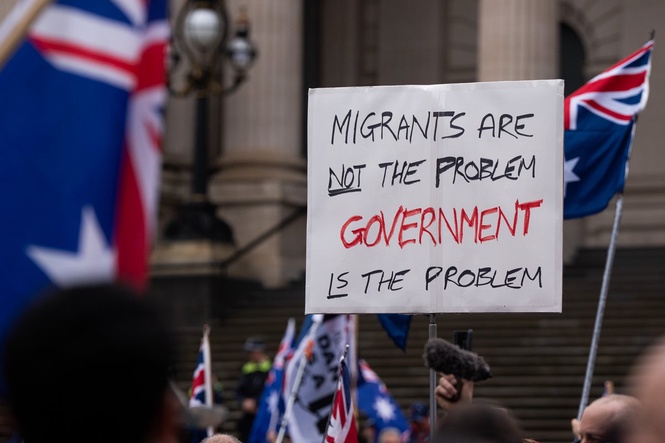
While migration has long been a key pillar of Australia's economic growth, it has also become a political flashpoint as the country suffers from its worst housing shortage in decades.
The issue has fuelled support for the populist One Nation party, which has gained in surged in opinion polls since last year’s election. Its leader Pauline Hanson has campaigned against immigration for decades.
Australian Human Rights Commission has warned that job insecurity and the technological revolution were driving rising anti-immigration rhetoric.
Hugh de Krester, president of the watchdog, said on Wednesday that there could be a “sensible debate” about migration policy and immigration rates.
“But, too often this debate is demonising migrants and driving polarisation and racism and it is wrong,” he said.
Read MoreIndia celebrates Zohran Mamdani for Koh-i-Noor diamond remarks
Inquiry into antisemitic attack that left 15 dead in Sydney recommends gun reform
US infant formula supply is 'safe,' FDA says after looking for potential contaminants