
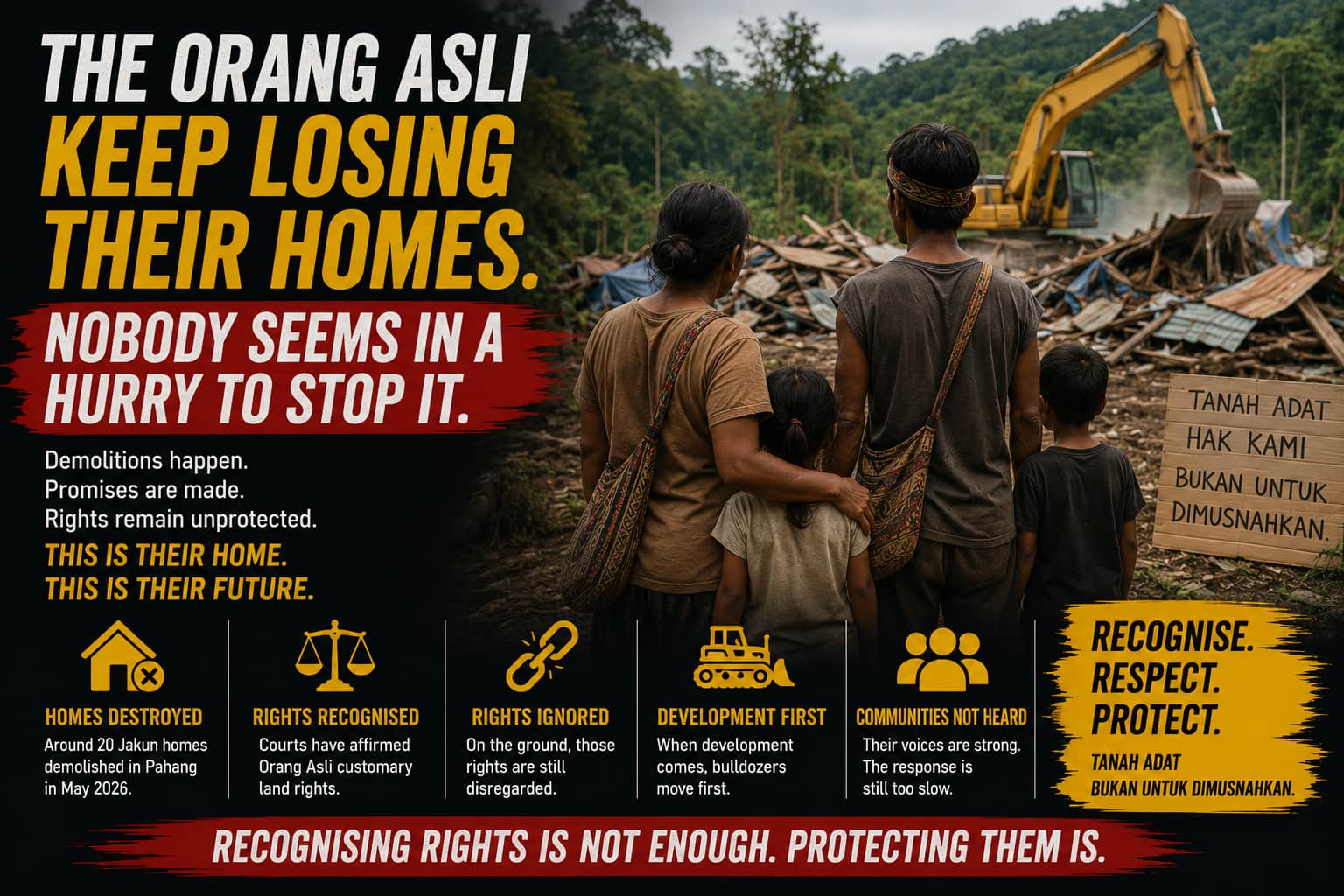
In May 2026, authorities in Pahang demolished around 20 houses belonging to the Jakun community. MalaysiaNow reported that thousands of Orang Asli subsequently rallied outside the Ministry of Rural and Regional Development in Putrajaya, stating the Pahang demolitions were part of a longer pattern of their customary land rights, tanah adat, being disregarded when development interests push in. FMT reported that the houses were demolished on May 4 by workers from SRS Makmur Sdn Bhd without prior notice, consent, or a court order.
This is not a new story. It is the same story, repeated.
Who the Jakun are
The Jakun are one of the Orang Asli subgroups in Peninsular Malaysia, concentrated in Pahang and Johor. Like many indigenous communities, their land rights sit in a legal space that is acknowledged in principle but inconsistently protected in practice.
The legal position
Malaysian courts have affirmed in several landmark cases that Orang Asli do have customary land rights. The Federal Court has ruled in their favour before. The gap is between what courts say and what enforcement agencies do when development interests push against those rights.
What keeps happening
The pattern is familiar. A community occupies land their ancestors have occupied for generations. Development interest emerges in the area, from state governments, private developers, or government-linked entities. Legal processes move slowly. Demolition orders move quickly.
The communities most affected rarely have the legal resources to mount a court challenge quickly enough to stop the bulldozers. By the time a lawyer is found and papers are filed, the houses are already down.
Where the government stands
The current federal government has spoken about indigenous rights as a policy priority. The Pahang demolitions happened under a state government that is part of the ruling coalition. There is a gap between federal rhetoric and state action that the Orang Asli community lives inside every day.
What they are actually asking for
The communities want formal legal recognition of customary land rights, with enforcement mechanisms that actually work when it matters. Not a policy statement. Actual legal protection that does not disappear the moment a development project needs the land.
The history of these promises going unfulfilled is long enough that hope, for many in these communities, has become a measured thing.
Do you think Malaysia is doing enough to protect Orang Asli land rights? And do these issues get the media attention they deserve compared to other national stories?
Ronny M (ronny76netstuff@gmail.com) is a content creator under the Newswav Creator programme, where you get to express yourself, be a citizen journalist, and at the same time monetize your content & reach millions of users on Newswav. Log in to creator.newswav.com and become a Newswav Creator now!
The User Content (as defined on Newswav Terms of Use) above including the views expressed and media (pictures, videos, citations etc) were submitted & posted by the author. Newswav is solely an aggregation platform that hosts the User Content. If you have any questions about the content, copyright or other issues of the work, please contact creator@newswav.com.