

If it was not enough that Sin Chew daily had come under fire by the Home Ministry for publishing an illustration of the national flag without the crescent moon symbol on its front page yesterday (April 15), today, Kwong Wah Yit Poh has become the next Chinese-language daily to wade through the same troubled water, when it uploaded a Facebook post showing the Jalur Gemilang without the crescent moon.
“The ministry has received a complaint about an incomplete illustration of the Jalur Gemilang on the Kwong Wah Yit Poh Facebook page dated April 16,” said the ministry, to indicate that Kwong Wah Yit Poh is going to have the books thrown at it for the same reason that it was thrown at Sin Chew previously.
Although the Home Ministry has yet to state whether action will be taken against Kwong Wah Yit Poh for the omission, considering that that it has launched an investigation on Sin Chew, under the reasoning that Sin Chew's omission was a serious lapse, as the crescent represents Islam as the religion of the federation that not only “shows a lack of professionalism, but it could also disrupt harmony in our multiracial society,” it is hard to see how Kwong Wah Yit Poh is going to be left of the hook so easily.
Now all of us were likely taught in school that the crescent moon in the flag is a symbol of Islam, and this is indeed the case, as many Muslim countries like Pakistan, Algeria and Turkey also feature the crescent moons on their flags to signify their status as an Islamic country.
But did you know that the crescent moon, as well as the star, that we unanimously associate with Islam today was actually not originally a symbol of Islam.
The original flag or banner that the Islamic prophet Muhammad himself used was the Black Banner or Black Standard (Arabic: الراية السوداء, romanized: ar-rāyat as-sawdāʾ), also known as the Banner of the eagle (Arabic: راية العقاب, romanized: rāyat al-ʿuqāb) or simply as The banner (Arabic: الراية, romanized: ar-rāyah) .
According to tradition, it was in the shape of a quadrangle and its colour was black.
The association of the star and the crescent moon with Islam only happened after the conquest of the city of Constantinople, where the modern city of Istanbul today stands, by the Ottoman Muslims in the year 1453.
Constantinople was the last great seat of the Roman empire – although it is called the seat of the Eastern Roman Empire or Byzantine empire by many historical books today, the fact that when the last Roman emperor of the West, Romulus Augustulus, was deposed by the German warlord Odoacer in 476, Romulus Augustus would send the the imperial insignia of the Western Roman Empire to Constantinople, signifies that that Roman empire did not end when Rome fell the to the Odoacer in 453, but continued on for another 1000 years, with its reign centred in Constantinople.
One might even say that the Roman empire continued for more than a 1000 years, as a matter of fact, because when Constantinople fell to the Ottoman Turks in 1453, the sultans of the Ottoman Empirecontinued to lay claim to represent the legitimate Roman emperors.
The early sultans after the conquest of Constantinople—Mehmed II, Bayezid II, Selim I and Suleiman I—staunchly maintained that they were Roman emperors and went to great lengths to legitimize themselves as such.
Various titles were used by the sultans to stress their claim, including kayser-i Rûm ("Caesar of Rome") and basileus (the Byzantine ruling title).
Not only did the Ottoman leaders style themselves as Caesar and basileus after the Romans they conquered, they also adopted the symbol of the "The star and crescent", which was the symbol of the city of Constantinople.
It was first used by the Muslim when it was hoisted by Mahomet II following the capture of Constantinople in 1453, on behalf of the Muslims.
The city of Byzantium ( which was another name for Constantinople) was originally dedicated to Diana, goddess of the hunt, and the crescent was the symbol of Diana. In 330, the first Christian Roman emperor, Constantine the great, would rededicate the city to the virgin Mary, whose star symbol was added to the previous crescent.
It was Constantine the Great, incidentally, that renamed the city of Byzantium to Constantinople in 330, before moving the capital of the Roman Empire from Rome to the city.
Prior to the adoption of the crescent and moon by the Muslims, the symbol was commonly found on the arms of Christian knights and esquires. The star and a crescent, in fact, was a badge of the legendary Richard the Lion Heart , 250 years before Constantinople fell.
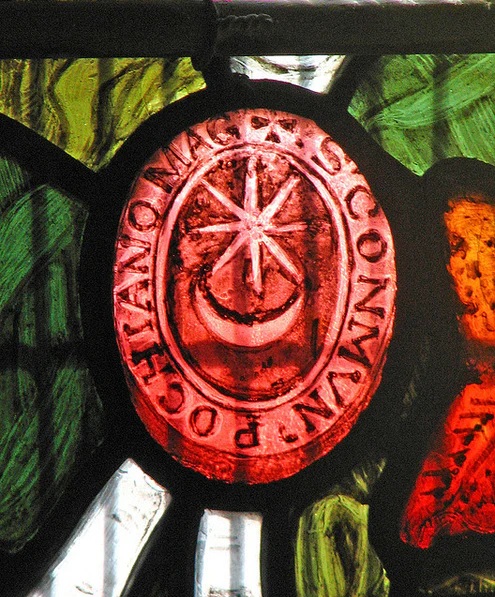
Christians however, stopped using the symbol of the crescent moon and the star when it became the banner of Muslims.
Today, the west has almost completely ceased using the crescent moon and the star as a symbol of their identity, while the Muslims since the Ottoman times, have used it more and more as a symbol to identify themselves, to the point that the symbol has become an inalienable part of their identity.
Being the most powerful Muslim polity for centuries, the Ottomans had an understandably lasting influence on the rest of the Islamic world, which of course, includes Malaysia.
In other words, It is through the influence of the Ottomans on our country, and their ambition to replace the Roman empire, whose last great city was Constantinople, whose ancient symbol was “the crescent and moon”, that that symbol of “the crescent moon and star” has become a part of our national identity today.
TheRealNehruism is a content creator under the Newswav Creator programme, where you get to express yourself, be a citizen journalist, and at the same time monetize your content & reach millions of users on Newswav. Log in to creator.newswav.com and become a Newswav Creator now!
The User Content (as defined on Newswav Terms of Use) above including the views expressed and media (pictures, videos, citations etc) were submitted & posted by the author. Newswav is solely an aggregation platform that hosts the User Content. If you have any questions about the content, copyright or other issues of the work, please contact creator@newswav.com.
