
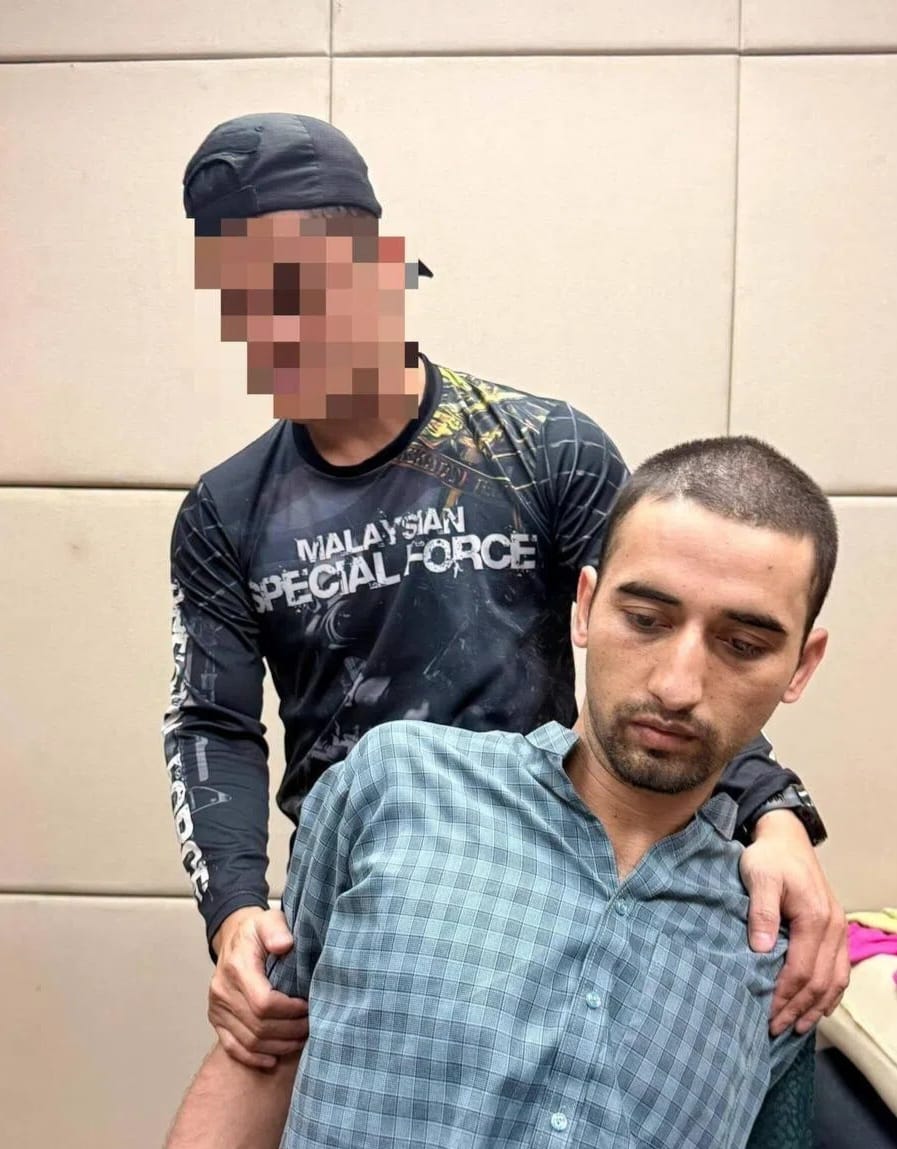
It was supposed to be a routine logistical operation a standard transfer of a remand detainee involving a police escort and a transport vehicle. In a system governed by rigid Standard Operating Procedures (SOPs) and high-security protocols, the movement of a prisoner is designed to be the most controlled environment possible. Yet, on April 9, 2026, those protocols collapsed. Muhammad Hassan, a 24-year-old Pakistani national facing grave charges, including child sexual offenses and immigration violations, vanished into thin air the moment he stepped off the transport vehicle within the grounds of Sungai Buloh Prison.
For nine agonizing days, the nation watched as a high-stakes manhunt unfolded across the dense undergrowth and construction sites of the Gombak district. The fugitive, hungry and desperate, managed to evade a massive cordon of police, tactical units, and K9 teams. When the Royal Malaysia Police (PDRM) finally announced his recapture on April 18, 2026, the relief was palpable. However, for those who scrutinize the state of our correctional infrastructure, the recapture is not a victory it is a temporary pause in a recurring narrative of institutional failure.
The Anatomy of an Escape: Complacency as a Catalyst
The escape of Muhammad Hassan was not the result of a meticulously planned heist involving blueprints and bribed insiders. It was, according to preliminary investigations, a product of human complacency. When a detainee, categorized as high-risk, manages to simply "walk away" during a disembarkation process, we are forced to confront the uncomfortable reality that our correctional system’s weakest link is not the bars on the windows, but the adherence to basic, repetitive security protocols.
As reported by Bernama, the investigation is now focused on whether negligence occurred during the transport process. The incident triggers a mandatory investigation under Sections 223 and 224 of the Penal Code sections that deal specifically with public servants allowing prisoners to escape, whether intentionally or negligently. This is not merely a legal process; it is a spotlight on the culture of "routine." When security measures become routine, they become invisible. The guard who has walked a prisoner from the truck to the cell a thousand times may eventually stop looking for the signs of a struggle or the twitch of a muscle, because "nothing ever happens." Until it does.
The "Swiss Cheese" Model of Failure
In the world of safety engineering, we use the "Swiss Cheese Model" to explain catastrophic failures. A system has multiple layers of protection (the cheese), but each layer has holes. Usually, these holes are misaligned, meaning a mistake is caught by the next layer. In this escape, the holes aligned perfectly. The lack of adequate physical restraints, the failure of the transport team to maintain a tight formation, and the lack of a secondary biometric perimeter check allowed the fugitive to slip through the "holes" in the system. The failure was not one single event, but a cascading series of lapses that transformed a prison transfer into a public safety crisis.
The Cost of the "Manhunt Economy"
While the authorities are currently patting themselves on the back for a successful operation, we must examine the astronomical cost of the "manhunt." When a prisoner escapes, the state does not simply close the gate and hope for the best. It mobilizes. This involves the General Operations Force (PGA), air support, drone surveillance, ground patrols, and intelligence gathering.
These resources are finite. Every ringgit spent chasing a fugitive through a construction site in Gombak is a ringgit diverted from proactive crime prevention, drug rehabilitation programs, or the desperately needed upgrade of prison infrastructure. According to analyses published by Astro Awani, the logistical strain on the police force during such manhunts is immense. The public pays twice: first through the failure of the correctional facility to keep the prisoner contained, and second through the tax-funded mobilization of an entire tactical division to clean up the mess.
If the Department of Prisons and the Ministry of Home Affairs were to allocate even a fraction of the "manhunt budget" toward technological upgrades, we would likely see fewer of these headlines. We are currently funding a reactive system that waits for disasters to happen rather than an infrastructure that prevents them.
The Technology Gap: Why Antiquated Protocols Are Costing Us
We are currently operating in 2026, yet many of our detention facility protocols feel as though they were written for the 1990s. The reliance on manual headcounts, analog logbooks, and visual identification is an invitation to failure. As documented in reports by Free Malaysia Today, the fugitive survived for nine days by blending into the environment and utilizing construction sites for shelter.
This brings us to a critical question: Why is there no integrated, real-time perimeter surveillance that flags unauthorized movement? Why is there no mandatory biometric handshake between the transport vehicle and the facility’s receiving dock?
The technological solutions exist. AI-driven behavioral analytics, which can detect a human presence in restricted zones, are standard in modern logistics and warehouse management. Yet, in our high-security facilities, we seem to rely on the eyes and ears of an exhausted guard. This is not a slight against the officers on the ground; it is a critique of the senior management that fails to provide these officers with the tools they need to succeed. When the toolset is archaic, the workforce becomes brittle, and the perimeter becomes a paper tiger.
The Societal Stigma and the Diversionary Tactic
In the wake of this escape, much of the public discourse fueled by social media focused on the nationality of the fugitive. The "Pakistani" label became the centerpiece of the narrative. This is a dangerous and lazy distraction. By focusing on the foreigner, we effectively ignore the system that failed to hold him.
Whether the detainee is a local citizen or a foreign national, the systemic breach remains the same. If a facility cannot hold an individual, the institutional rot is internal. Research from The Star often highlights that overcrowding in our detention centers leads to a breakdown in order, regardless of who is incarcerated. When the system is bursting at the seams, guards are overworked, resources are stretched, and corners are cut. The fact that the escapee was a foreign national is a demographic detail; the fact that he escaped is an institutional indictment. We must not allow the "foreigner" narrative to shield the Ministry of Home Affairs from the accountability it so desperately needs.
Institutional Reform: The Path Beyond Rhetoric
We have seen this movie before. A prisoner escapes, the public is outraged, an internal inquiry is announced, and the news cycle moves on. But the fundamental questions remain unanswered. What is the current capacity of our prison transport units? Have the SOPs for high-risk transfers been audited by an independent, third-party body?
As highlighted in archival reporting by Bernama, the Department of Prisons is chronically underfunded, struggling to maintain facilities that are in many cases decades old. To truly fix this, we need a three-pronged approach:
- Digital Integration: Replace manual logging with automated, sensor-based tracking for every movement of high-risk detainees.
- External Accountability: Internal inquiries are rarely transparent. We need an independent oversight committee, comprised of security experts and legal professionals, to audit prison security protocols annually.
- Human Capital Investment: We cannot just demand more from guards; we must pay them, train them, and staff them appropriately. A tired guard is a dangerous guard.
The Psychological Toll on the Community
Beyond the economics and the logistics, there is a profound human cost. The nine days that Muhammad Hassan spent at large left the residents of Gombak and the surrounding areas living in a state of heightened anxiety. Schools, businesses, and families were forced to look over their shoulders.
This anxiety is corrosive. It erodes the social contract between the state and the citizen. When the government demonstrates, time and again, that it cannot contain those it has charged with dangerous offenses, it creates a vacuum of trust. People begin to rely on their own measures neighborhood watch groups, private security, and self-imposed curfews effectively privatizing the security that the state is meant to provide.
What Do You Think? I’d Love to Hear Your Opinion in the Comments Section.
The recapturing of Muhammad Hassan is a milestone, but it is not a resolution. It is a temporary pause in a cycle that will repeat itself until the fundamental structural flaws are addressed. As long as our prisons remain overcrowded, underfunded, and reliant on outdated, human-centric security models that are easily exploited, the "Great Escape" will remain a recurring feature of our national news cycle.
We cannot afford to treat these escapes as isolated events that end the moment the handcuffs are back on. We must hold the Ministry of Home Affairs and the Department of Prisons accountable for the systemic weaknesses that allow these breaches to happen in the first place. These institutions must move beyond the reactive "Ops Kesan" mindset and adopt a proactive, technology-driven, and transparent approach to security.
Until we do, we are all just waiting for the next fugitive to find the next open door, the next blind spot in a camera, or the next distracted guard. The door is already ajar; the question is, will the authorities close it, or simply paint over the cracks?
AM World (tameer.work88@gmail.com) is a content creator under the Newswav Creator programme, where you get to express yourself, be a citizen journalist, and at the same time monetize your content & reach millions of users on Newswav. Log in to creator.newswav.com and become a Newswav Creator now!
The User Content (as defined on Newswav Terms of Use) above including the views expressed and media (pictures, videos, citations etc) were submitted & posted by the author. Newswav is solely an aggregation platform that hosts the User Content. If you have any questions about the content, copyright or other issues of the work, please contact creator@newswav.com.