While the family of the late Noorizwan Zulkefly was forced to publicly beg the police to stop investigating their defense lawyers following a lockup death marked by over twenty blunt-force injuries the government was busy in Parliament defending the VIP safety of a foreign preacher.
The contrast could not be more damning. When ordinary Malaysian citizens face severe physical danger inside state detention, grieving families struggle for basic accountability while their legal counsel faces police intimidation. Yet, when it comes to Dr. Zakir Naik, Home Minister Datuk Seri Saifuddin Nasution Ismail confirmed in a Dewan Rakyat written reply that Malaysia has officially decided not to extradite him, granting him permanent residency, state-backed security, and full shelter under Article 6 of the 2010 Extradition Treaty and the Extradition Act 1992.
A state that cannot guarantee physical survival or unhindered legal representation for its own citizens in custody cannot convincingly claim that its protection of a foreign firebrand is guided by universal human rights. In practice, ordinary Malaysians inherit the risk, while a foreign guest receives first-class sanctuary and state-backed immunity.
| Key Dimension | Malaysia's Stated Position | New Delhi's Strategic Reality |
|---|---|---|
| Legal Framework | Cites Article 6 of the 2010 Treaty and 1992 Extradition Act. | Has submitted no new formal requests or evidence since May 2020. |
| Strategic Benefit | Protects domestic voter base. | Avoids security, legal, and political costs of a domestic trial. |
| Public Posture | Asserts non-commitment to extradition. | Uses proxy media stings and diplomatic rhetoric to maintain leverage. |
1. The Phantom Request and New Delhi's Silence
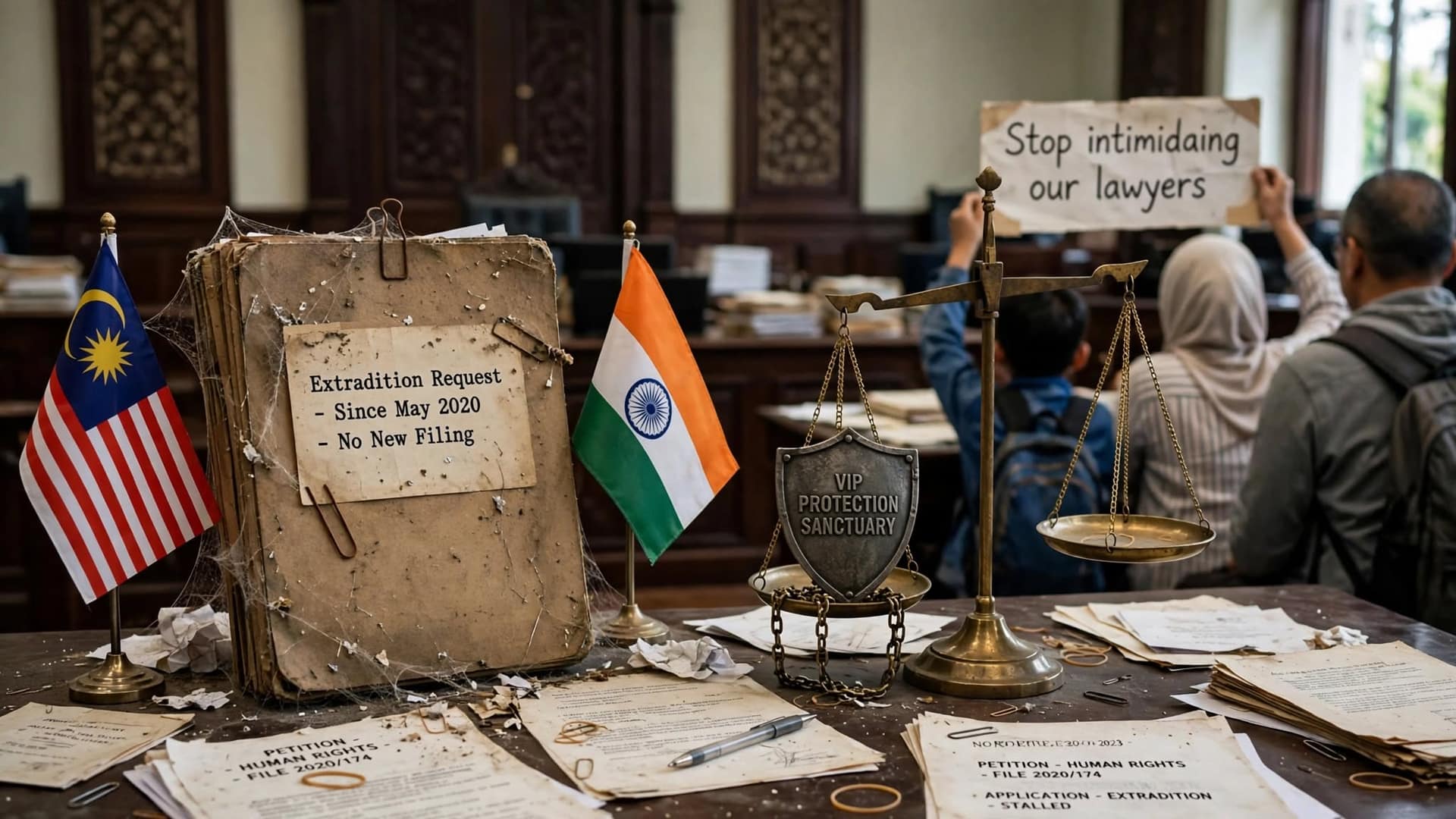
Buried beneath Saifuddin’s statutory citations was a far more revealing piece of news: since a diplomatic note seeking reconsideration was received on May 29, 2020, New Delhi has submitted zero new extradition requests, updated evidentiary files, or fresh judicial material.
For years, the public narrative has framed this dispute as a tense tug-of-war between Prime Minister Narendra Modi’s insistence on extradition and Prime Minister Anwar Ibrahim’s reliance on due process. But the paper trail tells a different story. If New Delhi has allowed its legal pursuit to sit dormant since 2020, why is Putrajaya absorbing all the domestic and diplomatic heat for refusing an extradition that India is no longer actively pushing through legal channels?
The answer lies in the convenient realpolitik of both nations: a status quo where India gets a permanent political lightning rod abroad, and Malaysia hides behind treaty clauses to manage domestic political optics.
2. Selective Sanctuary vs. Domestic Order
This domestic double standard extends directly into social cohesion. While federal authorities use treaty clauses to shield a foreign guest, domestic state authorities including Selangor, Johor, and Sarawak previously had to issue local administrative bans restricting Naik's public lectures to preserve local peace.
The state effectively claims a high moral obligation to protect a foreign preacher’s liberty, while relying on internal police restrictions to protect its own multiracial citizenry from the divisive impact of his rhetoric. When "humanitarian safety" is invoked to harbor an individual whose speeches have repeatedly inflamed communal lines, human rights cease to be a universal standard they become a selective political shield.
3. Why New Delhi Stalled Its Own Legal Machinery
While Putrajaya takes the public blame for harboring a fugitive, New Delhi’s inaction since 2020 exposes a calculated diplomatic strategy. For Narendra Modi’s government, keeping Zakir Naik in Putrajaya is far more advantageous than bringing him back to Mumbai or New Delhi.
If India were to successfully extradite Naik, it would inherit a massive domestic security and legal headache: high-profile court trials, international media scrutiny, potential communal unrest, and prolonged appeals. Housed in Putrajaya, Naik serves as a zero-cost political talking point useful for domestic nationalist narratives during election cycles, but safely outsourced to another government to monitor and feed.
Furthermore, India’s case faced a wall when Interpol repeatedly declined to issue an unconditional Red Notice due to insufficient judicial thresholds. Submitting another formal extradition request to Malaysia without bulletproof, internationally admissible evidence would only invite another formal rejection under Article 6. Rather than suffer a public legal defeat, New Delhi simply stopped sending paperwork, choosing instead to let proxy media channels and high-level closed-door meetings maintain public pressure.
4. The High Cost of Unilateral Defense
The irony of the current stalemate is that Putrajaya has volunteered to take the political fallout for a request that is effectively dead on paper.
Instead of holding New Delhi publicly accountable to the evidentiary standards of the 2010 Treaty demanding that India either provide unassailable proof or drop the matter entirely Malaysian officials repeatedly issue statements declaring "we will not extradite him". By making the refusal sound like a unilateral political choice under Article 6 rather than a failure of Indian evidentiary pursuit, Malaysia absorbs all the reputational damage. Putrajaya pays the price in bilateral trade friction and sovereign exposure, while New Delhi enjoys the political leverage without ever having to test its case in court.
Time for Diplomatic Coherence
Statecraft cannot operate indefinitely on phantom disputes. Harboring a foreign preacher whose legal case has been allowed to go cold by his home country yields no strategic dividend for Malaysia. It leaves Putrajaya vulnerable to foreign undercover media operations, strains relationships with major economic partners, and maintains a perpetual fault line in domestic communal relations.
If New Delhi is serious about justice, it must submit fresh, internationally sound judicial evidence under the 2010 Treaty. If it cannot or will not, Putrajaya must stop acting as the willing shield for a frozen legal file. Courts require proof, sovereign nations require clarity, and a multiracial society where ordinary citizens are still fighting for basic safety within their own institutions cannot remain a convenient parking spot for another country’s political liabilities.
Annan Vaithegi - Commentator on diplomacy, statecraft, and public order in multiracial societies.
Annan Vaithegi (annanvaithegi@icloud.com) is a content creator under the Newswav Creator programme, where you get to express yourself, be a citizen journalist, and at the same time monetize your content & reach millions of users on Newswav. Log in to creator.newswav.com and become a Newswav Creator now!
The User Content (as defined on Newswav Terms of Use) above including the views expressed and media (pictures, videos, citations etc) were submitted & posted by the author. Newswav is solely an aggregation platform that hosts the User Content. If you have any questions about the content, copyright or other issues of the work, please contact creator@newswav.com.