
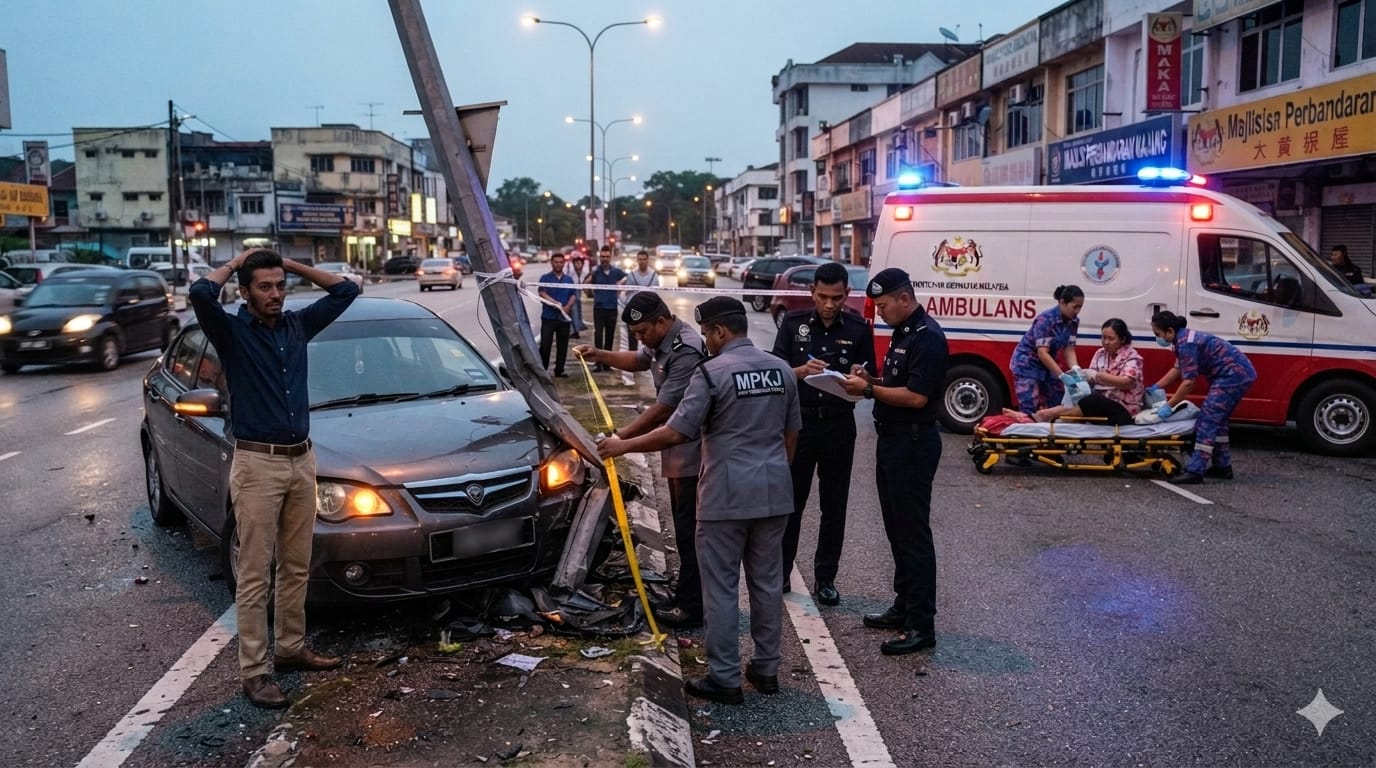
Let’s talk about the absolute circus that unfolds every time a car tyre kisses a curb in Malaysia. Right now, we have two distinct tragedies playing out. The first is in Bandar Mahkota Cheras, where a woman tragically lost her life in a bizarre, devastating freak accident involving a fleeing driver and a collapsing metal pole. The second tragedy is happening on your smartphone screens, where the comment sections have collectively suffered an intellectual blackout.
Whenever a horrific accident occurs whether it’s the heartbreaking tragedy in Klang or this latest incident in Cheras the Malaysian internet machinery deploys a predictable, toxic script. Within five minutes of the news breaking, netizen investigators ignore the speedometers, the CCTV footage, or the breathalyzers. Instead, they scan the driver’s face, determine their ethnicity, and immediately activate the "Racist Comment Overload" protocol.
If the driver is non-Muslim and alcohol is suspected, the keyboard warriors do not just demand jail time; they demand the condemnation of an entire demographic. "Alcohol is the root of all evil! Ban everything! These people have no morals!" goes the digital chorus.
But wait. Let’s do a quick reality check for our memory-deficient keyboard warriors. Do you remember the tragic accident on the MEX Highway involving a young messenger/vlogger from Bangladesh who was visiting Malaysia? He died on the spot after his e-hailing ride was rammed. The suspected drunk driver behind the wheel was a local Malay guy (a soldier, no less).
When that news broke, the comment section suddenly suffered from severe cognitive dissonance. The "ban all alcohol" crowd suddenly became very quiet, while the opposing camp logged on to spam equally vile, generalized insults about rempit culture and systemic lawlessness. One individual makes a catastrophic, criminal decision, and suddenly thirty million citizens are dragged into an online holy war.
Let's be clear: we do not support drunk drivers. At all. Full stop. But as a matter of law, let us clear up the legal mechanics of how we actually punish this behavior under the Road Transport Act 1987. Netizens love to scream that the law is "too weak," usually while typing in all-caps. In reality, the law was heavily tightened under the Road Transport (Amendment) Act 2020.
Under Section 44(1), if you drive under the influence of alcohol or drugs and cause death, you face a mandatory jail term of 10 to 15 years, alongside a fine between RM50,000 and RM100,000 for a first offense. For subsequent offenses, the prison sentence escalates up to 20 years, and your license is stripped for a decade. The law does not give a single care about your race, your background, or what you choose to drink on a Friday night. If you kill someone while drunk behind the wheel, the law treats you as a criminal, plain and simple.
⚖️ The "Great Escape" Column: How a Drunk Driver Slips Through the Legal Net
Disclaimer: Explaining the loophole does NOT mean we endorse the driver. Don't lodge a police report against me, please.
Now, let's look at the fascinatingly messy legal headache of the Cheras incident. The police are currently investigating under Section 41(1) for reckless or dangerous driving causing death. Why? Because the car did not physically crush the victim. The driver allegedly hit a lamp post, and the lamp post fell on the victim.
The drunk driver's initial act (Act A) triggers a liability chain where the car strikes a rusty lamp post, which acts as a novus actus interveniens due to its intervening weakness. This structural failure, rather than direct impact from the vehicle, causes the fatal result, potentially allowing the defense to argue a broken chain of causation.
This brings us to my favorite law school exam question: proximate cause and the chain of causation. The defense lawyer will undoubtedly walk into court wearing a very expensive suit and argue novus actus interveniens a fancy Latin term for "an intervening event that breaks the chain of causation."
The defense argument will sound something like this:
- The "I Didn't Touch Her" Defense: My client hit a piece of municipal property, not a human being.
- The Foreseeability Loophole: A reasonable driver can foresee that hitting a curb might pop a tyre. They cannot reasonably foresee that a massive, industrial metal pole will snap like a cheap piece of keropok lekor upon a low-speed impact.
- Shifting the Blame: If the lamp post was properly maintained, it would have dented the car's bumper. Instead, it fell like a twig. Therefore, the immediate cause of death wasn't the car; it was the gravity-assisted municipal guillotine.
If the judge buys this argument, the driver could potentially escape the heavier "causing death" charges under Section 41(1) or Section 44(1) and get downgraded to mere reckless driving or property damage. And that, my dear angry netizens, is why we need to stop looking at skin color and start looking at the literal rusty iron right in front of us.
🏢 The Unsung Hero of Negligence: Majlis Perbandaran Kajang (MPKj)
While everyone online is busy arguing about race, religion, and nationwide prohibition, we need to ask a very pragmatic, very Malaysian question: Who installed that lamp post, and did they secure it with double-sided tape?
As highlighted in our previous discussion regarding Kuala Lumpur's infrastructure, Malaysia's local governments have become highly skilled at highly visible enforcement while remaining dangerously inconsistent in invisible maintenance. Councils move at lightning speed to clamp your car, raid roadside nasi lemak stalls, or issue technical compounds. Yet, when it comes to the actual statutory duties they are funded to perform, the efficiency completely vanishes until someone dies.
Let's look at the law, shall we? Under Section 101(k) of the Local Government Act 1976 (Act 171), local authorities are explicitly empowered to arrange for the lighting of public streets and public places. But power comes with responsibility. If we pivot over to Section 26(1) of the Street, Drainage and Building Act 1974 (Act 133), it clearly states that the local authority may put up lamp posts and lamps. Legally, when a council exercises its power to erect heavy infrastructure over public roads, it owes a duty of care to the public to ensure that infrastructure doesn't become a looming public hazard.
💼 How a Civil Lawsuit Against a Malaysian Local Council Actually Works
Can the victim's family actually sue the local council? Absolutely. But suing a government body in Malaysia isn't as simple as shouting "I sue you!" in a TikTok video. It is a grueling, bureaucratic marathon that works like this:
Step 1: The Public Authorities Protection Act 1948 (PAPA) Trap
You have a strict 36-month limitation period to file a suit against a public authority. If you miss this window by even one day because you were waiting for an internal council report, your case is legally dead.
Step 2: Proving the Breach of Statutory Duty
You must prove the council didn't just make a mistake, but committed misfeasance or total neglect of their duties under Act 171 and Act 133. You have to bring in engineering experts to show the pole was rusted, improperly anchored, or ignored during routine maintenance audits.
Step 3: The Precedent Shield
The council's legal team will try to invoke Ahmad Jaafar Abdul Latiff v Dato' Bandar Kuala Lumpur (2014) to claim they took "reasonable steps." Your lawyer's job is to smash that shield by citing the Majlis Perbandaran Seremban and Langkawi tree-fall precedents to prove that if a council is liable for a falling coconut tree, they are definitely liable for an industrial metal pole.
Ordinary taxpayers shell out their cukai tanah, assessment rates (cukai taksiran), license fees, and parking compounds with a basic expectation of public safety and responsible governance. Instead, public funds are increasingly being drained to finance the consequences of institutional neglect through lawsuits and heavy compensation payouts.
Let the courts handle the driver under the strict laws we already have. And maybe, just maybe, let’s demand that MPKj audit every single pole in Cheras before another innocent life is taken by a combination of criminal choices and municipal loose bolts.
Final Thoughts…
Annan Vaithegi writes, the law will handle the driver, but it’s up to us to hold the council accountable to the community. In our rush to look at skin color, let’s not ignore the rusty bolts putting us all in danger. Let's drive responsibly, keep a clear head, and always look up at the road ahead before looking down at our phones.
Annan Vaithegi (annanvaithegi@icloud.com) is a content creator under the Newswav Creator programme, where you get to express yourself, be a citizen journalist, and at the same time monetize your content & reach millions of users on Newswav. Log in to creator.newswav.com and become a Newswav Creator now!
The User Content (as defined on Newswav Terms of Use) above including the views expressed and media (pictures, videos, citations etc) were submitted & posted by the author. Newswav is solely an aggregation platform that hosts the User Content. If you have any questions about the content, copyright or other issues of the work, please contact creator@newswav.com.