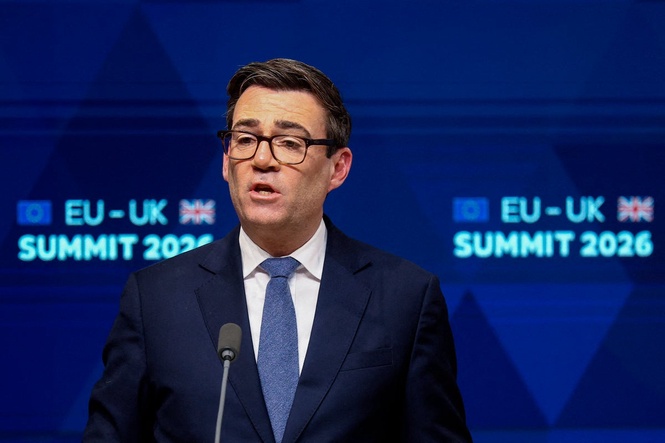
Andy Burnham said he wants a “national conversation” about Britain’s future relationship with the European Union, and that is precisely what he has got.
The old Leave and Remain organisations are regrouping, rearming and rebranding. They are now “Stay Out” and “Get In”. All agree that the world of 2026 is very different to that of 2016, and there’s no benefit in reviving old arguments – but then trading some familiar arguments about the costs and benefits of integration.
No sooner had the prime minister delivered his “reset” deal in Brussels than Nigel Farage was holding a press conference with the jarringly oxymoronic slogan “Forward with Farage”. The man some call “Mr Brexit”, not the winning sobriquet it once was, declared that a Reform UK government would tear the deal up.
Indeed, he wants to renegotiate Brexit again to make it even more difficult to trade with Europe. He may have lost his touch for judging public opinion. By contrast, Ed Miliband, the foreign secretary, wants all options on the table, and we know what he means by that.
The present prime minister has also had comradely advice from some of his many predecessors. Theresa May thinks it will take up too much time, and she has said in the past that the “soft Brexit” she negotiated with the EU, and which was rejected by her own party, would have been best for the country (and could be again). Her successor, Boris Johnson, did “get Brexit done”, would do it all again his way, and warns Mr Burnham that “he will impale himself and his party on this”.
He should know. In her tragic digital afterlife of self-parody, Liz Truss comments that “the prime minister is lying about his surrender deal”, about as constructive as she gets these days. For his part, Sir Tony Blair is wary about the impact rejoining the EU might have on the British AI sector and technological innovation. David, now Lord, Cameron says the world’s moved on and he’s changed his mind.
No doubt Sir John Major, Gordon Brown and Rishi Sunak (the only ex-PM to have actually campaigned in 2016 to come out) will offer their own considered judgements in good time. Understandably, given the circumstances, Sir Keir Starmer might keep his counsel, though it’s only fair to add that the “reset” was his idea and he skilfully made it happen in relatively short space of time.
Sir Keir’s strategy to win the last election was to end the endless arguments about Europe by setting clear red lines in the manifesto, and limiting his ambitions to the modest reset which has now been partially achieved. What he makes of Mr Burnham stirring it all up again and potentially splitting the Labour Party over it so long before the next election may be shrewdly guessed.
So the national conversation is well underway, but it is a curious, inchoate one. There is, after all, no actual proposition upon which the debate can focus. Everyone has their own ideal version of the UK-EU relationship, from Britain being a federal member of a United States of Europe through joining the customs union to trading with Europe on World Trade Organisation terms and sending the Royal Navy in to take irregular migrants back to France.
There are endless permutations. Questions such as the budget contribution, immigration and free movement of labour, joining the euro, the national veto, fishing rights, regulation, Gibraltar, the Irish border, sovereignty, and collective European defence all mean different things to different voters.
Each have trade offs. The danger, already apparent, is the conversation becomes a Tower of Babel. Just as in 2016 there was no clear notion or plan of what Brexit would actually be, so today there’s no concrete text that defines what “rejoining” the EU, even in the loosest sense, would entail.
Second, lets's not forget the conversation within Europe, though less urgent or obsessive, about what the EU would like from a deal.
The habitual British weakness is to assume that the EU is so desperate to have the British inside the club that London can more or less dictate terms. Successive prime ministers going back to Harold Macmillan have learned this the hard way - Europe can say “non” too.
It is also true that there is a wave of momentous elections coming, from Spain currently to France next May, Poland next winter, and Germany and the European Parliament itself in 2029. These could easily see the extreme Right dominate the bloc - an unprecedented development with huge implications for it and for potential British membership.
In any case, after this reset, once concluded with agreement on tuition fees and the Made in Europe protection project, nothing can happen in Britain before the next general election. That much at least is clear. The Labour manifesto says so, and the European Commission has let it be known it dislikes the prospect of more "cherry picking" British resets. Ideally, the national conversation, including contributions from his nine predecssors, will help Mr Burnham stay where he wishes to be - not getting ahead of public opinion.
This will then guide his general policy on closer relations which he can outline in the next Labour manifesto, including the possibility of full membership - if that is demonstrably in the national interest, as it must be. Mr Burnham need therefore do no more than undertake to try and negotiate the best new deal he can.
If the terms are favourable, he can to put it to parliament. Another divisive, exhausting and confusing referendum campaign followed by the trauma of government, parliament and the EU jointly trying to make sense of it all is what people really dread, and rightly.
It should always have been a matter for parliament in the first place and in the end it will have to be again.
Read MoreAfter that EU stitch-up, does Andy Burnham really think rejoining is a good idea?
Andy Burnham can find a clever way to make reparations work
The Brexiteers are getting back together – we can’t fall for their nonsense again
New ideas are needed to move beyond this annual Cop climate circus
The Brexit reset is done. Now Britain must decide where it wants to end up