
Author: Dr Dian Nasriana binti Nasuruddin, Chemical Pathologist, Pathology Department, Hospital Canselor Tuanku Muhriz UKM (HCTM); Treasurer of Malaysian Sepsis Alliance (MySepsis)
Co-authors: Dr Khaizurin Tajul Arifin, Department of Biochemistry, Faculty of Medicine, Universiti Kebangsaan Malaysia, committee of MySepsis; Associate Professor Dr Tan Toh Leong, Consultant Emergency Physician, Faculty of Medicine, UKM, Founder and President, MySepsis
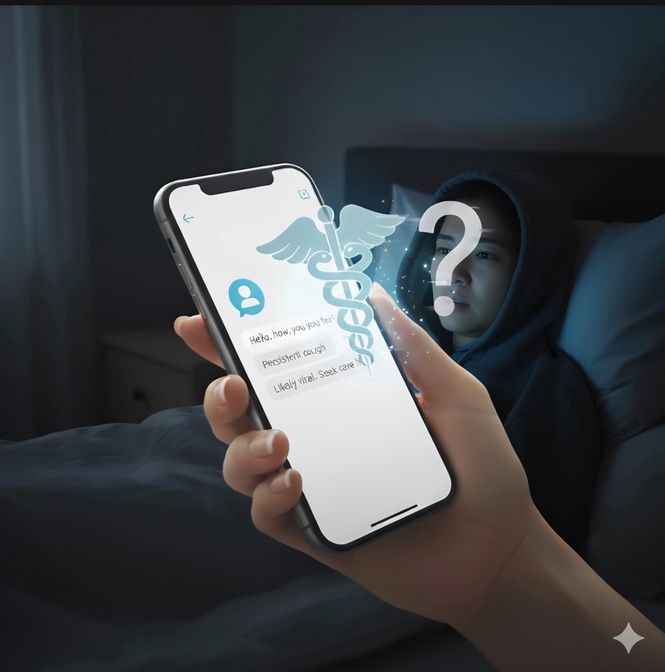
It's 3 in the morning. Your eyes are wide awake. You worry about this nasty cough that's been plaguing you for the past few weeks. A quick Google search came up with the diagnosis of a common cold. A deeper search, however, came up with a few other rare but worrying diagnoses. You're now getting more anxious. What would be the next step now, you wonder?
You then do what millions of people would now do.
You open a medical chatbot.
You then describe your symptoms and woes to the chatbot.
Within seconds, it offers a preliminary assessment: It's likely a lingering viral infection. It then offers a few tips with a note at the end advising you to see a doctor immediately if your symptoms persist or worsen.
No judgment. No waiting.
Meet your new best friend.
Chatbots are fast becoming (almost) everyone’s new ‘Pocket Doctor’ cum best friend.
This is the new reality of AI chatbots in healthcare. A few short years ago, what felt like science fiction is now a surprisingly beneficial health companion accessible to all. These mobile companions are doing everything from mental health coaching to helping people manage chronic diseases.
This raises an important question. Is this actually good for patients? Or are we trading convenience for something a little more precious
Like many other disruptive technologies, medical chatbots are a double-edged sword. They offer genuine, life-changing benefits, but they also carry serious risks we cannot afford to ignore.
Why patients are embracing chatbots.
The appeal is obvious. Healthcare's most frustrating aspects- the waiting, the limited access, and the cost are addressed by medical chatbots.
1. Round-the-clock access when you truly need it
The most immediate benefit? No more waiting rooms (Coherent Solutions, 2025).
Chatbots provide instant, 24/7 support. This is critical since health concerns rarely follow office hours. Instant access can be a genuine lifeline for someone in a rural area, or for those with mobility issues.
How do the chatbots work? They analyse the user's input, i.e., the symptoms they are experiencing, and help them determine whether they need self-care, a virtual consultation (if available), or an urgent trip to the Emergency department. Indirectly, they also help ease the workload for medical staff and reduce pressure on overwhelmed healthcare systems (Salgado, 2025).
2. Mental health support without the stigma
This is an area where chatbots really shine. Apps like Woebot and Wysa, which offer AI-driven cognitive behavioural therapy (CBT) techniques, mindfulness exercises, and emotional support, have been shown to benefit patients.
Understandably, patients often find it easier to open up to a chatbot than to a human, at least initially. A 2025 study by Dellavalle et al found that anonymity feels safer without judgment or stigma attached. Next comes the million-ringgit question. Do the chatbots work? Well, a study by Laymouna et al in 2024 showed that these tools can genuinely improve mental well-being, especially for mild to moderate anxiety and depression. For the record, the apps are not meant to replace therapy. However, for anyone who's struggling and not ready for a therapist, or who can't afford one, this is definitely better than nothing.
3. Mobile personal health coach
Chatbots are also helpful for patient education. They can answer medication questions, explain conditions in lay terms, and reinforce the doctor's advice (which we often only half-recall the moment we leave the consultation room).
For people with chronic diseases like diabetes mellitus, advanced chatbots can send medication reminders, track vital signs, and provide motivational nudges to help patients stick with their treatment plans (Laymouna, 2024). It's like having a personal health coach cum the whole cheerleading squad on our side.
The problems we need to discuss.
That all sounds wonderful. However, we must acknowledge the risks even though the benefits have been compelling. These drawbacks range from poor (and potentially dangerous) medical advice to a cold, impersonal healthcare experience.
1. Can Chatbots give wrong information?
The biggest risk is simple. Chatbots can give you wrong information. In healthcare, this is not a minor error. It can be fatal.
AI models, especially large language models, can ‘hallucinate’. This means that they generate responses that sound confident but are completely wrong (Mount Sinai, 2025). Imagine getting an incorrect dosage or being told your severe symptoms are nothing to worry about. The consequences could be dire. The problem gets worse when patients provide vague information.
A human doctor would proceed to ask follow-up questions for clarification and use his or her clinical acumen and judgment.
A chatbot might just guess, and guess what? It can guess wrong.
2. Is your data safe?
Patient health data is incredibly sensitive and vulnerable asset. Chatbots represent a risk to data leaks. Many chatbot developers claim that their chatbots are secure. However, the invaluable trove of medical data sets them up as ripe targets for hackers (Waiyaki, 2025).
The next insidious issue comes in the form of bias in the training data. Most of the chatbot models are trained on datasets that may omit certain underrepresented populations, e.g. women, children, the elderly and certain ethnic minorities. If a user does not fit the training profile, the chatbot may give an inaccurate response and advice.
This is not just a technical flaw. It is, in fact, a safety issue that sustains health disparities.
3. Losing something essential.
This is, perhaps, the number one worry. Healthcare isn't just about a diagnosis or a prescription. It's a human effort built on empathy, trust, and the patient-provider relationship.
A chatbot can give users information, but it can't offer the humanistic components of care. It can't provide a comforting tone when users are scared, an intuitive understanding of what users are not saying, or the moral support of a clinician who knows them (Farhud, 2021). Patients, especially vulnerable ones, may even feel reduced to an algorithm, leading to a loss of faith in the system itself (Wang, 2023).
After all, when we are sick, we want someone who really cares to be with us, right?
What’s next?
Medical chatbots are here to stay, as they should be. The goal isn't replacing doctors. It’s using AI to help doctors and give patients better access. For this partnership to work, we need a few changes.
1. Transparency. Patients must know when they're talking to an AI and understand its limitations. A chatbot's advice should be presented as informational, never as a definitive medical judgment
2. Regulation. The technology is ahead of the rules. We need clear government and medical guidelines for validating and certifying medical AI before these tools are released to the public, not after harm occurs.
3. Ongoing monitoring. After deployment, we must continuously ask: Is this tool harming patients? Is it biased? Is it keeping up with medical knowledge
Final Thoughts
Our new best friend, i.e. the ‘digital doctor’ in our pockets, should be a helpful and powerful assistant, not a replacement for human care. This is a vision that we must pursue.
Patients can navigate this emerging landscape wisely if they understand the potential and drawbacks. The technology can make healthcare more accessible and responsive, but only if we remain honest about its limitations and by prioritising the human side of care.
Medicine, after all, is fundamentally about people taking care of people. No chatbot, however sophisticated, should ever make us forget that.
References
Coherent Solutions. (2025). How AI Chatbots Advance Healthcare for Patients and Providers. Retrieved from https://www.coherentsolutions.com/insights/how-ai-chatbots-advance-healthcare-for-patients-and-providers
Farhud, D. D. (2021). Ethical Issues of Artificial Intelligence in Medicine and Healthcare. Iranian Journal of Public Health, 50(2), 226–227. https://pmc.ncbi.nlm.nih.gov/articles/PMC8826344/
Mary Salgado. Hit Rate Solutions. (2025). Benefits of Chatbots in Healthcare, Drawbacks & Common Uses. Retrieved from https://hitratesolutions.com/blog/pros-and-cons-of-healthcare-chatbots
Laymouna, M. (2024). Roles, Users, Benefits, and Limitations of Chatbots in Health Care: Rapid Review. JMIR, 26(1), e56930. https://www.jmir.org/2024/1/e56930/
Mount Sinai. (2025). AI Chatbots Can Run With Medical Misinformation, Study Finds, Highlighting the Need for Stronger Safeguards. Retrieved from https://www.mountsinai.org/about/newsroom/2025/ai-chatbots-can-run-with-medical-misinformation-study-finds-highlighting-the-need-for-stronger-safeguards
Natalia S Dellavalle, Jessica R Ellis, Annie A Moore, Marlee Akerson, Matt Andazola, Eric G Campbell, Matthew DeCamp, What patients want from healthcare chatbots: insights from a mixed-methods study, Journal of the American Medical Informatics Association, Volume 32, Issue 11, November 2025, Pages 1735–1745, https://doi.org/10.1093/jamia/ocaf164
Itotia Waiyaki. Trustshoring. (2025). The Ethical Considerations of AI-Powered Chatbots in Healthcare. Retrieved from https://www.trustshoring.com/blog/the-ethical-considerations-of-ai-powered-chatbots-in-healthcare/
Wang, C. (2023). Ethical Considerations of Using ChatGPT in Health Care. Journal of Medical Internet Research, 25(1), e48009. https://www.jmir.org/2023/1/e48009/
陈沱良医生DrSeb (drsebchannel@gmail.com) is a content creator under the Newswav Creator programme, where you get to express yourself, be a citizen journalist, and at the same time monetize your content & reach millions of users on Newswav. Log in to creator.newswav.com and become a Newswav Creator now!
The User Content (as defined on Newswav Terms of Use) above including the views expressed and media (pictures, videos, citations etc) were submitted & posted by the author. Newswav is solely an aggregation platform that hosts the User Content. If you have any questions about the content, copyright or other issues of the work, please contact creator@newswav.com.