

By Dr Victor SL Tan
Most people believe good writing is about talent.
Seasoned writers know better.
Great writing is not born—it is edited into existence.
Over three decades of consulting, training, and writing about leadership, strategy, and change, I have learned one fundamental truth: editing is thinking in action. Writing captures ideas; editing refines wisdom. Writing is expressive; editing is disciplined. Writing is emotional; editing is intentional.
In my experience, weak articles, papers or books fail not because of poor ideas, but because of insufficient depth of editing. Editing is not a single activity—it operates at multiple levels, each building upon the other.
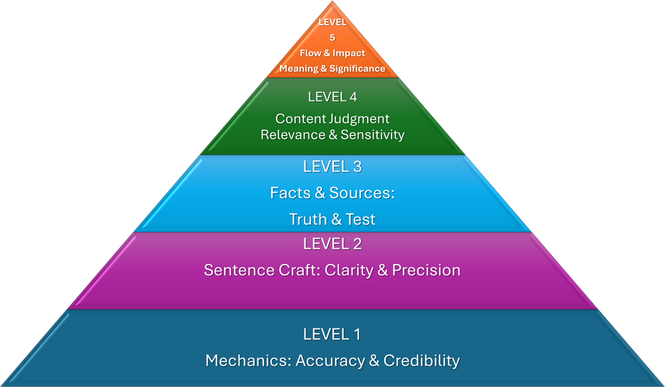
This article introduces what I call the KLSCC 5 Levels of Editing Model —a structured way to elevate any piece of writing from acceptable to impactful.
Level 1: Mechanical Accuracy – Respecting the Reader
The first level of editing deals with the basics:
- Typographical errors
- Spelling mistakes
- Grammatical inaccuracies
- Punctuation errors
At this level, editing is about credibility.
A single typo may seem minor, but to the reader, it signals carelessness. When mechanics are weak, readers subconsciously question the writer’s competence—even if the ideas are sound.
Level 1 editing answers a simple but critical question:
“Can I trust this writer?”
This level does not make writing powerful—but without it, writing loses authority. It is the hygiene factor of communication: invisible when done well, glaring when neglected.
Level 2: Sentence Strength – Clarity over Cleverness
Once mechanics are corrected, the next level addresses how sentences work:
- Sentence structure and rhythm
- Wordiness and redundancy
- Duplication of ideas
- Awkward or convoluted phrasing
Many writers confuse complexity with intelligence. In reality, clarity is the highest form of sophistication.
Level 2 editing trims excess fat. It tightens sentences. It removes repetitions that add length but not meaning. It replaces vague expressions with precise language.
Here, the editor asks:
“Is this sentence serving the reader—or the writer’s ego?”
Strong editing transforms rambling thoughts into sharp insights. It respects the reader’s time and attention.
Level 3: Factual Integrity – Truth before Persuasion
At Level 3, editing moves beyond language into substance.
This level focuses on:
- Accuracy of facts
- Verification of statistics
- Credibility of sources
- Logical consistency of arguments
In an era of misinformation, factual integrity is not optional—it is a moral responsibility.
Powerful writing persuades, but ethical writing first tells the truth. Editing at this level protects the writer from unintentional errors and reputational damage.
The guiding question here is:
“Is what I am saying true, current, and defensible?”
A well-edited article at Level 3 does not merely sound convincing—it stands up to scrutiny. It has credible source of information, facts or statistics.
Level 4: Strategic Inclusion – What Belongs, What Doesn’t
This is where editing becomes judgment.
Level 4 editing examines:
- Missing information
- Overlooked perspectives
- Cultural, emotional, or ethical sensitivities
- Content that distracts rather than strengthens
Many articles or books fail not because they include too little—but because they include too much of the wrong things.
At this level, the editor asks two powerful questions:
- What should be here but isn’t?
- What is here but shouldn’t be?
This is also where sensitivity matters. Words carry impact beyond intention. Mature editing anticipates how different audiences may interpret content.
Level 4 editing separates relevance from noise and insight from indulgence.
Level 5: Flow and Impact – Seeing the Big Picture
The highest level of editing is strategic and holistic.
Level 5 focuses on:
- Overall flow and coherence
- Alignment between sections or chapters
- Logical sequencing of ideas
- Significance, resonance, and lasting impact
This is where editors stop looking at sentences and start seeing architecture.
An article may be accurate, clear, and well-written—yet still forgettable. Level 5 editing ensures the piece lands with meaning.
The final question becomes:
“So what?”
At this level, editing aligns the writing with purpose. It ensures the conclusion feels inevitable, the argument feels complete, and the reader leaves changed—however subtly. (KLSCC’s 5 Levels of Editing Model are as shown in the graphic)/
Editing Is Leadership
Editing is not about perfection.
It is about intentionality.
Just as leaders refine strategies and coaches sharpen thinking, writers refine meaning through editing. The deeper the level of editing, the higher the level of leadership expressed in the writing.
In the end, powerful writing is not about saying more.
It is about saying what matters—well, truthfully, and with impact.
That is the true power of editing.
Dr Victor SL Tan is the Chief Executive Officer of KL Strategic Change Consulting Group. He is an author 21 books including Changing Mindsets, Releasing Trapped Minds, Changing Your Corporate Culture and Lessons of Tan Sri Teh Hong Piow (the late founder of Public Bank Berhad). KL Strategic Change Consulting Group is the winner of The Brandlaureate Award for the company that makes the most positive and profitable impact on organisations through corporate training. For further information he can be contacted at victorsltan@klsc.com
Dr Victor SL Tan (victorsltan@klscc.com) is a content creator under the Newswav Creator programme, where you get to express yourself, be a citizen journalist, and at the same time monetize your content & reach millions of users on Newswav. Log in to creator.newswav.com and become a Newswav Creator now!
The User Content (as defined on Newswav Terms of Use) above including the views expressed and media (pictures, videos, citations etc) were submitted & posted by the author. Newswav is solely an aggregation platform that hosts the User Content. If you have any questions about the content, copyright or other issues of the work, please contact creator@newswav.com.