
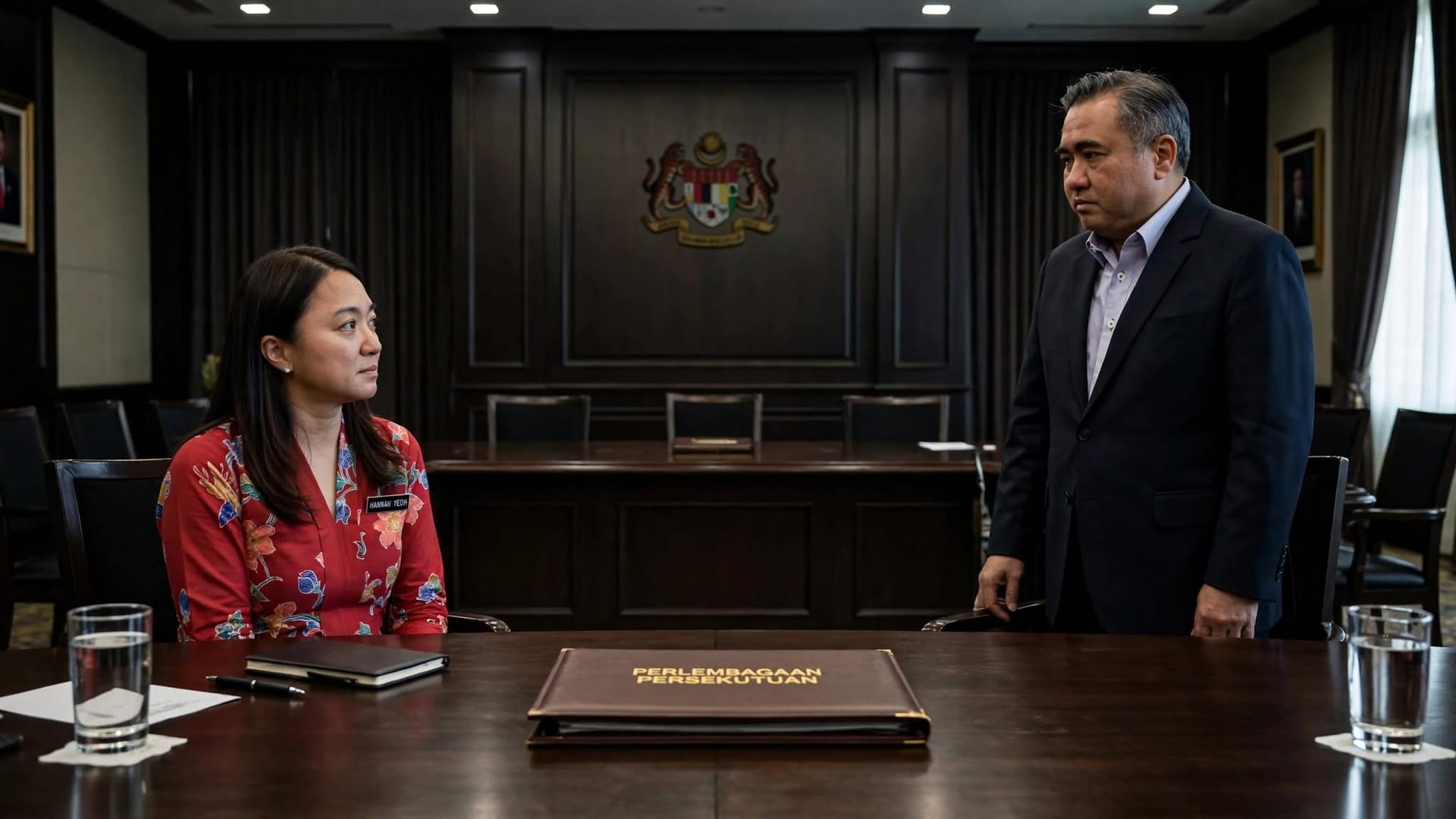
When a political movement builds its identity on anti-corruption, reform, and uncompromising institutional integrity, its leaders are rarely judged by the speeches they give on campaign trails. They are judged by what they do when they sit in the rooms where power is exercised.
This is the uncomfortable reality currently facing Minister in the Prime Minister’s Department (Federal Territories), Hannah Yeoh. Unlike her Cabinet colleagues who can observe controversial executive outcomes from a comfortable administrative distance, Yeoh holds a unique, legally defined seat on the Federal Territories Pardons Board. She was in the room. She was privy to the deliberations, the pressures, and the push for clemency regarding former Prime Minister Datuk Seri Najib Razak.
When a decision of such monumental gravity occurs one that directly touches on national integrity and the rule of law hiding behind collective party decisions or constitutional secrecy does not shield a minister’s credibility; it erodes it.
If a leader recognizes that a prospective outcome violates the fundamental principles upon which their mandate was built, the time to act is before the gavel falls. To voice dissent early, to challenge the trajectory, or even to tender a resignation as a matter of principle before a compromise is finalized preserves moral authority. Credibility is not maintained by managing the fallout after the fact; it is defined by the courage to draw a line in the sand when the outcome is still in the balance.
Instead, the political response has been a masterclass in institutional hedging. The declaration that the Democratic Action Party’s (DAP) Central Executive Committee (CEC) has made a final decision binding its ministers to stay the course frames political survival as party discipline. It asks the electorate to accept that collective strategy supersedes individual moral responsibility. But voters do not cast ballots for party committees; they vote for principles and the leaders pledged to uphold them.
This dynamic becomes even more stark when contrasted with Transport Minister Anthony Loke’s symbolic offer to resign. Having a single party leader step forward to take the political heat allows the broader Cabinet machinery to continue uninterrupted. But to the public, a singular, controlled sacrifice feels less like an act of principled protest and more like calculated political containment. If a decision fundamentally compromises a party’s core promises on accountability, relying on one individual to bear the burden while others remain in office signals that holding power has become higher priority than holding the line.
The argument that remaining in Cabinet is necessary to preserve administrative stability or maintain representation falls flat when principles are traded away in the process. Political leverage is only meaningful if a party is willing to use it. When leaders repeatedly defer to expediency, the promise of reform transforms into empty rhetoric.
When the dust settles, history does not measure leaders by the procedural shields they used to justify their silence. It measures them by whether they had the conviction to stand firm when their core values were put to the test. Holding a seat at the highest tables of governance is a privilege granted by public trust and when that trust is compromised for the sake of political quietude, no committee decision can restore what was surrendered.
When power requires you to compromise the very principles that brought you to the table, staying silent isn't governance it is capitulation. - Annan Vaithegi
Annan Vaithegi (annanvaithegi@icloud.com) is a content creator under the Newswav Creator programme, where you get to express yourself, be a citizen journalist, and at the same time monetize your content & reach millions of users on Newswav. Log in to creator.newswav.com and become a Newswav Creator now!
The User Content (as defined on Newswav Terms of Use) above including the views expressed and media (pictures, videos, citations etc) were submitted & posted by the author. Newswav is solely an aggregation platform that hosts the User Content. If you have any questions about the content, copyright or other issues of the work, please contact creator@newswav.com.