
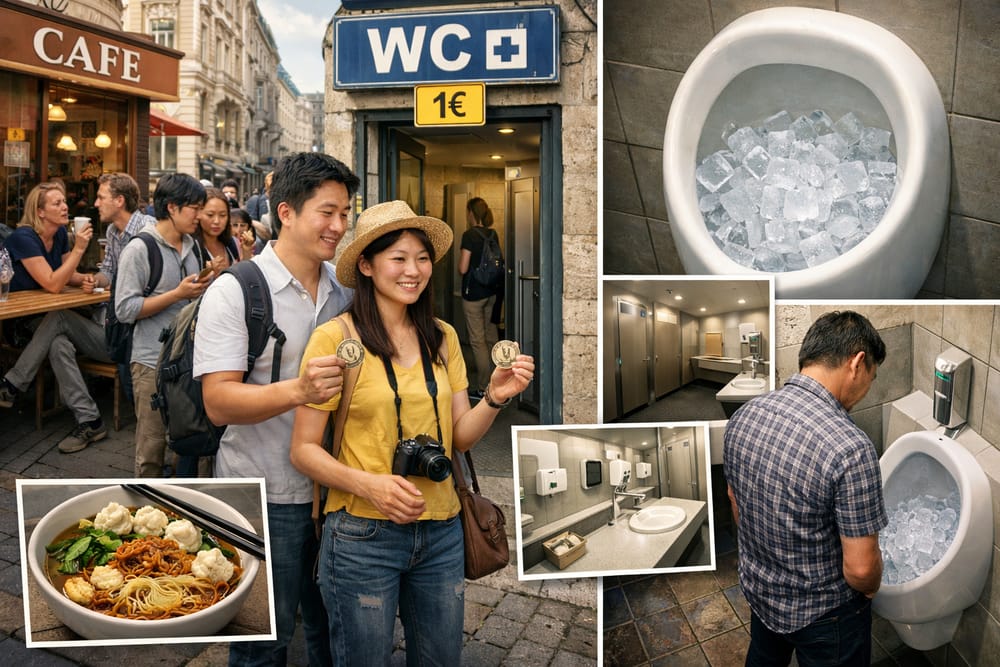
My friend returned from Europe with the usual stories—old buildings, long walks, beautiful cities. But the story he kept coming back to had nothing to do with museums or architecture. It involved his observation on the usage of toilets there.
In several European cities, he discovered that using a public toilet costs about one euro (RM4.77). One euro, in Ipoh, in Simee morning market, that same amount can buy you a decent bowl of wan tan noodles complete with soup and dignity. https://www.washingtonpost.com/travel/2024/07/03/paid-public-bathroom-europe. In Europe, it buys you a few quiet minutes behind a locked door and the privilege of flushing afterwards.
What made this even more interesting was his observation that it seemed Asians were far more willing to use these paid public toilets than Europeans themselves. While locals often appeared, at least to him, to hold on bravely or duck into cafés and petrol stations, Asian tourists queued up, coins in hand, apparently at peace with the transaction.
At first glance, this seemed puzzling. Why would visitors—already dealing with jet lag, foreign languages, and unfamiliar food—be more eager to pay for public toilets than the people who live there?
Then a rather logical explanation might be, In many East Asian cities such as Japan, South Korea, and Singapore, public toilets are everywhere. More importantly, they are clean. Sometimes impressively so. They come with proper doors, functioning locks, soap, toilet paper, and occasionally even background music. When toilets are free, plentiful, and well maintained, people may grow accustomed to using them without hesitation or strategic planning. https://en.nippon-foundation.or.jp/what/projects/communities/thetokyotoilet.
Asians travelling in Europe may simply be carrying this habit with them. When nature calls, you answer. You do not negotiate. You certainly do not wander around pretending you are “just looking” while secretly searching for a café. After all, when you’ve been on your feet all day, sightseeing from morning to night, your bladder has very little interest in in negotiations of any kind.”
Europeans, on the other hand, seem to have developed a different system. Toilets are often accessed through coffee purchases, petrol stops, or polite requests that may or may not be granted. The governments also actively encourages private businesses like food outlets to make their toilets available to the public for free. https://en.wikipedia.org/wiki/Community_toilet_scheme Paying one euro for a public toilet, while normal, is perhaps treated as a last resort—something to be avoided unless the situation becomes truly urgent. https://www.reddit.com/r/germany/comments/1eac6ew/paying_for_toilets.
So maybe the perception isn’t that Asians use public toilets more than Europeans; it’s that they’re simply less emotionally prepared to bargain with their bladder. When faced with a choice between paying one euro or suffering quietly, they choose efficiency—and dignity. After all, you can always earn back a euro. But once you miss the moment, no amount of wan tan noodles can save you.
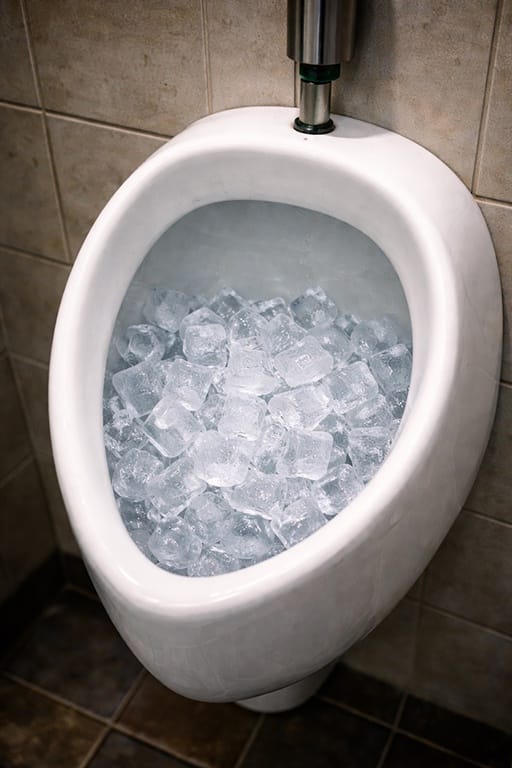
And speaking of global bathroom wisdom, Asia offers its own ingenious contributions. Travel through Thailand or Vietnam, and you might encounter a curiously refreshing sight in the men’s rooms in restaurants and cafes: urinals filled with ice cubes. At first glance, it looks like a misplaced cocktail station, but the reasoning is brilliantly practical. The ice acts as a natural odor controller—keeping the porcelain cold to slow the release of ammonia, while the meltwater provides a steady, quiet rinse.
But perhaps the real stroke of genius is behavioral. It turns out men, when presented with a glistening, shifting target, become unexpectedly focused marksmen. Splash and spill decline dramatically, because ice absorbs impact better than ceramic—transforming a mundane act into a game of gentle precision. It’s cheaper than chemicals, simpler than installing high-tech vents, and, let’s be honest, offers a moment of cool amusement in an otherwise warm and hurried place. Proof that sometimes the best solutions aren’t about grand infrastructure, but about understanding human nature—one ice cube at a time.
In the grand tapestry of travel, toilets are the threads we don’t boast about on Instagram. Yet, they shape our journeys more than any gallery or landmark. They test our resolve, our change purse, and sometimes our aim. So, let us toast—with a small, affordable bottle of water—to the unsung rest-stops of the world. May we find them in time, may they catch us in our moment of need, and may they leave us with just a story… and not a souvenir on our shoes.
Chris (protocall22@gmail.com) is a content creator under the Newswav Creator programme, where you get to express yourself, be a citizen journalist, and at the same time monetize your content & reach millions of users on Newswav. Log in to creator.newswav.com and become a Newswav Creator now!
The User Content (as defined on Newswav Terms of Use) above including the views expressed and media (pictures, videos, citations etc) were submitted & posted by the author. Newswav is solely an aggregation platform that hosts the User Content. If you have any questions about the content, copyright or other issues of the work, please contact creator@newswav.com.