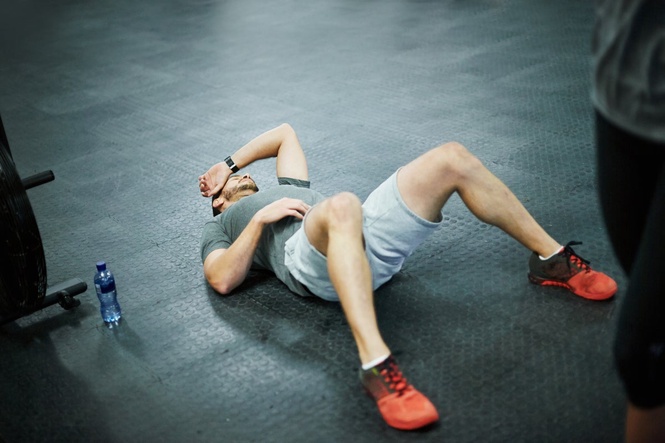
“I want to be unhealthy. And unfit. As unfit and unhealthy as possible, actually.”
I doubt you’ve ever heard anyone say this. I certainly haven’t. If anything, the opposite is true.
I walked down my street on recycling day this week and saw plastic boxes filled with protein shakes, supplement tubs, cardboard cartons from meal delivery services and more health-minded products.
Sign up for the Well Enough newsletter here
It cemented my belief that the vast majority of people want to be healthy and happy, and they’re putting a lot of time, money and effort into achieving it, which should be enough. Yet there is plenty of health data to suggest we’re moving in the other direction.
The 2024 health survey for England found that 66 per cent of adults were either overweight or living with obesity – up from 53 per cent in 1993. But body composition is just one of many signifiers of health.
Perhaps a bigger concern is that, despite an ageing population, the UK’s healthy life expectancy – that is, how long we can expect to live in good health – has fallen in recent years.
On a personal level, as a fitness journalist and coach, I speak to many people who are throwing the kitchen sink at getting fitter only to be left frustrated with a lack of results. But why?
That is the theme of this week’s newsletter.
I posed this question to independent sport and exercise scientist Dr Ash Cox, who raised an interesting point.
Recent Sport England data found the number of adults in the UK meeting government physical activity guidelines is actually on the rise, with the latest figure climbing to nearly two-thirds.
“People participating [in exercise] isn’t necessarily the issue,” he says. “It’s the environment.”
This applies on both the exercise and diet front. Humans, historically, needed to be active to survive – hunting, gathering, seeking out resources and suitable places to sleep. But in the modern world, movement is surplus to requirements.
We work desk jobs, drive home, then unwind from a stressful day with a spot of TV on the sofa, often ordering food on an app when too exhausted to cook. Sitting still is the common denominator.
A cost-of-living crisis also means many of us are working harder than ever with less cash to splash. We’re left with limited time, energy or money for exercise, with sports clubs and gym memberships often the first expenses to fall by the wayside as we look to conserve finances.
Then we walk into the supermarket to buy food, only to be faced with a barrage of more-ish snacks and packaging covered in tenuous health claims. In a time when money is tight, the most readily available and affordable food is often disproportionately energy-dense and low in genuine nutritional value.
Put plainly: modern life is a minefield, and no normal person could be expected to navigate it without taking a knock to their health.
At this point, I should make clear that nothing in here is accusatory. We’re all trying to be healthy, and we’re all playing this game with a significant handicap.
And while you can manipulate your environment slightly by filling your fridge with pre-chopped vegetables and leaving fitness kit around the house for exercise snacking, wholesale societal changes do not seem to be on the horizon.
So what should we do? Well, if there’s one thing I’ve found the human brain loves, it’s being part of something. Most people also enjoy being a tad rebellious. For that reason, I would like to invite you to join my mini movement revolution.
In it, we are not moving as punishment, or purely as a vehicle for changing the way we look. We are moving because it feels good, because everything is telling us not to, and we are squeezing it in whenever we can as a result.
This does not mean immediately running a marathon. Instead, we’re taking a more playful approach.
Whack on a song and dance while you’re cooking dinner; join in wholeheartedly with your kids’ games; run to the top of a hill, simply because you can; skip up the stairs while swerving the lift; balance on one leg while brushing your teeth; catch up with friends while chucking a frisbee around.
As Dr Cox advises: “All movement adds up. Do the school run on foot; take the stairs when you can, and do it with some intensity; move around the office.
“Dedicated exercise is such a small part of someone’s day, and it has to be squeezed in. But the biggest wins come from habitual physical activity. Put more movement into your life, and go about it with more intent.”
Add this to a nourishing diet – nothing puritanical, just prioritising fruits, vegetables and other foods your grandparents would generally find in their childhood kitchen – and you have a fairly straightforward recipe for better health.
In a world where complexity sells but delivers questionable results, I hope this helps!
Get the Well Enough newsletter
To receive Well Enough with Harry Bullmore, simply enter your email address in the box at the top of this page.
You can also head to our newsletter preference centre to sign up for the email.
Once there, all you need to do is press the ‘+’ button and enter your email address to sign up.