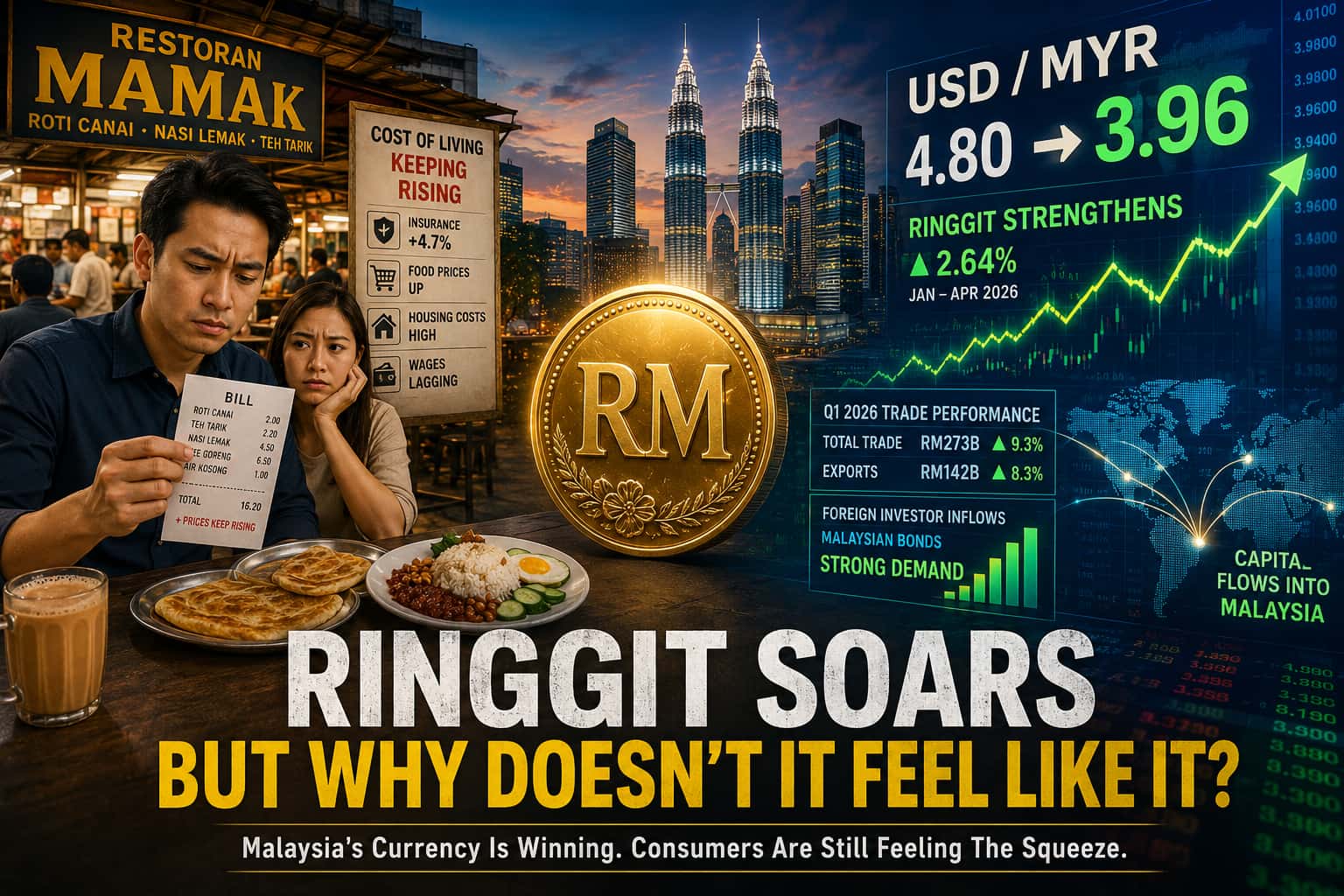
Here is a genuinely strange situation. The ringgit is currently one of Asia's best-performing currencies in 2026, ranking at the top of the regional table ahead of the Chinese yuan. Finance Minister II Datuk Seri Amir Hamzah confirmed just days ago at Invest Malaysia 2026 that Malaysia is outperforming a lot of other countries around the world on currency strength. The ringgit appreciated approximately 2.64% against the USD between January and April, trading around RM3.96 to 4.06 against the dollar as of early June.
Compare that to March 2024 when the ringgit touched 4.80 against the USD, its weakest level since the Asian Financial Crisis of 1998. The recovery over the past 14 months has been real, meaningful, and data-backed. Trade data from DOSM showed total trade in Q1 2026 growing 9.3% year-on-year to RM273 billion, with exports rising 8.3%. Foreign investors have been buying Malaysian bonds at significant volumes. The fundamentals are genuinely solid.
So why doesn't the average Malaysian feel this? Why does the standard of living conversation remain so dominated by cost pressure despite a strengthening currency?
The answer lies in the gap between what the ringgit does in international markets and what it does in your daily life in Petaling Jaya. Currency strength reflects macroeconomic confidence and capital flows. It helps Malaysians who buy imported goods, travel overseas, or repay USD-denominated debts. But insurance costs are still up 4.7%. Food prices at the mamak have been creeping upward since pre-pandemic years and haven't reversed. Housing costs in the Klang Valley remain structurally disconnected from median wages.
A stronger ringgit against the dollar makes your US-purchased gadget cheaper. It doesn't make your roti canai bill smaller. And for most Malaysians, roti canai is a much more daily economic data point than USD/MYR exchange rates.
(The above analysis is my personal interpretation of the relationship between macroeconomic indicators and lived economic experience. Economists may disagree on the transmission mechanisms.)
The narrative Malaysia needs to work on is bridging this gap: using the strong economic fundamentals that support the ringgit to drive real wage growth and reduce the cost pressures that ordinary Malaysians feel daily. The currency numbers are encouraging. The mamak bill is the real test.
My Opinion
I check the ringgit rate the way most people check their horoscope: with genuine interest and very little ability to do anything about it. What I want is for the macroeconomic strength to eventually show up in my grocery receipt. That's the transmission mechanism that actually matters to most Malaysians.
Ronny M (ronny76netstuff@gmail.com) is a content creator under the Newswav Creator programme, where you get to express yourself, be a citizen journalist, and at the same time monetize your content & reach millions of users on Newswav. Log in to creator.newswav.com and become a Newswav Creator now!
The User Content (as defined on Newswav Terms of Use) above including the views expressed and media (pictures, videos, citations etc) were submitted & posted by the author. Newswav is solely an aggregation platform that hosts the User Content. If you have any questions about the content, copyright or other issues of the work, please contact creator@newswav.com.