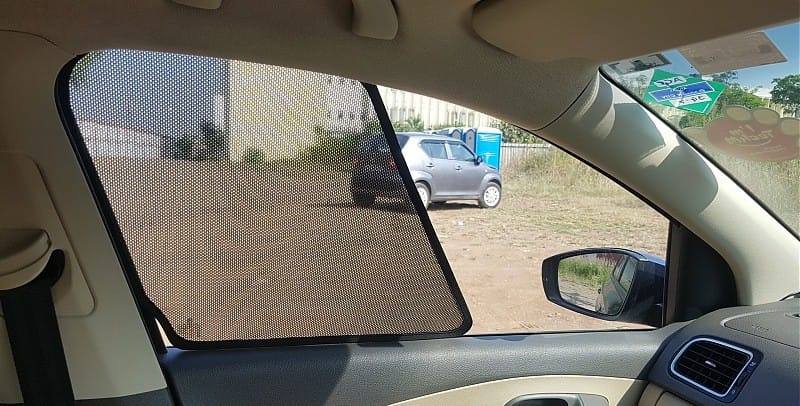
Picture the scene: it is 3:15 PM on a Tuesday along the absolute gridlock of the Federal Highway. The tropical sun is beating down with a fierce, unforgiving intensity, turning the asphalt into a shimmering mirage and transforming the interiors of thousands of localized sedans and hatchbacks into claustrophobic greenhouses. Sweat beads on the foreheads of exhausted commuters as air conditioning units struggle violently against the ambient heat. In a desperate bid for immediate relief, a driver reaches into the glove box, pulls out a pair of cheap, collapsible mesh sunshades, and slaps them onto the driver-side and front passenger windows. It feels like an instant victory against the elements a quick, harmless DIY hack to survive the daily grind.
Yet, this small act of climate self-defense can instantly turn into an expensive legal headache. Many Malaysian motorists remain completely unaware that this exact action can attract an immediate fine of up to RM300 from the Road Transport Department (JPJ). According to an official investigation carried out by the national fact-checking platform MyCheck Malaysia, mounting temporary blinds, suction-cup curtains, or cloth screens on the front lateral windows constitutes a explicit traffic offense under Malaysian law.
The enforcement architecture is unambiguous. This specific restriction falls under Section K 4(1) of the Motor Vehicles (Prohibition of Certain Types of Glass) Regulations 1991. Within the internal regulatory databases of the JPJ, it is cataloged as offense number 245. Under standard enforcement procedures, the compound structure is progressive: a fine starts at RM150 if settled within 15 days, climbs to RM200 between 16 and 30 days, and reaches its absolute maximum of RM300 if left unpaid up to 60 days. For the average urban commuter, what seemed like a minor accessory purchase from an online shopping platform can rapidly spiral into a substantial financial penalty.
The Institutional Standpoint on Visibility and Crime Prevention
The strict prohibition against temporary curtains and blinds is not an arbitrary exercise in bureaucratic overreach; it is rooted deeply in fundamental automotive engineering and public safety principles. Institutional analysis indicates that the primary hazard of these movable fabrics is the sudden, severe restriction of a driver's peripheral field of vision. Unlike premium engineered window tints that filter out infrared and ultraviolet rays while preserving structural transparency, physical blinds act as opaque or semi-opaque blocks. They dramatically expand a vehicle's inherent structural blind spots, making it exceptionally difficult to spot lane-splitting motorcyclists or pedestrians navigating complex urban junctions.
From an institutional perspective, the safety parameters governing what can and cannot be placed on vehicle glass are meticulously defined. The JPJ maintains distinct Visible Light Transmission (VLT) benchmarks for all private passenger vehicles. As outlined by the department's historical regulatory updates comprehensively detailed by automotive portals like Paultan.org, a vehicle’s front windscreen must always maintain a minimum of 70% VLT, while the front side windows flanking the driver and front passenger must achieve at least 50% VLT. While the regulations were relaxed to allow unrestricted darkness for rear side windows and the rear windscreen provided the car has functioning dual side mirrors the front cockpit remains heavily protected.
The structural danger of curtains is compounded by the fact that they are completely unmetered. While a traffic officer can utilize a calibrated digital photometer to measure whether a permanent window tint complies with the 50% VLT rule, a physical fabric shade completely invalidates the measurement process by blocking light transmission entirely. Authorities note that these temporary items drastically reduce situational awareness, especially during sudden downpours or when entering poorly lit basement parking structures across Klang Valley shopping malls.
Furthermore, historical policy declarations from the JPJ’s Automotive Engineering Department reveal that the ban on curtains and blinds serves a dual purpose linked directly to national crime prevention. Darkened, curtained vehicle interiors prevent law enforcement officers from conducting visual inspections during routine roadblocks or high-security checks. When an enforcement officer cannot see the occupants of a vehicle, it compromises tactical safety and creates operational blind spots that can be exploited for criminal activities, ranging from text-and-drive infractions to high-stakes human tracking or illicit transport. This reality has forced a unified enforcement front. As confirmed by the Kuala Lumpur Traffic Investigation and Enforcement Department, both regular police units and JPJ officers possess the concurrent legal authority to issue summonses for this specific offense.
The Compounding Risks of Legal Conviction and Insurance Defiance
While an individual roadside encounter with a JPJ officer usually results in a standard RM300 compound fine, the legal architecture allows for significantly harsher penalties if an offender chooses to contest the matter or is formally prosecuted in a court of law. As reported by national media outlets like Free Malaysia Today, first-time offenders convicted in court for serious window compliance violations face maximum statutory fines of up to RM2,000 or an explicit prison sentence of up to six months. For repeat offenders, the legal stakes double immediately, rising to an RM4,000 fine, up to 12 months of imprisonment, or both.
Beyond the immediate domain of criminal statutes and roadside summonses, the use of temporary blinds and unapproved window blockages introduces an entirely separate layer of financial risk: the potential invalidation of private motor insurance claims. Modern insurance frameworks operate on the foundational legal doctrine of uberrimae fidei, commonly known as the principle of utmost good faith. Under this framework, a policyholder is legally obligated to maintain their vehicle in a fully roadworthy condition and disclose any material changes or non-compliant modifications that could alter the vehicle's baseline risk profile.
According to an industry analysis by insurance and risk-advisory group PolicyStreet, if a vehicle equipped with temporary blinds or illegal window blockages is involved in an accident, the insurer’s claims department will launch a detailed investigation into the physical state of the vehicle. If the post-accident assessment or police report indicates that the driver's visibility was actively compromised by unapproved temporary curtains or mesh screens, the insurance firm has substantial legal grounds to challenge or completely deny the payout.
The insurer can logically argue that the policyholder willfully operated a vehicle with compromised visibility, thereby directly increasing the probability of a collision. In the event of a severe accident involving major property damage or personal injury liabilities, having a claim rejected due to a cheap, unapproved sunshade can lead to immediate, devastating financial ruin for an ordinary Malaysian family.
What do you think? I’d love to hear your opinion in the comments section.
As the sun continues to bake the peninsula's expanding highway networks, the tension between personal comfort and absolute regulatory compliance shows no signs of slowing down. The ongoing public conversation around window visibility highlights a broader societal challenge: how to effectively balance the immediate, physical needs of drivers working in a harsh tropical climate against the collective, unyielding demands of public road safety and institutional crime prevention.
While the desire to shield oneself and one's passengers from blinding sunlight and intense cabin heat is completely understandable, opting for unregulated, vision-blocking shortcuts like temporary curtains and suction-cup blinds represents a clear hazard to everyone sharing the road. The hard truth remains that a split-second reduction in peripheral vision is all it takes to trigger a catastrophic accident, transforming a routine daily drive into an absolute tragedy.
True road safety requires us to re-evaluate our driving habits and prioritize structural visibility over quick, cheap comfort fixes. It demands that we understand that the rules governing our vehicles are designed to protect the fragile ecosystem of our public roads. Ultimately, surviving the tropical heat cannot come at the expense of ignoring the law or endangering human lives.
It is highly likely that you, or someone you care about, currently has a pair of these common mesh shades tucked into a door pocket, ready to be used during the next intense heatwave. It is a small choice that carries surprisingly heavy consequences.
AM World (tameer.work88@gmail.com) is a content creator under the Newswav Creator programme, where you get to express yourself, be a citizen journalist, and at the same time monetize your content & reach millions of users on Newswav. Log in to creator.newswav.com and become a Newswav Creator now!
The User Content (as defined on Newswav Terms of Use) above including the views expressed and media (pictures, videos, citations etc) were submitted & posted by the author. Newswav is solely an aggregation platform that hosts the User Content. If you have any questions about the content, copyright or other issues of the work, please contact creator@newswav.com.