
Malaysia has always had a strange talent for waiting until a small fire becomes a national inferno before searching for a fire extinguisher.
For years, issues involving houses of worship, land ownership, relocation disputes, and religious sensitivities were handled through improvisation, political bargaining, selective intervention, or emotional damage control after tensions exploded publicly. One week it is a temple relocation controversy. Another week it is a sermon, a social media outrage, or politicians competing to sound “protective” of religion while quietly inflaming public distrust.
Now, the Unity Government says it wants to change that.
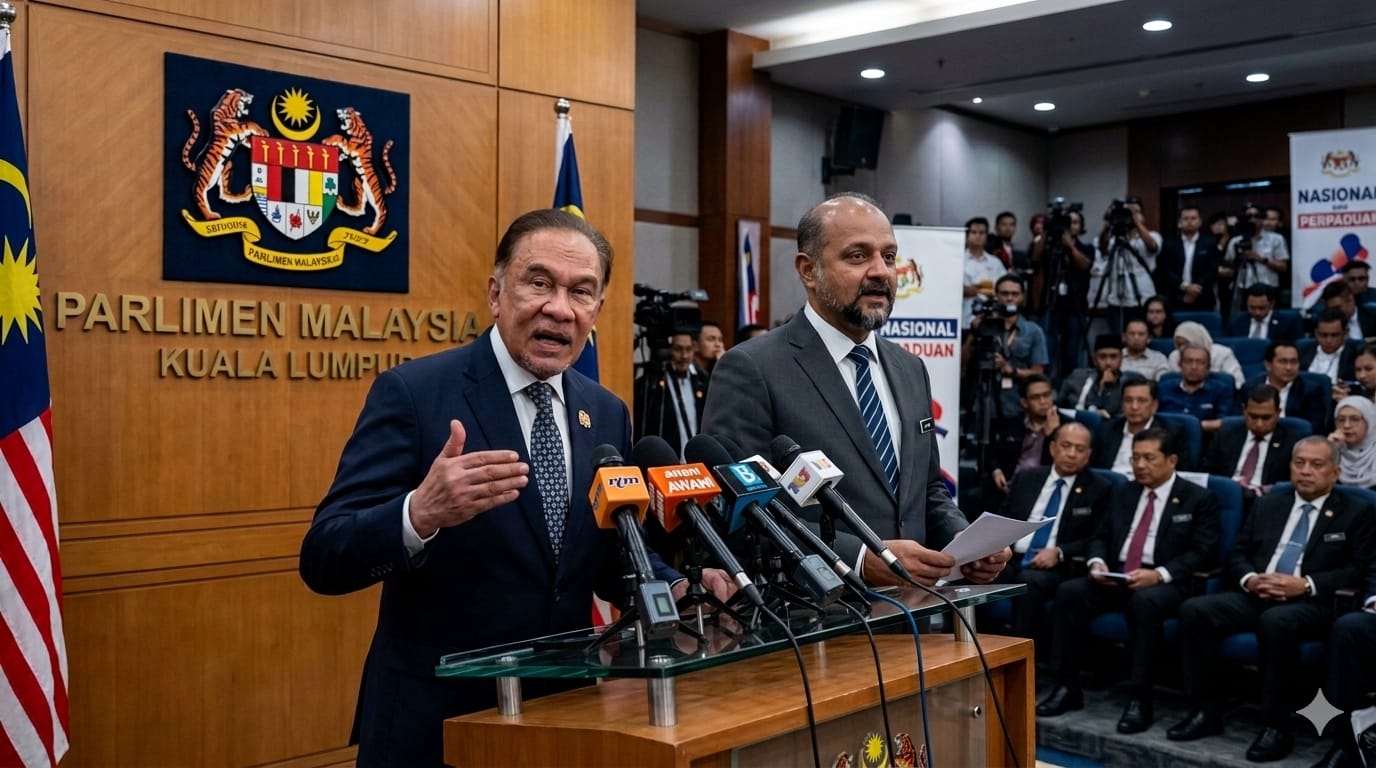
With Gobind Singh Deo announcing a cabinet-approved three-tier coordination process involving federal, state, and local authorities for handling houses of worship, the government is attempting something Malaysia has long avoided: turning deeply emotional religious disputes into structured administrative matters.
At almost the same time, Prime Minister Anwar Ibrahim called for “firmness tempered with respect” in handling racial and religious tensions.
Together, these two developments reveal the government’s emerging strategy: centralise the process, standardise the rules, reduce vigilantism, and remove politically motivated improvisation from sensitive religious matters.
At least, that is the theory.
From firefighting to framework
The real significance of the new three-tier mechanism is not merely bureaucratic. It represents an admission that Malaysia’s traditional way of handling religious disputes has failed.
For decades, too many cases were resolved through:
- informal negotiations,
- political pressure,
- inconsistent enforcement,
- selective tolerance,
- or last-minute “settlements” once public anger erupted.
This created two dangerous perceptions.
First, that enforcement depends on who is involved. Second, that the loudest group eventually wins.
That is why the proposed coordination system matters. In principle, standardising approvals, land matters, relocation procedures, and dispute resolution could reduce accusations of double standards.
And in a multicultural country, consistency matters as much as compassion.
Because once citizens believe rules are unevenly enforced, every religious issue stops becoming administrative and starts becoming emotional.
Anwar’s middle path law with restraint
Anwar Ibrahim’s call for “tempered firmness” is politically interesting because it attempts to balance two competing realities.
On one side, the state cannot appear weak in enforcing laws involving land, planning, or public order.
On the other, Malaysia is not a mono-ethnic society where blunt enforcement carries no social consequences. Every careless statement, every uneven action, and every perceived double standard risks widening distrust between communities.
The Prime Minister appears to be searching for a middle path:
- enforce the law,
- but avoid humiliation,
- maintain order,
- but avoid polarization,
- preserve authority,
- while still respecting diversity.
In theory, this is the correct approach.
But theory is easy. Malaysia’s problem has never been slogans. It has always been consistency.
The rakyat’s real frustration is not policy it is selective confidence
Public reactions to the Prime Minister’s remarks reveal a deeper trust crisis.
Many Malaysians no longer judge leaders only by speeches. They judge them by who gets investigated, who gets ignored, who gets warned, and who appears politically untouchable.
That is why comments online are filled with accusations of:
- double standards,
- selective enforcement,
- different messages for different audiences,
- and political flexibility depending on electoral needs.
Whether fair or unfair, these perceptions are politically dangerous because they show the rakyat no longer separates rhetoric from enforcement.
When inflammatory remarks by certain figures appear tolerated while minority concerns are met with faster administrative action, people stop debating policy details and start questioning institutional sincerity.
That is the real challenge facing the Madani government. Not communication. Not branding. But credibility.
Can administration depoliticise religion?
This is where Gobind’s three-tier process faces its biggest test.
Can a standardised administrative mechanism truly depoliticise race and religion in Malaysia?
Or will it eventually collide with political realities at the state and local level?
Land matters remain heavily tied to state authority. Local councils operate differently across the country. Religious sensitivities vary enormously between regions.
Which means even the best federal framework can still be weakened by:
- inconsistent state cooperation,
- political pressure,
- local resistance,
- or fear of backlash from vocal groups.
Malaysia’s history shows that informal influence often overrides formal process.
And that is precisely why this reform matters.
If implemented properly, it could finally move sensitive religious disputes away from mob pressure, emotional politics, and opportunistic politicians.
If implemented poorly, it risks becoming another impressive-sounding framework that collapses during the first major controversy.
The danger of vigilantism and emotional politics
Perhaps the most important aspect of the government’s new direction is its apparent attempt to reduce vigilantism.
In recent years, Malaysia has seen too many individuals, groups, influencers, and political actors behaving as though they personally own the authority to define patriotism, morality, or religious legitimacy.
This is dangerous.
Once unofficial actors begin policing religion through intimidation, outrage campaigns, threats, or public humiliation, institutions themselves begin to weaken.
A functioning nation cannot allow:
- online mobs to replace due process,
- politicians to weaponise faith for relevance,
- or self-appointed guardians to inflame tensions for attention.
That road leads not to stability, but permanent suspicion.
Protecting minority rights requires clear rules, not emotional promises
One uncomfortable truth Malaysia must face is this:
Minority rights cannot depend solely on political goodwill.
They must be protected through:
- transparent procedures,
- equal enforcement,
- documented approvals,
- lawful land allocation,
- and predictable administrative standards.
This is why many Malaysians are asking a simple question:
If suraus and mosques are planned systematically in developments, why are non-Muslim houses of worship often left to decades of uncertainty, temporary arrangements, or reactive negotiations?
That question cannot be dismissed as provocation. It is a governance question.
And governance questions require institutional answers.
The real test begins now
The Unity Government’s latest initiative may genuinely represent an attempt to move Malaysia away from reactive politics toward structured governance.
But Malaysians have heard promises before.
The public no longer wants symbolic reassurance. They want evidence that:
- rules apply evenly,
- enforcement is impartial,
- extremists are restrained regardless of affiliation,
- and no community is treated as politically expendable.
Because in the end, social harmony is not sustained by speeches alone.
It survives when citizens believe the system protects everyone fairly.
And that belief can never be built through sentiment alone. It must be built through law, consistency, professionalism, and courage.
Annan Vaithegi crafts socially conscious and politically grounded commentary that explores the tensions between governance, identity, and public trust because in a multicultural nation, leadership is measured not only by power, but by fairness, restraint, and the courage to govern consistently.
Annan Vaithegi (annanvaithegi@icloud.com) is a content creator under the Newswav Creator programme, where you get to express yourself, be a citizen journalist, and at the same time monetize your content & reach millions of users on Newswav. Log in to creator.newswav.com and become a Newswav Creator now!
The User Content (as defined on Newswav Terms of Use) above including the views expressed and media (pictures, videos, citations etc) were submitted & posted by the author. Newswav is solely an aggregation platform that hosts the User Content. If you have any questions about the content, copyright or other issues of the work, please contact creator@newswav.com.