
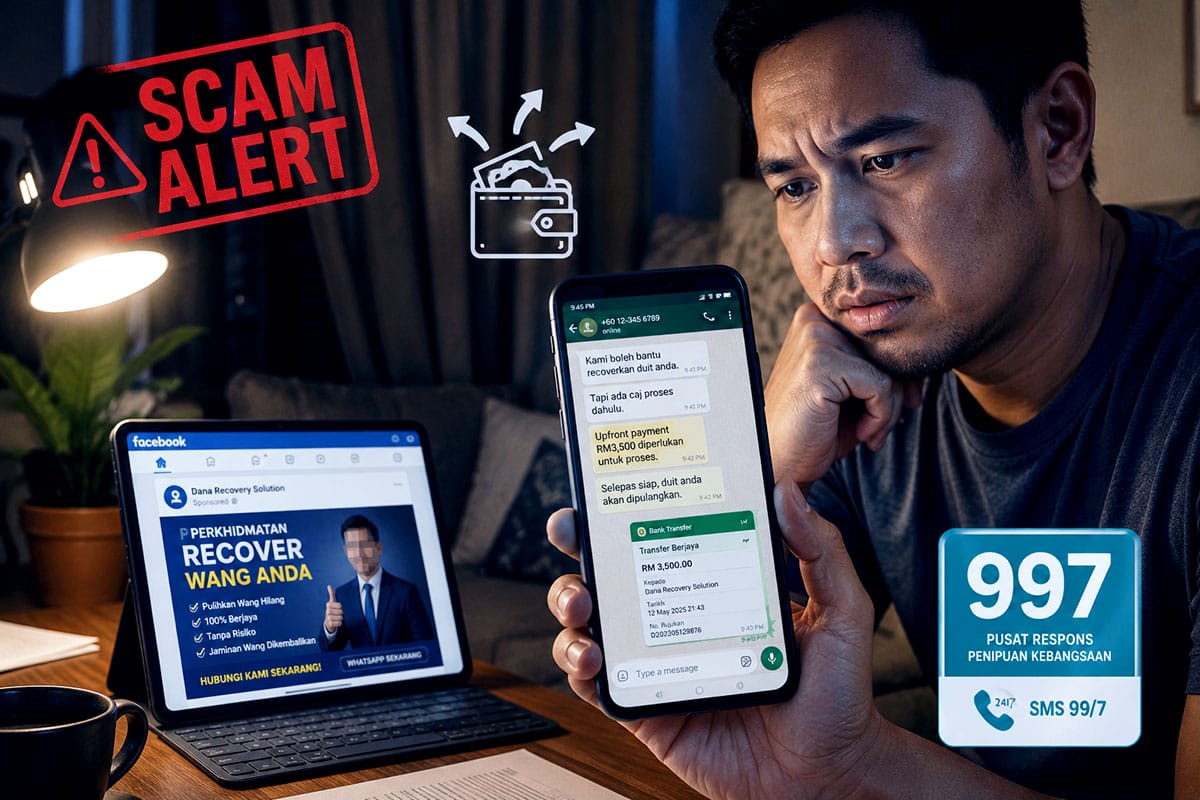
Some Malaysians who just lost money to a scam are about to lose it again. Not from the same criminal necessarily, but from someone who saw them coming from a mile away, precisely because they had already been scammed once.
Bukit Aman's Commercial Crime Investigation Department has flagged a modus operandi that deserves far more attention than it's getting. Scammers are now deliberately hunting fraud victims a second time, this time posing as the people who are supposed to help them.
What The Police Actually Found
According to JSJK director Rusdi Mohd Isa, the syndicate impersonates representatives of the National Scam Response Centre, the actual government body Malaysians are told to call when they've been defrauded. Between 2025 and March 2026, six such cases were reported, adding up to RM68,491 in fresh losses, on top of whatever these victims had already lost the first time around.
The pattern, as reported by Malay Mail, starts on Facebook. The syndicate runs ads promoting fund recovery services, then moves the conversation to WhatsApp once someone bites. From there, the pitch is simple: they claim to have the expertise to recover your stolen money, but they need an upfront payment first. Victims are then told to send money to several different bank accounts, one after another, each time believing this is the final step before their funds come back. No refund ever arrives. Instead, they're asked for more. Cases have already surfaced in Selangor, Kuala Lumpur, Johor and Terengganu, and there's no reason to assume it stops there.
Why A Scam Victim Makes The Easiest Second Target
This isn't random opportunism. It's a calculated bet on human psychology, and it's a bet that keeps paying off.
Research on recovery scams, including AARP's reporting on the pattern, points to something uncomfortable: once you've been scammed, you're statistically more likely to be scammed again, not less. Shock, grief, shame and financial panic all hit at once, and that combination narrows a person's judgement exactly when they need it most. When someone shows up promising to make the loss disappear, hope overrides caution in a way it normally wouldn't.
There's also a colder, more mechanical reason victims get targeted twice. Once your details surface in one scam, they're valuable to other criminals precisely because you're a proven responder, someone who has already shown they'll follow instructions and send money under pressure. That data doesn't just vanish after the first scam ends.
The Staged Payments Are Doing The Damage
The detail that stands out most in the police report is the multiple payments to different bank accounts. This isn't sloppy scamming, it's deliberate. A single large upfront demand would trigger suspicion immediately. A smaller first payment, framed as processing or admin fees, gets a foot in the door. Once someone has paid once and been told they're almost there, walking away suddenly feels like giving up on money they've already spent trying to get back. Each additional request looks like the last one standing between them and their funds, and each one is easier to justify than the first, because backing out now would mean admitting the earlier payment was wasted too.
This is exactly the desperation a first scam creates. Someone who lost their savings once isn't thinking clearly about probabilities. They're thinking about the fastest way to undo a mistake that's already cost them dearly, and that's precisely the emotional state a recovery scammer is built to exploit.
The Real Recovery Service Doesn't Charge You Anything
Here's the distinction that should end this scam the moment someone hears it: NSRC doesn't charge a fee. Ever. According to NSRC's own guidance, the centre, the police, Bank Negara and your bank will only ever contact you after you've made a report to them, not the other way around, and none of them will ask for banking passwords, PINs, TAC or OTP codes, let alone an upfront service fee to "unlock" your stolen funds.
If you've been scammed, the actual process costs you nothing beyond a phone call. Contact your bank's 24-hour hotline or call NSRC at 997, available daily from 8am to 8pm, as soon as you realise money has moved without your consent. Follow that with a police report within 24 hours, since NSRC cannot act without one. Speed matters here because the realistic chance of freezing stolen funds shrinks fast, but nobody legitimate will ever ask you to pay them first to try.
My Take
What gets me about this particular scam isn't the technical sophistication, there isn't much. It's the cruelty of the timing. These syndicates aren't picking targets at random, they're specifically going after people at the exact moment they're most frightened, most ashamed, and most willing to believe a stranger who says they can fix it. That's a colder kind of criminal than the one who tricks you the first time.
I haven't personally seen this scam land on anyone close to me, and I'm genuinely relieved about that. But the lesson here doesn't need a personal story to matter. If you or anyone in your family has ever lost money to fraud, the rule going forward is simple and non-negotiable: nobody who can genuinely help you will ever ask you to pay them first. Not the police, not the bank, not the NSRC. The moment a "recovery agent" asks for an upfront fee, you're not talking to someone who can undo the first scam. You're already inside the second one.
Kamarul Azwan (k.azwan@gmail.com) is a content creator under the Newswav Creator programme, where you get to express yourself, be a citizen journalist, and at the same time monetize your content & reach millions of users on Newswav. Log in to creator.newswav.com and become a Newswav Creator now!
The User Content (as defined on Newswav Terms of Use) above including the views expressed and media (pictures, videos, citations etc) were submitted & posted by the author. Newswav is solely an aggregation platform that hosts the User Content. If you have any questions about the content, copyright or other issues of the work, please contact creator@newswav.com.
