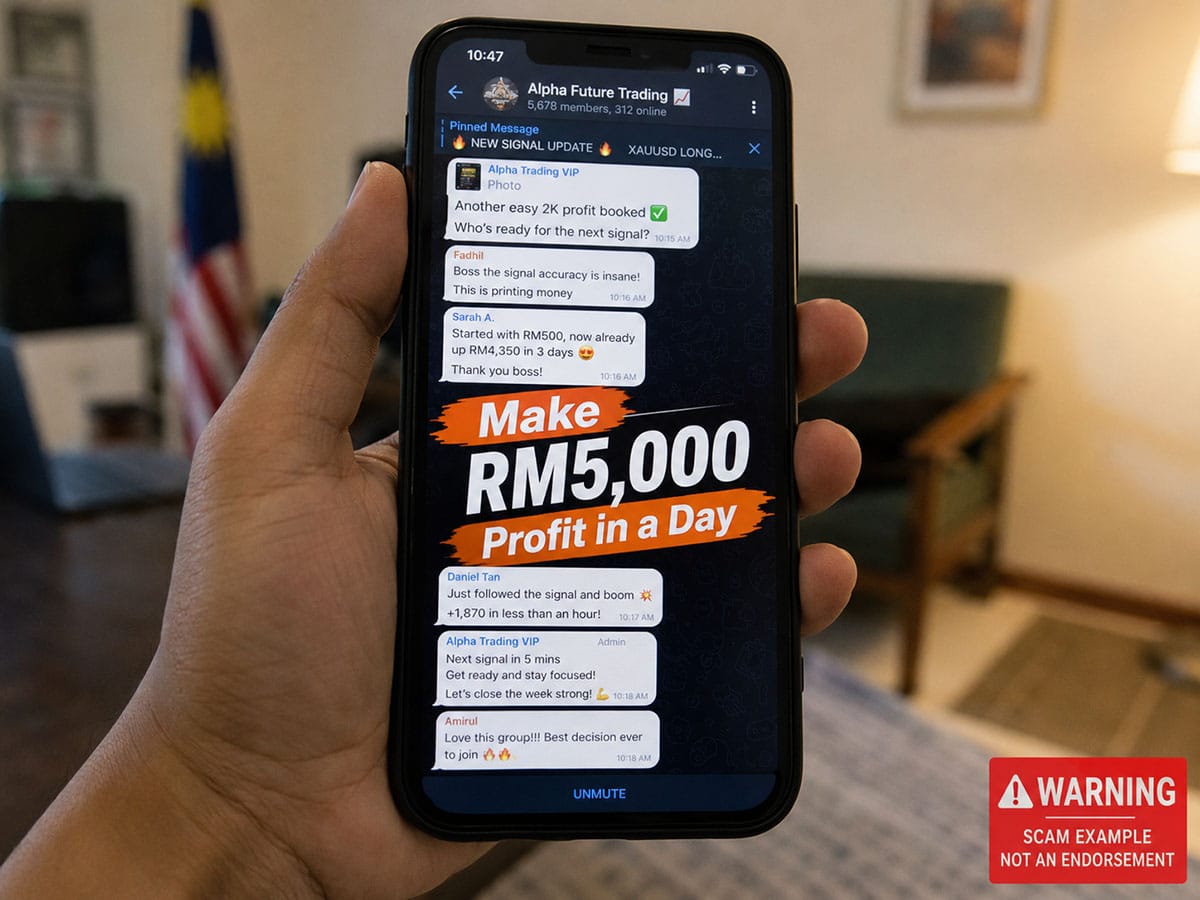
The early win is exactly what convinces you the next round will be bigger.
I put RM200 into a trading app once, one of those slick mobile platforms that made currency trading look as simple as ordering food delivery. This wasn't completely foreign territory for me either. Years earlier, an old job had actually trained me to read candlesticks, spot trending movements, and time a buy or sell off those patterns. So I went in with a bit of real technical grounding, not none at all.
Within a week I was up RM100. I remember feeling briefly clever about it, like the old skill still had some life in it. The following week, one wrong call wiped out the lot, my original RM200 and the profit both. Knowing how to read a chart, it turns out, isn't the same as knowing the platform you're reading it on, or being disciplined enough to walk away once emotion creeps into the decision.
I got off lightly. RM200 stings, but it doesn't ruin you, and having some background in it meant I at least understood what had actually gone wrong. A friend of mine wasn't so lucky, and had far less to fall back on when it went sideways. He's been chasing MLM and networking-style opportunities for years, and the last one pulled him into cryptocurrency.
It gave him tens of thousands in returns early on, which is exactly the problem, because that early win is what convinced him the next round would be even better. He's since lost more than RM10,000, possibly a fair bit more. I keep telling him the same thing every time a new "opportunity" comes along, and he keeps finding reasons why this one is different.
The real cost isn't just the money you lose
Here's the thing about being data poor before you sign up for something, whether it's an investment scheme, an insurance add-on you didn't fully understand, or a side hustle "opportunity" someone pitched you over kopi. The real cost isn't only the ringgit that disappears. It's the time you spent chasing it, the trust you handed to a stranger on Telegram, and the quiet erosion of your own judgement every time you tell yourself "just this once" felt different enough to skip the homework.
And the numbers show this isn't a fringe problem anymore. According to police figures reported by Malay Mail, Malaysians lost RM1.47 billion to investment fraud in 2025 alone, across 9,603 reported cases, up sharply from RM848.6 million the year before.
The pattern the police describe is eerily close to what happened to my friend: victims get pulled from social media into a Telegram or WhatsApp group run by "professional traders," shown fabricated profits on a fake platform, and only hit a wall when they try to withdraw, at which point they're told to pay more fees just to unlock their own money.
Working adults aged 41 to 50 got hit hardest, followed closely by the 51 to 60 group, which tells you this isn't just younger people being naive online. It's anyone who lets a good early result override their better judgement.
Even I got added to a few Telegram groups out from nowhere and those people in it, talked about how they are making profits from a simple initial investment of RM100 at minimum. They even screenshot their own banking accounts to show their “profits” that can happen within a trading day. I was enticed, of course. But because my spider sense is tingling, I always do my research first. I ended up reported, deleted and exiting the group soon after.
Why we skip the research in the first place
Nobody sits down and consciously decides to skip due diligence. It happens because the pitch is designed to move faster than your caution can catch up. There's a friend or relative vouching for it. There's a screenshot of someone else's profit. There's a countdown or a limited slot creating urgency. By the time you'd normally start asking questions, you've already transferred the money, because asking questions felt like it would slow down an opportunity that "won't wait." That urgency is the tell, not a coincidence.
Insurance add-ons work on a milder version of the same pattern. An agent bundles in a rider during a routine renewal call, explains it in thirty seconds, and most people say yes because saying no feels like more effort than it's worth in the moment. A year later you're paying for coverage you don't fully understand and have never once used, simply because nobody paused long enough to ask what it actually does.
It's not fraud, nobody's trying to trick you, but the outcome rhymes with the investment scam story anyway, money leaving your account every month for something you never properly evaluated before agreeing to it.
My take
Check if it's actually licensed and registered before a single ringgit changes hands. Malaysia's Securities Commission runs a free Investment Checker where you can search any individual or entity and see immediately whether they're authorised to offer investment products here, or whether they're already sitting on the Investor Alert List as a known problem. It takes two minutes. Compare that to the weeks or years some people spend trying to claw back money from something that was never legitimate in the first place.
That's the boring, unglamorous truth about avoiding these traps. It's not about being smarter than the scammers, most of these schemes are run by people who are genuinely good at what they do. It's about being willing to spend five minutes checking before you spend RM200, or RM10,000, finding out the hard way.
My friend still hasn't fully learned that lesson, and I doubt one article changes that on its own. But I keep having the same conversation with him because the alternative, saying nothing and watching him walk into the next one, feels worse. If you've got a friend doing the same thing right now, chasing a return that sounds too good because the first round genuinely paid out, send them this before they send anyone their next transfer. I'm hoping writing this down helps at least one person catch their own RM200 moment before it turns into someone else's RM10,000 one.
Kamarul Azwan (k.azwan@gmail.com) is a content creator under the Newswav Creator programme, where you get to express yourself, be a citizen journalist, and at the same time monetize your content & reach millions of users on Newswav. Log in to creator.newswav.com and become a Newswav Creator now!
The User Content (as defined on Newswav Terms of Use) above including the views expressed and media (pictures, videos, citations etc) were submitted & posted by the author. Newswav is solely an aggregation platform that hosts the User Content. If you have any questions about the content, copyright or other issues of the work, please contact creator@newswav.com.