
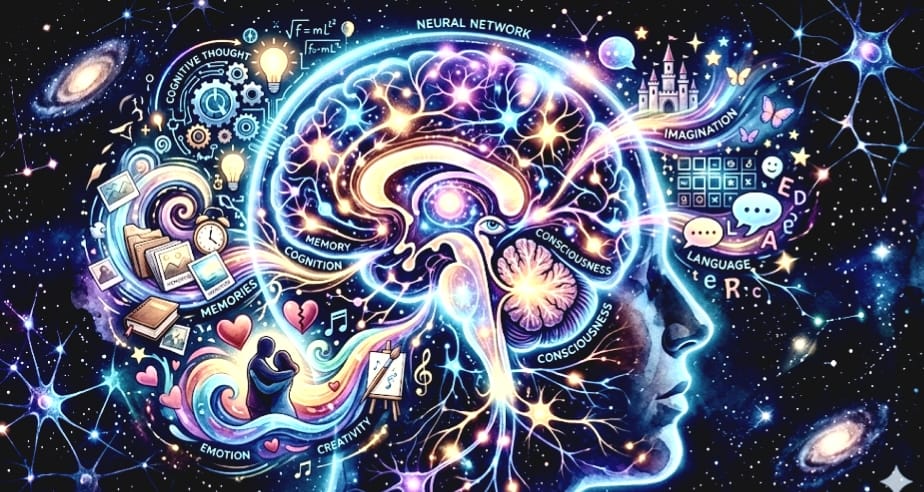
Most of the things that happened in our brain are not under our control.
The human mind is arguably the most sophisticated piece of hardware in the known universe, yet it operates with the logic of a haunted house. We like to think of ourselves as rational pilots steering a logical vessel, but a closer look at our internal architecture suggests we are more like passengers on a ship where the engine room speaks a language we don't understand, and the navigator is prone to vivid hallucinations.
The Illusion of Continuity
Perhaps the strangest feature of the mind is the illusion of the "Self." We feel like a singular, consistent entity traveling through time. However, neuroscience suggests the mind is actually a collection of competing modules.
There is no "central command" where a tiny version of you sits at a desk. Instead, your brain is a cacophony of impulses—hunger, memory, fear, and ambition—all shouting at once.
The "Self" is simply the narrator that steps in after the fact to weave these disparate impulses into a coherent story.
We don't act because we decide;
we often act and then invent a reason why we did it.
The Filter of Reality
We do not see the world as it is; we see a simulated version that our brain deems useful for survival.
Sensory Compression:
Our eyes and ears capture only a fraction of the available data. The brain then fills in the "blind spots" with guesswork.
Cognitive Biases:
We are hardwired to find patterns in chaos, leading us to see faces in clouds or conspiracies in coincidences.
Time Dilation:
In moments of extreme fear, the brain's "recording rate" increases, making seconds feel like minutes—a literal stretching of subjective reality.
The Theater of the Unconscious
Incubation
The vast majority of our mental life happens in the basement. Consider the phenomenon of incubation: you struggle with a problem for hours, give up, and then the answer "pops" into your head while you’re washing dishes. ( Aha moment)
Your mind was working in the dark, processing variables without your permission or awareness.
Dreams.
Then there are dreams—the nightly theater of the absurd. Every night, the mind deconstructs our memories and reassembles them into surreal narratives. This isn't just "noise"; it's the mind’s way of stress-testing our emotions and filing away information. The fact that we can experience a world that feels 100% real while lying paralyzed in a dark room is a testament to the mind’s terrifying creative power.
The Hardware-Software Paradox
The mind is also strangely fragile. A tiny chemical shift or a microscopic lesion can transform a person's entire personality.
Capgras Syndrome: A person believes their loved ones have been replaced by identical imposters.
Synesthesia: The wires get crossed, allowing a person to "taste" colors or "see" music.
These conditions reveal that our "normal" experience is just a very specific, calibrated balance. If the chemistry shifts by a few milligrams, the world as we know it dissolves.
Conclusion
The mind is not a cold, calculating computer. It is a biological mystery—a mix of ancient survival instincts and modern abstract thought. We are the only creatures we know of that can contemplate the stars while simultaneously forgetting why we walked into the kitchen.
To live with a human mind is to live with a stranger who knows all your secrets, a brilliant architect who occasionally forgets how doors work.
We are, quite literally, the universe trying to understand itself through a very foggy, very strange lens.
Now we can understand why the world is as chaotic today as it was yesterday.
It's the Strangeness of our Mind.
Jack Ung (jack.uct1953@gmail.com) is a content creator under the Newswav Creator programme, where you get to express yourself, be a citizen journalist, and at the same time monetize your content & reach millions of users on Newswav. Log in to creator.newswav.com and become a Newswav Creator now!
The User Content (as defined on Newswav Terms of Use) above including the views expressed and media (pictures, videos, citations etc) were submitted & posted by the author. Newswav is solely an aggregation platform that hosts the User Content. If you have any questions about the content, copyright or other issues of the work, please contact creator@newswav.com.