Taiwan's Coast Guard Administration (CGA) has spent the past few years drawing closer to the navy as it confronts China's gray zone pressure at sea. It now takes part in the military's Han Kuang exercises, and during a precision munitions drill in 2026 the coast guard ship Qijin (旗津艦) even fired a Hsiung Feng III missile. The signs all point in one direction: the coast guard is being remade into what many in Taiwan call a "second navy."
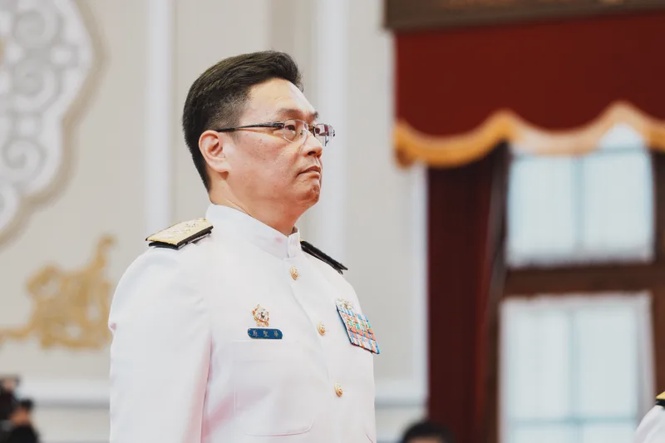
The latest step came on October 1, 2026, when President Lai Ching-te (賴清德) presided over a promotion ceremony for senior officers. Among them was Yuan Sheng-hua (原聖華), formerly the navy's deputy chief of staff, who was promoted to vice admiral and is set to become deputy director general of the CGA. He will be the first navy vice admiral ever to hold the post, breaking with the usual career paths for senior naval officers and showing how closely the navy and the coast guard are now intertwined in Taiwan's maritime defense. Who is Yuan, why was he chosen, and what is the Lai administration trying to achieve?
A Career Built On Operations And Intelligence
Yuan graduated from the Republic of China Naval Academy in 1993. He has served as director of the Strategic Analysis Division in the Ministry of National Defense's Department of Strategic Planning, commander of the navy's 192nd Fleet and director of the Operations and Training Division at Navy Command, before becoming the navy's deputy chief of staff ahead of his promotion.
Before earning his first star, sources say, Yuan also served as director of the navy's Taipei Operations Center, a highly sensitive post that oversees maritime intelligence around Taiwan and must report immediately to the navy commander whenever something happens. A military source said the director's job is to give the commander the clearest possible picture of a situation.
People who know him describe Yuan as hardworking and quick thinking, an officer from the operations and training side who thinks about combat every day. He is said to be capable and willing to offer his views to his superiors while accepting that the final call is theirs. Staff officers who keep their opinions to themselves or simply flatter their bosses, the source said, are the real problem.
What Lai Expects From The Appointment
Because Yuan's background is in operations and intelligence, the military source said, he will be a clear asset as the coast guard prepares to shift from peacetime to wartime roles. At the promotion ceremony, Lai said he hoped Yuan would draw on his experience to improve coordination between the navy and the coast guard, strengthen the sharing of maritime intelligence, and closely link maritime surveillance with emergency response to protect Taiwan's waters. For Taiwan, Lai added, the armed forces and the coast guard must work together more closely to keep up with a rapidly changing situation at sea.
Why The Coast Guard Borrowed An Admiral
Yuan's move was not a surprise to insiders. As director of the navy's Operations and Training Division, he ran the very office that serves as the navy's link to the coast guard. The two belong to different government bodies, but that division handles their coordination on wartime transition, routine drills and exchanges, and gray zone responses.
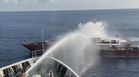
Beyond surrounding Taiwan with warships to apply pressure, China regularly sends coast guard vessels to harass waters near the island. The CGA is on the front line of those encounters, and the standoffs sometimes come close to a clash. To stop Chinese coast guard ships from crossing in, Taiwanese crews have at times positioned their vessels directly in the other ship's path to force it to turn away, where a single mistake could lead to a collision. The pressure on the coast guard is enormous.
Ocean Affairs Council Minister Kuan Bi-ling (管碧玲) brought Yuan over from the navy to deal with this increasingly tense situation. The move also signals that the navy and the coast guard will no longer operate separately but will be genuinely linked. A military source said Yuan understands both how to respond on the front line and how to read strategic guidance from the top.
Bringing Naval Tactics Into The Coast Guard
Speaking at a rank ceremony at the CGA, Kuan said the appointment was designed to complement the agency's existing expertise. The coast guard's current leadership is strong in law enforcement, maritime search and rescue, and coastal patrol, she said, and bringing in a senior officer with long experience in fleet operations and strategic coordination would immediately strengthen intelligence sharing, command and communications, and the transition from peacetime to wartime operations with the military, building a stronger line of maritime defense.
"The coast guard and the navy are one family," Kuan said, noting that the two already work hand in hand. Drawing on Yuan's experience with ships and in operations and training would bring the navy's tactical thinking into the coast guard, inject new momentum into its wartime readiness, and connect communication channels among the military, the police and the coast guard. She said it would also deepen joint sea and air defense and response mechanisms and move maritime surveillance and law enforcement toward real integration.
Closer Ties With Washington
The CGA's budget for 2027 includes NT$1.229 million to send five people to the United States for a high-level Taiwan US national security meeting. According to the budget documents, the aim is to deepen intelligence cooperation and the sharing of practical experience between the two sides, expand channels for exchanging information, discuss key national security issues, and strengthen Taiwan's ability to deal with nontraditional threats.
That shows how closely the coast guard is already working with the United States as it responds to gray zone pressure. Yuan also handled exchanges with the United States during his time in the defense ministry's Strategic Analysis Division. Sending a navy vice admiral to serve as the coast guard's deputy chief shows that the government intends to bring military operational thinking into the agency rather than leave coast guard crews to face the danger on their own. The "second navy," it seems, is more than a slogan.