
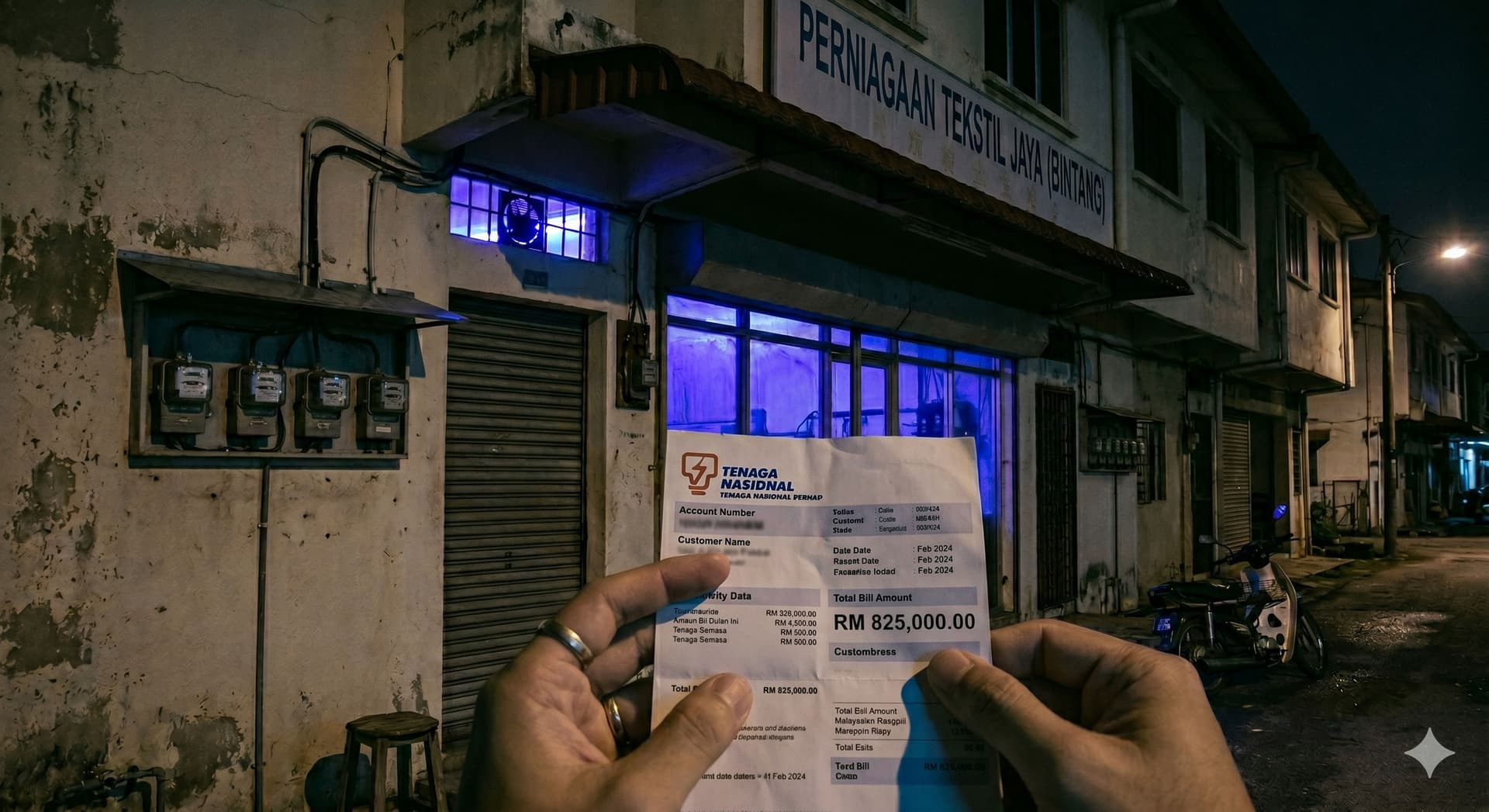
Let me tell you about Jason.
In July 2020, Jason rented his property to a tenant who claimed to run a computer business. Sounded legitimate enough. A few months later, his entire building experienced a power outage. Suspicious, but manageable. Then in December that year, TNB knocked on his door with a bill for RM1.7 million. The tenant? Long gone. Fake ID. Untraceable.
Jason fought TNB in court for two years. TNB reduced the bill to RM825,000. He still lost the case. Today, that RM825,000 continues to accumulate 5% interest.
Let that sink in.
This is Not a Rare Horror Story. This is Happening All Over Malaysia.
Jason is not alone. Forty-five homeowners and business operators across Klang Valley, Johor, and Seremban collectively racked up RM8.5 million in electricity bills because their tenants secretly used their properties for illegal Bitcoin mining. Most of them had no idea until TNB came calling.
There is Ganeson, who only found out about a RM73,000 bill after receiving a call from TNB. He ended up paying RM70,000 out of his own pocket. There is Tom, whose company documents were faked to register 10 TNB accounts, resulting in RM700,000 in unpaid bills. There is a wheelchair-bound landlord, KC Teo, who depends on rental income to survive, now staring at a RM300,000 bill because his tenant used a false identity to rent his home.
And just recently, a shoplot owner in Port Klang was ordered by court to pay TNB RM26,000 after her tenant tampered with the electricity meter for Bitcoin mining. Her defence? The tenant did it. The court's response? You are the registered consumer. You pay.
The law is brutally simple. Whoever's name is on the TNB account is responsible for the bill. Full stop.
How Does This Even Happen?
Cryptocurrency mining, particularly Bitcoin, requires enormous amounts of electricity running 24 hours a day. Mining rigs generate heat, consume power at an industrial scale, and can run up electricity bills of hundreds of thousands of ringgit in just weeks. TNB has reported losses of RM3.4 billion from electricity theft linked to illegal Bitcoin mining between 2018 and 2024. That is not a typo.
The modus operandi is disturbingly consistent. A tenant rents a property under a legitimate-sounding business pretext, sometimes using falsified documents. They set up mining equipment quietly. They tamper with meters to reduce what is recorded. By the time anyone notices, the bills have spiralled into the hundreds of thousands, and the tenant has vanished.
The property owner, whose name is still on the TNB account, gets the letter.
What You Should Do Right Now If You Are a Landlord
This is not just a warning. It is a checklist. Do these things before your next tenant moves in, or even with your current tenant if you have not done so already.
First, transfer the TNB account to your tenant. TNB allows landlords to submit a Change of Tenancy (COT) request so the tenant becomes the registered consumer and bears full legal responsibility for the bill. Yes, you lose the ability to instruct TNB to disconnect power if the tenant defaults, but that is a far smaller risk than inheriting a RM1.7 million electricity bill.
Second, download the myTNB app and monitor your account regularly. Even if your tenant's name is on the bill, staying vigilant about unusual usage spikes can flag problems early before they become catastrophic.
Third, do your due diligence before handing over keys. Verify your tenant's IC or business registration documents. Do not just take photocopies at face value. Call the Companies Commission of Malaysia (SSM) hotline to verify company details if you are renting to a business. A few minutes of verification can save you years of legal nightmares.
Fourth, include a specific clause in your tenancy agreement prohibiting cryptocurrency mining or any industrial-scale power consumption on the premises. It will not make you immune, but it gives you a legal foundation to pursue the tenant if things go wrong.
Fifth, if you suspect something is already happening, act immediately. Lodge a police report, contact TNB, and do not wait. The court in Jason's case noted that his inaction after the fact worked against him.
My Opinion on This
Here is the thing that gets me every time I read about these cases. These are not careless people. These are ordinary Malaysians who worked hard, saved up, bought a property, and tried to build a modest income stream from it. A retired army officer. A wheelchair-bound man depending on rental income to survive. A shoplot owner who had no idea her unit was being turned into a mining operation. None of them went looking for trouble. Trouble found them through their letterbox in the form of a TNB notice.
And what makes this genuinely maddening is that the legal framework has not caught up with the reality on the ground. You can do everything right as a landlord, screen your tenant, sign a proper tenancy agreement, hand over the keys in good faith, and still end up in court for something your tenant did behind your back.
Petaling Jaya MP Lee Chean Chung has called for TNB to set up a dedicated task force and for amendments to the Electricity Supply Act 1990 to better protect landlords. That conversation is long overdue. But until those amendments happen, the law as it stands holds you, the property owner, responsible.
The crypto miners are banking on your trust. They are banking on you not checking. They are banking on you being too busy or too trusting to monitor what is happening inside your own property.
Do not give them that opening. The time to act is before the TNB letter arrives. Because once it does, you are already fighting an uphill battle.
Kamarul Azwan (k.azwan@gmail.com) is a content creator under the Newswav Creator programme, where you get to express yourself, be a citizen journalist, and at the same time monetize your content & reach millions of users on Newswav. Log in to creator.newswav.com and become a Newswav Creator now!
The User Content (as defined on Newswav Terms of Use) above including the views expressed and media (pictures, videos, citations etc) were submitted & posted by the author. Newswav is solely an aggregation platform that hosts the User Content. If you have any questions about the content, copyright or other issues of the work, please contact creator@newswav.com.