
On the 25th of April 2024, Anwar announced that underperforming and lazy public servants will not be rewarded under the revamped Public Service Remuneration System (SSPA) next year. This will be part of the reform within the civil service which will be done in tandem when the new remuneration scheme is implemented. Anwar has said that he hopes the civil service reforms will improve the performance of public servants. While reforms are good, not everyone is keen on them. A public servant has taken to Reddit to expose governmental failures in civil service and why he thinks the revamped Public Service Remuneration System (SSPA) is doomed to fail.
The Reddit user shares his observations on civil service after 8 years of working as a public servant; it is worth mentioning that he's still working as a public servant. He details his thoughts on Reddit as follows (edited to improve readability):
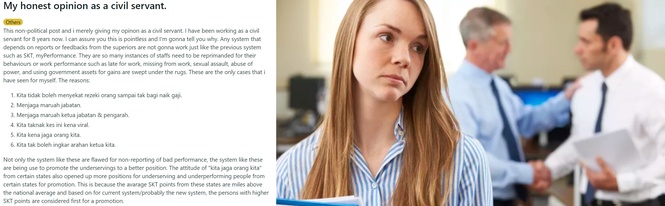
"This is a non-political post, and I'm merely giving my opinion as a civil servant. I've been working as a civil servant for 8 years now, and I can assure you that this is pointless (referring to the revamped Public Service Remuneration System (SSPA) as proposed by Anwar), and I'm going to tell you why. Any system that relies on reports or feedback from superiors is not going to work, just like previous systems such as SKT (Sasaran Kerja Tahunan) and myPerformance. There are so many instances where staff should be reprimanded for their behavior or work performance—like being late for work, absent from work, sexual assault, abuse of power, or using government assets for personal gain—that are swept under the rug. These are just the cases I've seen myself. The reasons for this are:
- We can't hinder someone's livelihood to the point of not giving them a raise.
- To protect the department's reputation.
- To protect the reputation of the department head & director.
- We don't want these cases to go viral.
- We need to look after our own.
- We can't disobey our boss's orders.
Not only are systems like these flawed because they fail to report poor performance, but they are also the same systems where the unqualified (or undeserving) get promoted to better positions. The "kita jaga orang kita" ("we look after our own") mentality from certain states also opens up more positions for unqualified and underperforming people from those states to get promoted. This is because the average SKT scores from these states are far higher than the national average, and based on the current system (or possibly the new system), the people with higher SKT scores are considered first for a promotion."
Many Reddit users agree with the sentiment of the Reddit user. One Reddit user, _Tremble, who is also a public servant herself shared the same sentiment and even shared her story in the comment section. She said, “Agreed, and they need to go through so many meetings in order to fire a non-performing civil servant. I had the misfortune to help my Head of Department investigate a case of severe absenteeism of an ICU nurse in GH. The individual in question (referring to the ICU nurse who has a history of absenteeism) hasn't shown up in the department for more than 3 years, citing various health issues. She has been seeing doctors from different departments in the hospital, and yes, she has also been diagnosed with anxiety and depression. So they set up a meeting to send her to a less stressful department a year ago but nothing changed, and she's been collecting salary as usual. Went through a few meetings but in the end…You guessed it, no action was taken!”

These accounts from public servants illustrate the deep-seated issues within the current civil service system, revealing how bureaucracy and protective practices can allow underperforming and unqualified individuals to remain in positions of responsibility — or even to be promoted. Despite the government's intention to revamp the Public Service Remuneration System (SSPA), the lived experiences of these insiders suggest that without meaningful cultural and procedural changes, true reform may remain elusive.
As the nation awaits the implementation of the new remuneration scheme, stories like these emphasize the critical need for accountability, transparency, and fairness in the civil service. While Anwar's reforms offer hope, the voices of those within the system underscore the work that remains. The challenge ahead is not just in revising policies but in changing the mindset that has allowed mediocrity to flourish.
The path to a more effective civil service requires listening to these voices and addressing the issues they raise. If the government is serious about reform, it must tackle these problems head-on, ensuring that the best and most deserving public servants are the ones leading the way. Otherwise, the cycle of underperformance and unearned promotions may continue, to the detriment of the entire nation.
Aaron Colt is a content creator under the Newswav Creator programme, where you get to express yourself, be a citizen journalist, and at the same time monetize your content & reach millions of users on Newswav. Log in to creator.newswav.com and become a Newswav Creator now!
The User Content (as defined on Newswav Terms of Use) above including the views expressed and media (pictures, videos, citations etc) were submitted & posted by the author. Newswav is solely an aggregation platform that hosts the User Content. If you have any questions about the content, copyright or other issues of the work, please contact Newswav.
