
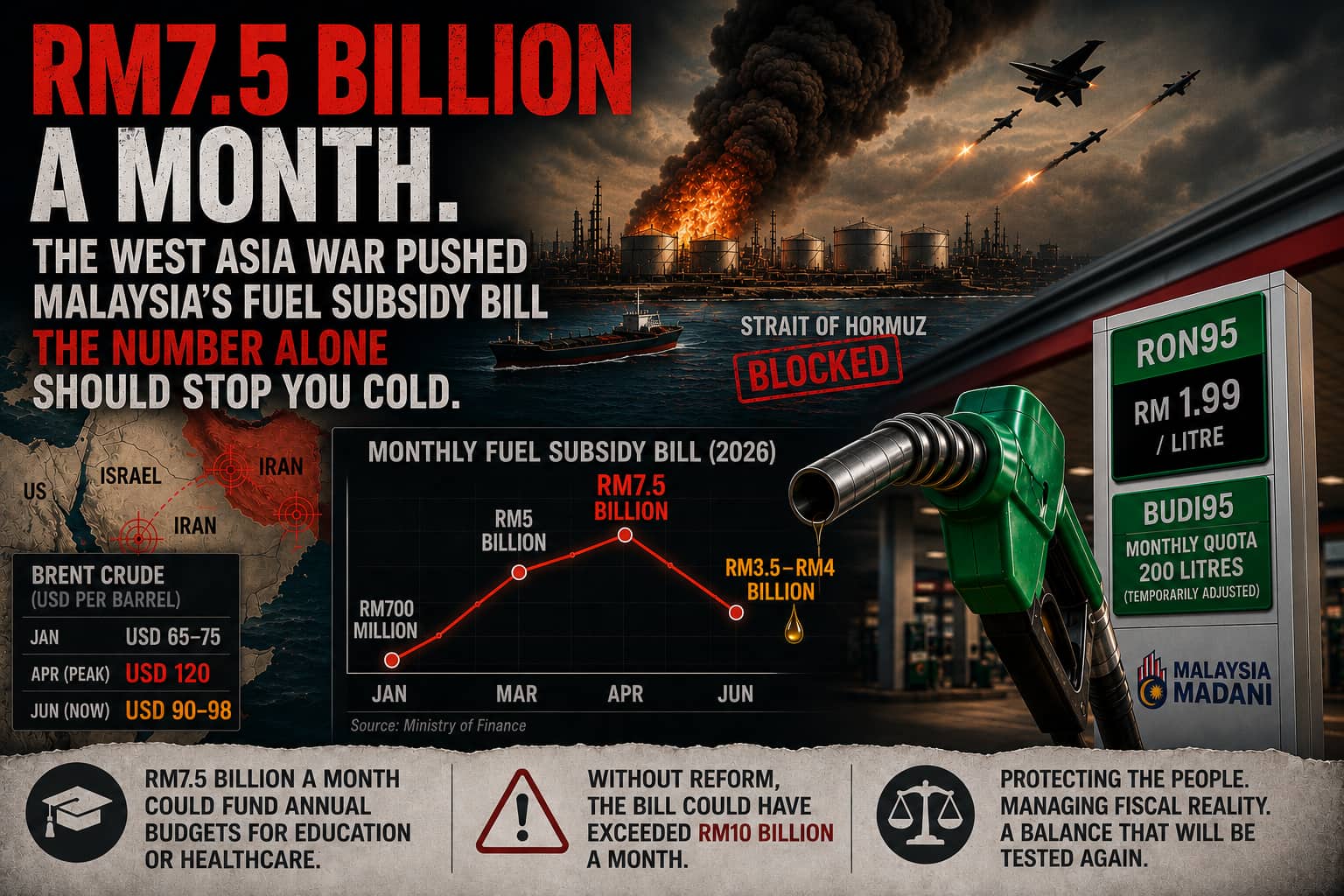
Cast your mind back to January 2026. Malaysia's monthly fuel subsidy bill was a relatively manageable RM700 million. That number, while significant, was within the government's fiscal planning parameters. The BUDI MADANI programme was humming along, RON95 stayed at RM1.99 per litre, and nobody was talking about a subsidy crisis.
Then the US and Israel launched coordinated airstrikes on Iran on February 28, 2026.
By March, the monthly subsidy bill had jumped to RM5 billion, as revealed by Prime Minister Anwar Ibrahim. By April, it peaked at RM7.5 billion in a single month, according to Finance Minister II Datuk Seri Amir Hamzah Azizan, who disclosed this publicly at the Invest Malaysia 2026 conference on June 9. The jump from RM700 million to RM7.5 billion is not a typo. It is a tenfold increase in the space of three months, driven entirely by Brent crude prices spiking from around USD 65-75 per barrel at the start of the year to a peak of approximately USD 120 per barrel in April after the Strait of Hormuz was effectively blocked by Iranian naval activity.
Amir Hamzah confirmed that without the targeted subsidy reform already implemented, the bill could have exceeded RM10 billion per month. Read that again. RM10 billion. Monthly. On fuel subsidies alone.
Oil prices have since moderated. Brent crude has pulled back to between USD 90 and USD 98 per barrel, and the current monthly subsidy cost has eased to approximately RM3.5 billion to RM4 billion. Still four to five times the January baseline, but no longer apocalyptic. The RON95 price at the pump remains RM1.99. The monthly quota under the Budi95 programme was temporarily adjusted from 300 litres to 200 litres to help manage supply during peak pressure.
What the April peak demonstrated is that Malaysia's subsidy architecture, while well-intentioned and effective at protecting low-income groups, is structurally exposed to global oil price shocks in ways that are not sustainable over a prolonged conflict. At RM7.5 billion per month, the entire annual development budget for education or healthcare gets consumed in a matter of months. Something has to give, and the government is now navigating the tightrope between protecting ordinary Malaysians from pump price increases and managing fiscal reality. That balance will be tested again if tensions in West Asia escalate further.
Ronny M (ronny76netstuff@gmail.com) is a content creator under the Newswav Creator programme, where you get to express yourself, be a citizen journalist, and at the same time monetize your content & reach millions of users on Newswav. Log in to creator.newswav.com and become a Newswav Creator now!
The User Content (as defined on Newswav Terms of Use) above including the views expressed and media (pictures, videos, citations etc) were submitted & posted by the author. Newswav is solely an aggregation platform that hosts the User Content. If you have any questions about the content, copyright or other issues of the work, please contact creator@newswav.com.
