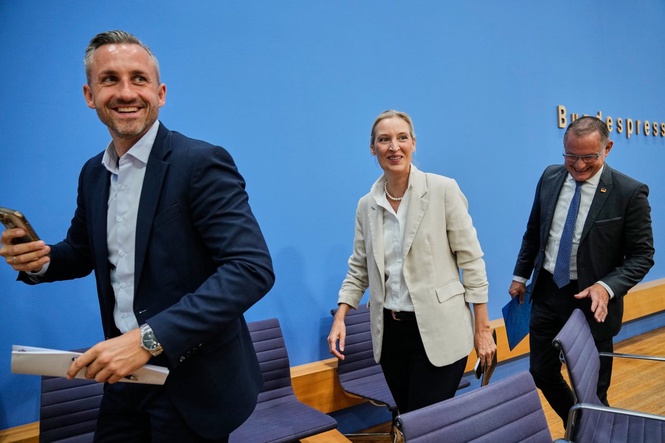
Mainstream politics received two wake-up calls this weekend. One was the emphatic victory of the far-right Alternative for Germany (AfD) in the Saxony-Anhalt state election. The other came from Dover, where black balaclava-wearing protesters lined the streets to demonstrate against the boat crossings.
There were other concerning images, too. In Portsmouth, where thugs turned out, in less-organised fashion but still in force, to blockade migrants arriving from France – and from the Reform UK conference, as hecklers were brutally ejected, with one picture showing a woman being dragged by her hair and struck with a walking stick. When the footage was played to Robert Jenrick, the Reform Treasury spokesperson said “boohoo” and told her to “get a life”.
Clearly something deeply worrying is afoot. The AfD celebrated in a country which, since the Second World War, has avowedly moved to prevent organisations on the right acceding to power. Yet the momentum of politics and power has lurched in that direction. In Britain, as protests against illegal immigration escalate and take one sinister turn after another, it is indefensible that a party with representatives in parliament, including Mr Jenrick, does not condone violence and instead adopts a boorish, nasty stance.
Nor are Germany and Britain outliers. In France, Marine Le Pen and her acolytes are in the ascendant – among them Reform’s party conference guest of honour Jordan Bardella, who signed a pact with leader Nigel Farage to send the migrants back to France. In other nations, too, not least the US, ICE continues to hunt down and deport undocumented immigrants.
What is doubly troubling is that anti-migration parties stand for a destabilising reordering of global politics. The victorious AfD is no supporter of Ukraine, Nato or indeed the EU, and if one incumbent ruler was delighted at the German result, it was Vladimir Putin. Should the AfD go on to replicate its march in an eastern corner across Germany as a whole, the foundation of the long-standing defensive alliance would seem very shaky. Trump is also no fan of Nato, and Europe’s ability to protect itself against attack, possibly from Russia, would undoubtedly weaken.
There is another aspect to these developments which is telling – whatever the mainstream says, fewer and fewer are listening. The AfD has been labelled an extremist organisation by the German security service, a tag usually reserved for the most hard-line groups, those that commit acts of aggression and terrorism. Yet that description did not prevent voters from indicating support in their droves.
Here in the UK, the government says Channel crossings have almost halved this year, thanks, at last, to France’s commitment to intervene and prevent their departure. But, as with Germany, that official account is simply not believed. It is noticeable how many of those basking in the AfD’s triumph are young. They are apparently not bothered about attempts to liken the party to the Nazis. In the UK, ministers can say what they like but their entreaties are equally falling on deaf ears.
It highlights an increasing distrust, a breakdown in faith between government and citizens. Carry on much further along this path, and momentum takes over. Only a very dark future awaits.
Migration is the lightning rod that governments nevertheless need to grasp. The widely held perception is that policies to date have not worked, or at least they have not succeeded in changing views, and frequently, they have been held up as making a bad situation worse. A rethink is urgently required, one that is accompanied by visible action, producing tangible results, not mere words. There is nothing wrong per se with a strong migration policy that is firm but fair. More must be done to show that illegal migration is a global concern, but it is not going to be solved by a patriotic front or minor right-wing demagogues.
There will always be those holding abhorrent, extreme views. What is happening now, however, is that groups previously consigned to the fringe are collecting voters, many of whom would not have dreamt of supporting them in the past. They are becoming ever more popular, and that growing populism, as it gathers swing voters, is capable of determining the outcome of national ballots, changing the tide of history – and not for the better.
The established parties, which have often enjoyed lengthy periods in charge, underestimate this shift at their peril. If they choose to discount and downplay, they will soon regret their folly, realising too late that their sensible, historic values have been rejected and in their place is a new set of rules that run counter to a civilised society, one in which justice, the rule of law and order and accountability, responsibility and decency prevail.
After what we have just witnessed in the past few days, it is a real and ever-looming danger. The terrible warning of the past is transparently clear. Established parties have received two wake-up calls. How many more must they receive?
Read MoreIf these great defenders of the UK are so brave, why are they hiding their faces?
Putin has no interest in peace – and Trump is falling into his trap