
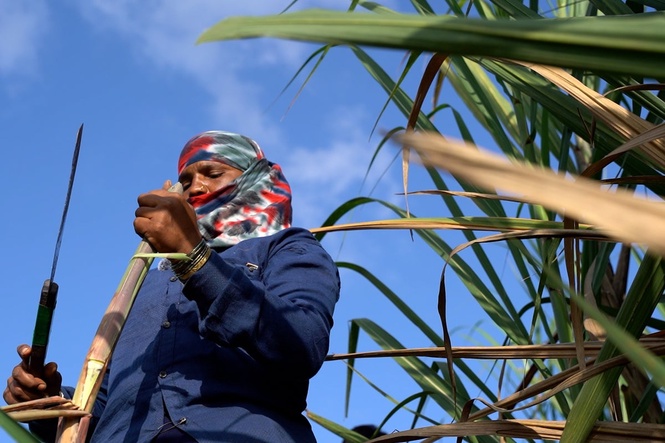
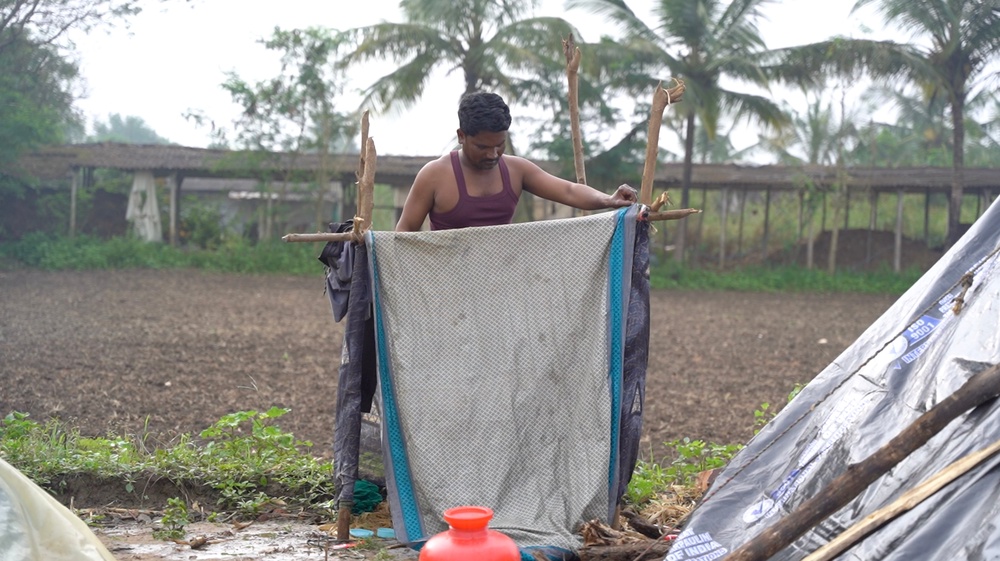
It’s 4am in Ramanal, a remote, rural area of Karnataka in southern India. Poornima steps out of her tent to begin another day. She, like all the women living in these makeshift shelters, washes before the men wake. They have travelled more than 500km from their villages to find work and pay off their debts.
Across India, an estimated 1.5 million people cut sugarcane, often working 14-hour days for as little as ₹400 (£3) per day. They work in pairs – usually husband and wife – from early morning until night, stopping only to load harvested cane onto trucks.
India produces 16 per cent of the world’s sugarcane, second only to Brazil in terms of volume. Sugarcane from this region is regularly supplied to soft drink giants such as Coca-Cola and PepsiCo.
The majority of cane cutters working in these fields come from the area of Beed in central Maharashtra. Since there aren’t many employment opportunities at home, people resort to this gruelling labour to feed their families.
Bitter reality of the lives of Indian sugarcane cutters
For many women, the physical demands are only part of the challenge. More deeply concerning is the pressure some face to put their reproductive health at risk in order to keep their jobs.
Living in makeshift camps without toilets or clean water, female cutters face an impossible reality; having to manage a period in these conditions isn’t just exhausting, but also financially disastrous.
In a system where missing a single shift triggers severe wage deductions, taking a day off for menstrual pain simply isn't an option.
The workers are left with a brutal choice - look after your body, miss work and receive a ruinous fine, or keep going and risk the long-term health effects.
To eliminate period cramps and pregnancy breaks entirely, many workers feel pressure to take drastic measures just to stay in the fields and earn, according to the women and activists supporting them.
“It'd be such a big help if someone can relieve me of this pain,” says Poornima, a worker who told The Independent she is seriously considering undergoing a hysterectomy as a solution.
“My suffering isn’t reducing. If I continue this work, it'll only grow. If I can stop lifting such heavy weights, maybe it'll be better. But we don't have an option other than to do this job.”
Workers held hostage by debt
Sugarcane cutting is a seasonal job on which many families in Beed depend. Each year, migrant workers are organised by a mukkadam, a contractor, who liaises with sugar factories, arranges travel and provides an advance.
Each couple – known as a koita – must then work to repay the advance, and are expected to harvest an average of three tonnes of cane a day.
Because earnings are shared among a group or seven or eight koitas, each is under pressure to keep pace with the others. If one woman cannot work, other pairs charge her a fine for the extra they have to do to make up for the missing harvest.
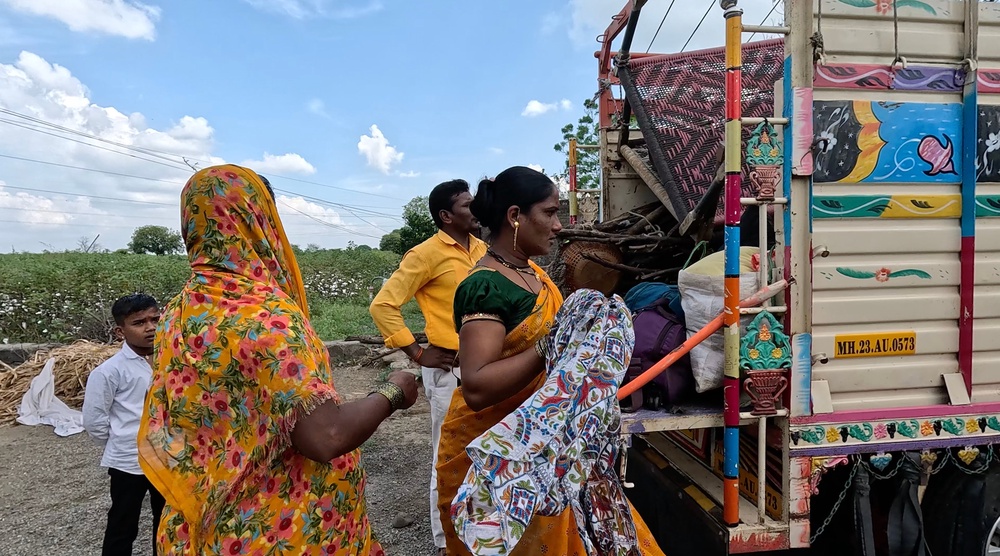
Savita is a cane cutter and recalls the hardships that led her to take the decision of getting a hysterectomy in March 2025.
“Nobody helps you (on the fields),” she says. “They don't let you rest at all. I was so sick yet no one helped me. My stomach hurt, I couldn't climb the ladder to load onto the truck; I fell thrice last year while doing that, yet I couldn't complain.”
It’s a sentiment echoed by Poornima. “We never have a day off,” she says. “Once we arrive here, it's constant work every single day for the next four to five months.”
She says she is considering a hysterectomy due to constant pain over the past three years. Yet even if she does decide to undergo the surgery, she may have to take out another loan to cover the cost.
“Even removing my own uterus requires taking on debt,” she says. “It feels like my body itself has become a slave to the system.”
‘I trusted the doctors, but months later I’m still in pain’
Activist Sangita Chavan is an advocate who has been working on women’s welfare alongside Dr Neelam Gorhe, a politician whose 2019 report about high rates of unnecessary hysterectomies put a spotlight on the issue.
Rather than being directed to public hospitals for low-cost, conservative treatments, Sangita says some women are pressured to go to private facilities where surgeries are performed without adequate clinical justification.
To tackle this, the government appoints ASHA (Accredited Social Health Activist) workers as community health workers in rural India. They connect women working in the fields with government medical care, maternal health support and education.
While many ASHA workers do vital work in helping these women, Sangita told us she has spoken to some ASHA workers who admitted getting paid in exchange for referring women for hysterectomies.
When The Independent asked ASHA workers in Maharashtra about this, they denied knowledge.
“I heard about women undergoing hysterectomies at young ages but I wasn't sure if it was at a public or a private hospital,” says Ganga Shevante, an ASHA worker from Wadwani district.
Ganga denies ASHA workers receive financial incentives to refer patients for surgery, and says she has never been paid to do so herself. She also says she doesn’t recommend going to private clinics, but “certain families who are able to afford private clinics turn to those for consultation, rather than the public hospitals we recommend”.
The Independent’s investigation and interviews found a cycle of blame, with everyone pointing the finger elsewhere. Meanwhile, the women at the centre of it feel powerless.
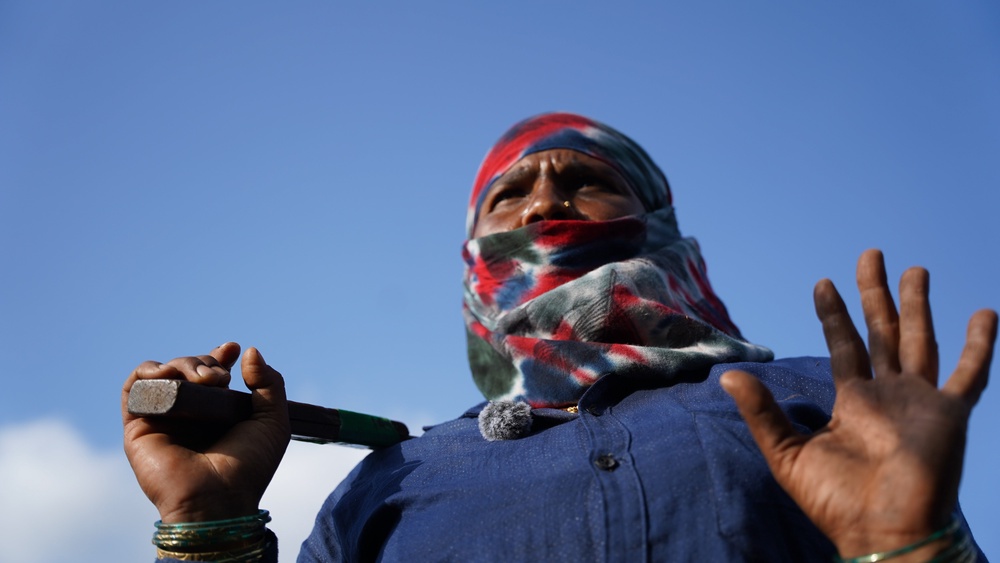
Savita says she is still bleeding and in more pain months after surgery, while the work feels even harder than before.
"I trusted them (the doctors), thinking the hysterectomy would actually help, so I agreed to get it done and end all the misery in one go,” she says.
After the surgery, Savita travelled to the city of Pune where she learned she had an infection. When she asked for her surgical reports, Savita claims her request was refused.
“I'm still in immense pain but nobody had warned me of this before at all.”
Government intervention has changed little on the ground
Sugarcane contractors say they do not force anyone to undergo surgery, but also do not allow workers to take paid days off, because it means they will have less to fill the trucks with – meaning the factories won’t hire them next time.
“Our wages depend entirely on the weight of the harvest we bring to the factory,” says Ashruba Datta, a local sugarcane workers’ contractor.
“If we get more labourers, our tractor earns well. If we have fewer labourers, we can't force them to lift more weight just to compensate for the missing people.”

Addressing the brutal working conditions for women demands a fundamental overhaul of how agricultural labour is structured and regulated in India.
In 2019, the Maharashtra government committee surveyed 82,309 women in Beed who had migrated for sugarcane harvesting and found that 13,861 had undergone hysterectomies. More than 45 per cent of those women later reported physical or psychological distress.
The government subsequently introduced measures intended to monitor hysterectomies and address the conditions faced by migrant workers.
In March 2025, the Bombay High Court ordered the regional government to bring in a series of welfare measures, including proper registration and improved access to welfare and healthcare. A follow up report was due in November 2025 but has not been published.
On the ground, workers say little has changed.
And Poornima and Savita both say they have received no welfare support from the government.
The cost of survival
“My pain is unbearable,” says Poornima, who says she spends ₹50,000 (£395) a year on pain relief. “I have to get the surgery done when I return to my village, but that requires borrowing more money.
“It feels like the system has claimed my very womb just so I can keep working.”

The Independent repeatedly approached district collector Vivek Johnson, a local official responsible for overseeing Beed district’s administration, public welfare execution and law enforcement, for comment on this story. He declined.
Coca-Cola says it has partnered with Solidaridad, an international civil society organisation, to improve workers’ access to clean water, sanitation, shaded rest areas and ergonomic tools, and feminine hygiene products. It says 100,000 people have benefited from the partnership.
The Independent also approached PepsiCo, but they didn’t respond.
For Poornima, her torment continues.
“I am torn between delaying the surgery or simply going through with it,” she says. “I hope that being pain-free will allow me to continue working in the fields and provide for my family.”
Wombs of Debt is being screened at 8.30pm on Tuesday, October 20, at the Institute of Contemporary Arts in London. More information here
Read MoreHow to tackle Africa’s chronic shortage of midwives: ‘Many feel invisible’
Meet Afghanistan’s last midwives: The women saving babies’ lives in defiance of Taliban rules
‘I had a hysterectomy at 33 due to my endometriosis – it was the ultimate sacrifice’
Police accused of sexual misconduct as protests against India’s election chief enter fourth day
Why is India’s election body chief under fire?
India’s Gen Z ‘cockroach’ movement vows to restart protests if election chief doesn’t resign
