
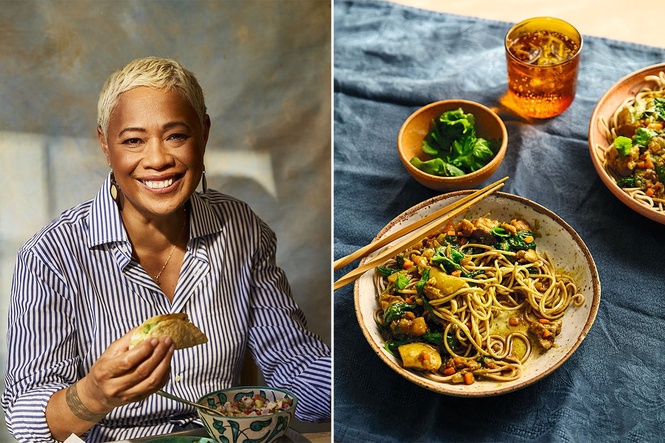
Samoan-Kiwi chef Monica Galetti spent her childhood checking on how the pineapples were growing and picking guavas and mangoes on her family’s lush plantation, filled with taro and cacao trees, with chickens running wild around her.
“A relative would show up, catch a fish, it was very much a sharing culture, my family lived in close proximity to each other,” says MasterChef: The Professionals judge.
For her dad, everywhere on their land was an opportunity to grow food. “My mum [grew] flowers, but I think over the years she just gave up because Dad would throw cabbages in between her rose bushes,” says Galetti with a laugh.
“The front yard and back garden were just covered with fruit and vegetables; he was such a green thumb. I think it’s where my love of gardening stems from.”
The family moved to New Zealand when Galetti was eight and her dad continued growing there – “He was so proud of his tomatoes. We used to finish school and come back and pick the ripest tomato, and he’d come home and knew exactly which tomato had been taken.”
Galetti’s dad died in October 2024, and she’s reflecting on both of her parents’ influence on her cooking and career.
“It was funny, at Dad’s funeral, a lot of his friends and people that I didn’t know said, ‘Oh your dad is so proud of you, he would tell everyone that he taught you everything you knew’.”
Cooking the food he grew wasn’t his strong suit though. “He was the worst! My mum was the great cook.”
It was her mum who taught Galetti – who became the first female sous chef ever of London’s famous Le Gavroche under Michel Roux Jr – “How to chop onions, that was all Mum. She also introduced me to cooking things like abalone [sea snails]. Her chop suey is my favourite chop suey ever.
“I always cooked growing up, helping my mum in the kitchen,” says the 51-year-old. “Being the oldest girl [one of five] I was sort of responsible for helping getting meals ready because my parents were both working. So I just had this natural flair and connection to it.”
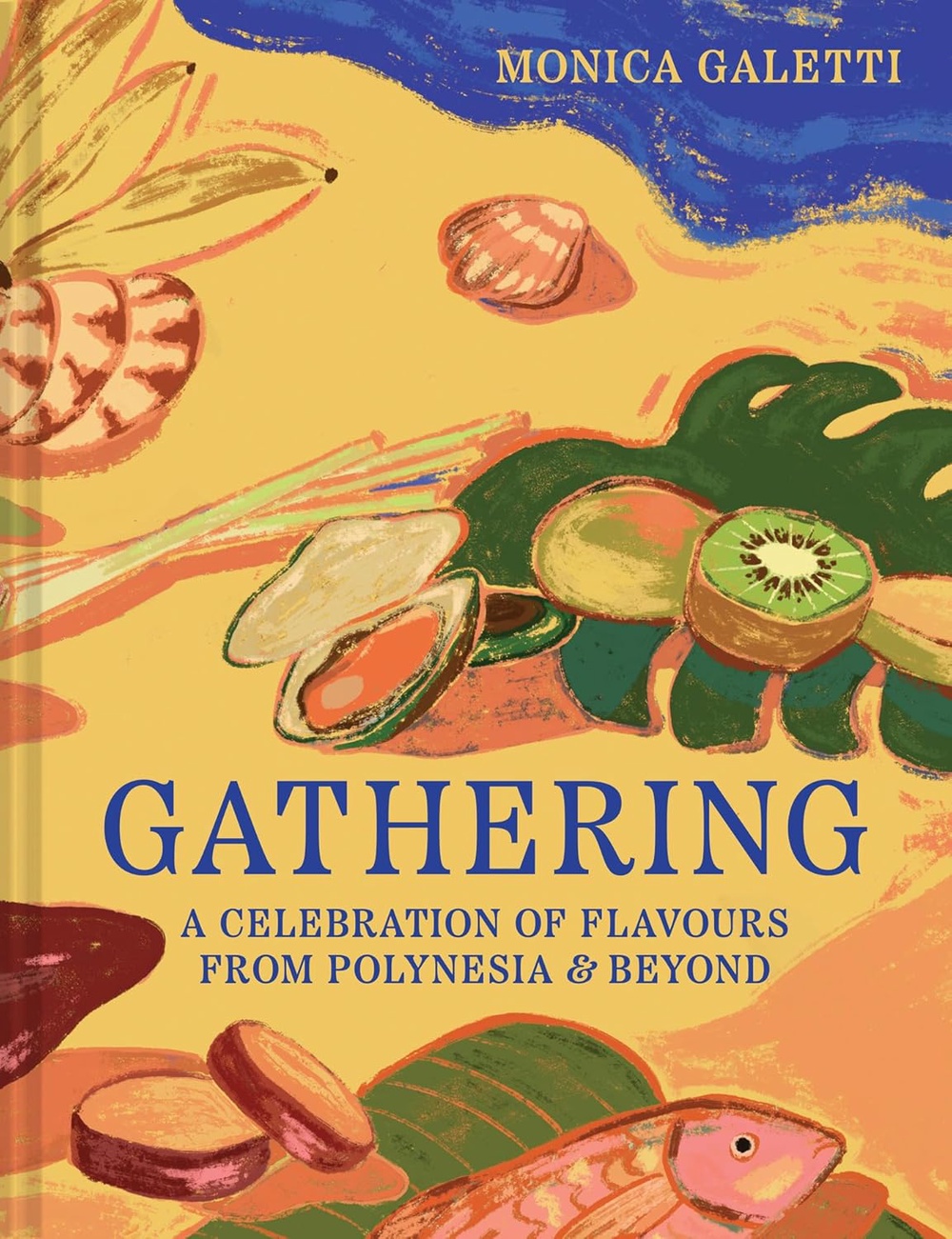
Galetti’s latest cookbook, Gathering, takes readers back through her roots, beginning at her early childhood in the South Pacific island of Samoa, often fishing with her dad at the crack of dawn.
“There’s a lot of Asian influence in Samoan food. We use a lot of coconut milk and staple starches, like taro and yams as well, cocoa [from Samoa], is more than just something we drink, I use it in desserts, I think it’s the closest you get to the most bitter chocolate you can get, I think you can even get 90 per cent dark chocolate.
Samoan flavours, she says, include a lot of sweet and sour flavours. And fresh produce – particularly fish – is key.
Umu is a traditional cooking method, now mostly used for special occasions, where food is cooked under rocks – “Then you pull the rocks apart once they’re completely burnt out and it’s so hot, and you have things like fish that’s been wrapped in banana leaves, or palm leaves with beef or pork. Same with taros, they go straight on, then rocks are piled on top and it sort of roasts and steams at the same time.”
The book is a “collection of memories and a collection of recipes and ingredients over the years”, including influence from her travels and life in Europe, she says. Think tacos with sea bream oka (a Samoan-type of ceviche) and umu-style baked sweet potato with coconut mustard, alongside Crete-inspired beef shortrib with tomato and lemon orzo, although bringing all the memories together did make her “feel like, gosh, I’ve aged”.
Galetti didn’t speak a word of English when the family moved 2,000 miles away to New Zealand. “It was tough, it was really quite scary having to go to school and learn another language, not understanding [the lessons].
“My sister and I were very tight because we didn’t have that ability to communicate [with anyone else].”
Food was very different too. “I remember making bread for the first time and something like pumpkin soup – it just blew my mind how different the flavours were to what I had grown up with.”
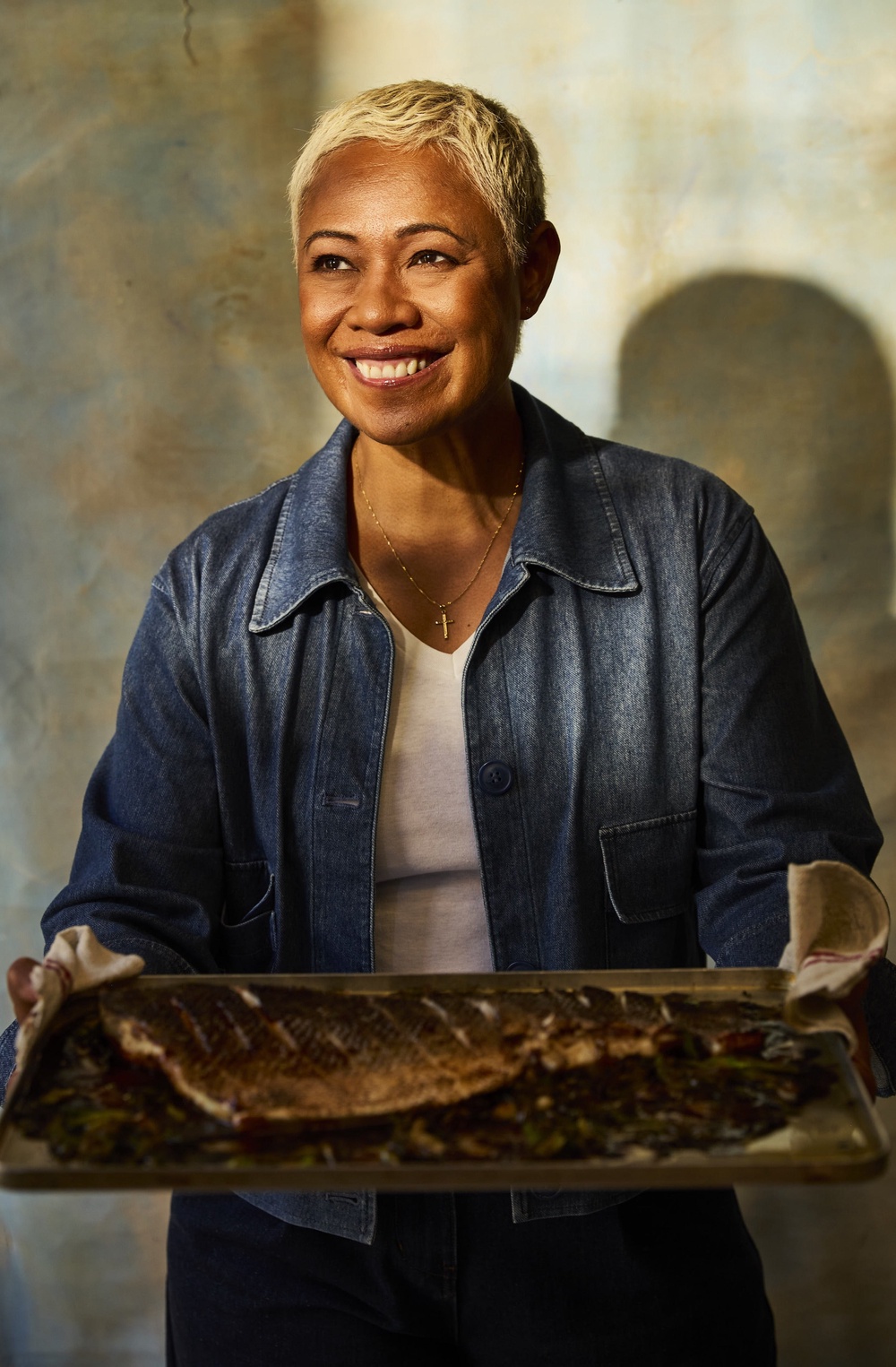
But the art of gathering was never lost. “My parents always had us around the table, having great family gatherings – it was so joyful.
Galetti later did her culinary training in New Zealand, worked in a small restaurant and competed in a cooking competition.
“I found out that I actually had a bit of a knack for it,” she notes. Moving to the UK in 1999, she planned to stay a couple of years. “I sent my CV to loads of places, Raymond Blanc, Pierre Koffmann… and Michel Roux was the first to reply and offered me a job at Le Gavroche.” With a stint in Mauritius in between, she now splits life between the UK and France, where she also has a home with her husband, David.
Their daughter, Anais, is 20 now, and Galetti recalls concern over the impact motherhood would have on a professional kitchen career. “I remember that being a real fear for me when we found out we were pregnant. I was like, ‘Oh my gosh, what do I do? Do I stop working?’
“Thankfully I was able to balance both. I went back to Le Gavroche as a sous chef and me and my husband just worked it out – you just do. We don’t have any family in the UK so that was tough. I was fortunate that Michel was able to adjust my hours to make it work, and so I had a couple of days off and work less hours so I could be at home with my daughter.” An experience that many female chefs say can be rare.
Roux Jr has been “an amazing ally”, she notes, having spent 12 years in total at his flagship restaurant, “I’ve left and gone back again and left again – I kept being drawn back.”
With her daughter now at university, Galetti likes to make her bread to take, saying: “I love that I can make it, slice it – I’m such a mum – wrap them up individually, they go into the freezer for her. When she’s away from me, I know that she’s got something that I’ve made for her.”
MasterChef, which she first began hosting with Roux Jr, before he left in 2014 to be replaced with Marcus Wareing, was never meant to be a permanent position, she says, even though she’s just finished filming her 18th series.
“I still get a thrill out of meeting new talent, and their stories are really what make it. I’m really someone who believes in sticking to something that is right – you know? It’s wonderful.”
Baked aubergine with whipped feta, pickled radish and chickpeas
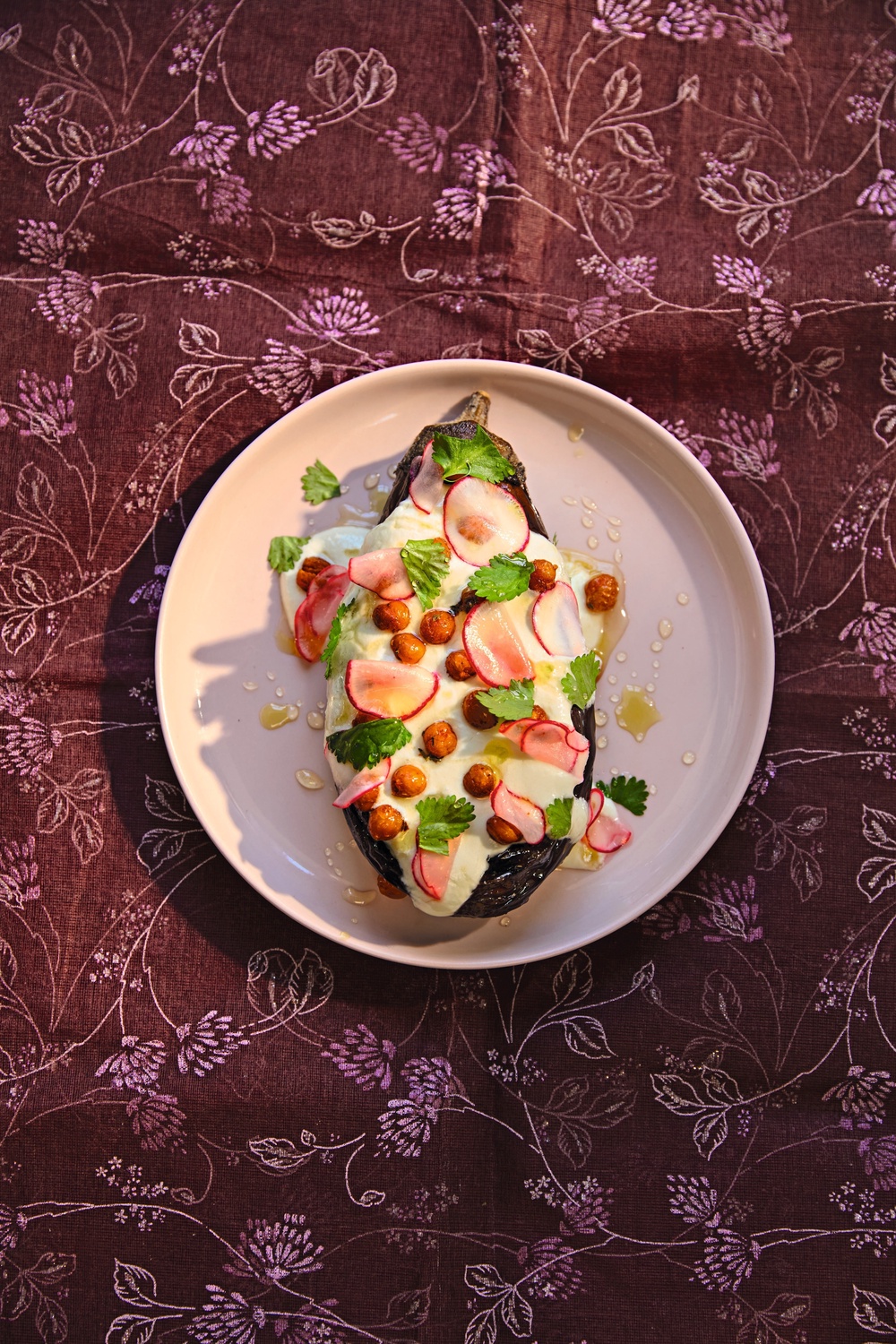
“I must have been six or seven when I first tasted aubergines in Samoa. They were the long, slender isalaelu, simply fried and caramelised, and I remember thinking they were the most exciting thing I’d ever eaten,” enthuses Galetti.
“So it was no surprise that when I visited Dad’s plantation, I found a healthy crop of the biggest aubergines I’d ever seen! This dish is a celebration of that beloved vegetable.
“For extra flavour, you can roast a whole garlic and fold it into the whipped feta. The chickpeas are also delicious on their own, perfect as a little snack with drinks.”
Serves: 4
Ingredients:
4 medium aubergines
4 radishes, thinly sliced
2 tbsp white balsamic vinegar
400g tin of chickpeas, drained
2 tbsp extra virgin olive oil plus extra for drizzling
1 tbsp finely chopped rosemary
1 tbsp finely chopped thyme
1 tsp sweet paprika
200g feta
100g Greek yogurt
1 lemon, zested
1 smoked garlic clove, finely grated
1 tbsp runny honey
1 tbsp roughly chopped coriander
Method:
1. Preheat the oven to 200C (180C fan/gas mark 6). Pierce the aubergines all over with a skewer.
2. Wrap each in foil and bake in the oven for 2 hours. Set aside to cool. Reduce the oven to 180C (160C fan/gas mark 4).
3. Heat a griddle pan over a high heat and char the aubergines for two minutes on each side.
4. In a small bowl, combine the radishes and white balsamic vinegar and set aside to steep.
5. Tip the chickpeas onto a baking tray. Drizzle with olive oil, the herbs and paprika. Season with salt and pepper and toss to combine. Bake for 17-20 minutes, until crisp. Set aside to cool.
6. Add the feta, Greek yogurt, lemon zest, the two tablespoons of olive oil and the smoked garlic to a blender, and blitz until smooth. Season to taste with salt and pepper.
7. Transfer the aubergines to serving plates, spread with a thick layer of the whipped feta, then garnish with the pickled radishes and crispy chickpeas. Drizzle with more olive oil and the honey, and sprinkle over the coriander to serve.
Chicken and spinach curry on soba
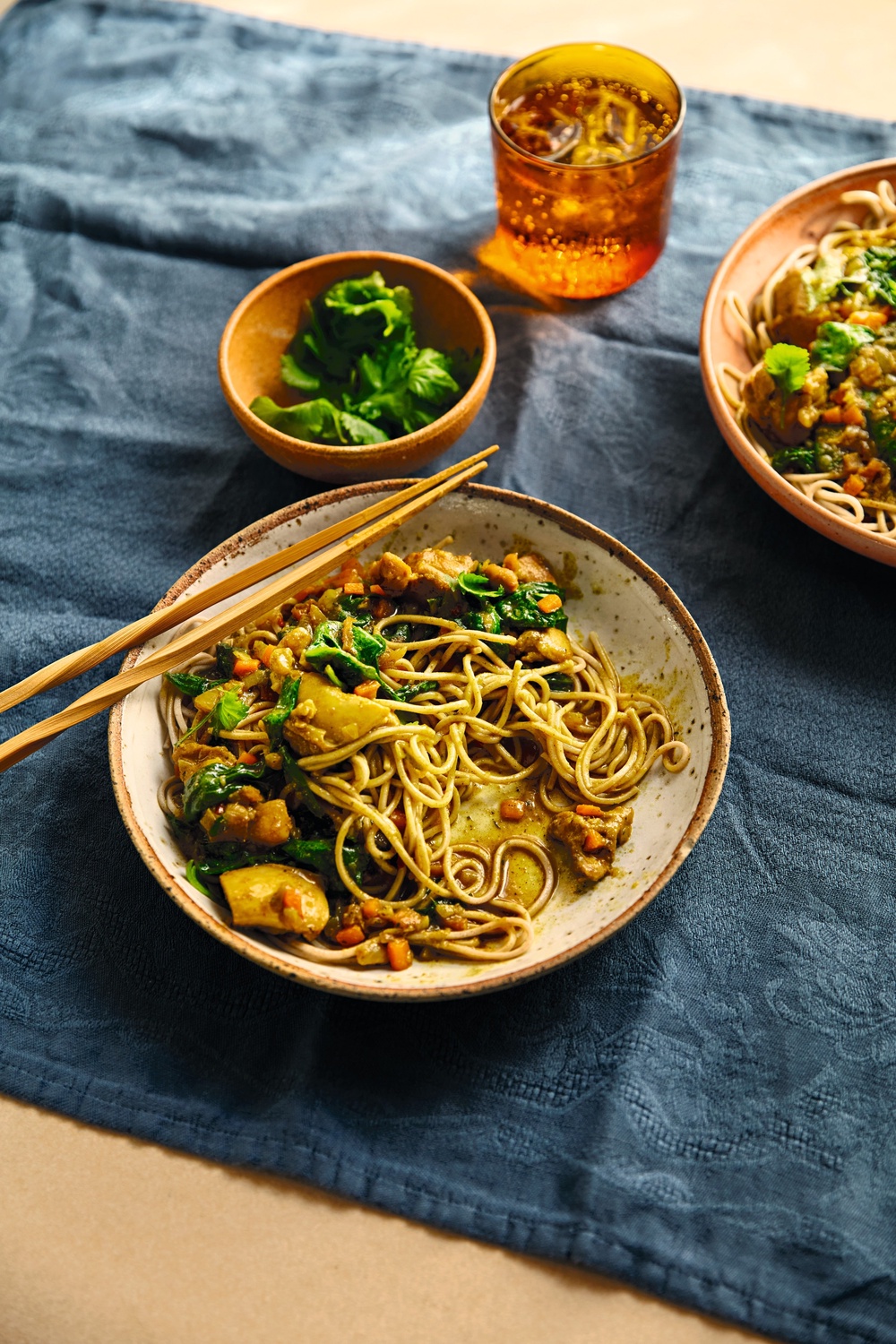
“This is inspired by a Japanese katsu-style curry but without breading the chicken. I’m using my favourite Japanese noodles here, soba, but you can use whatever variety you like best,” says Galetti.
Serves: 4
Ingredients:
1 tbsp olive oil
1 large carrot, diced
1 onion, diced
2 tbsp mild curry powder
1 tsp ground turmeric
1 tsp garam masala
½ tsp chilli powder
½ tsp ground cumin
1 tbsp root ginger, chopped
4 garlic cloves, chopped
200ml chicken stock
400ml good quality, thick coconut milk
6 boneless, skinless chicken thighs, roughly chopped
100g baby spinach
300g dried soba noodles
1 handful of fresh coriander, roughly chopped
Method:
1. Heat the olive oil in a large saucepan over a medium heat. Stir in the carrot and onion, and cook for two minutes. Stir in the spices and cook for a minute more.
2. Stir in the ginger and garlic and, stirring, cook for one minute. Add the chicken stock and bring to the boil. Repeat with the coconut milk.
3. Stir in the chicken, reduce the heat to low, and gently simmer, stirring occasionally, for 15 minutes. Stir in the baby spinach, and season to taste with salt and pepper.
4. Meanwhile, bring a pan of salted water to the boil. Add the soba and cook for six minutes, until tender. Drain the soba and serve in bowls, topped with the curry and some coriander.
Pani popo coconut buns
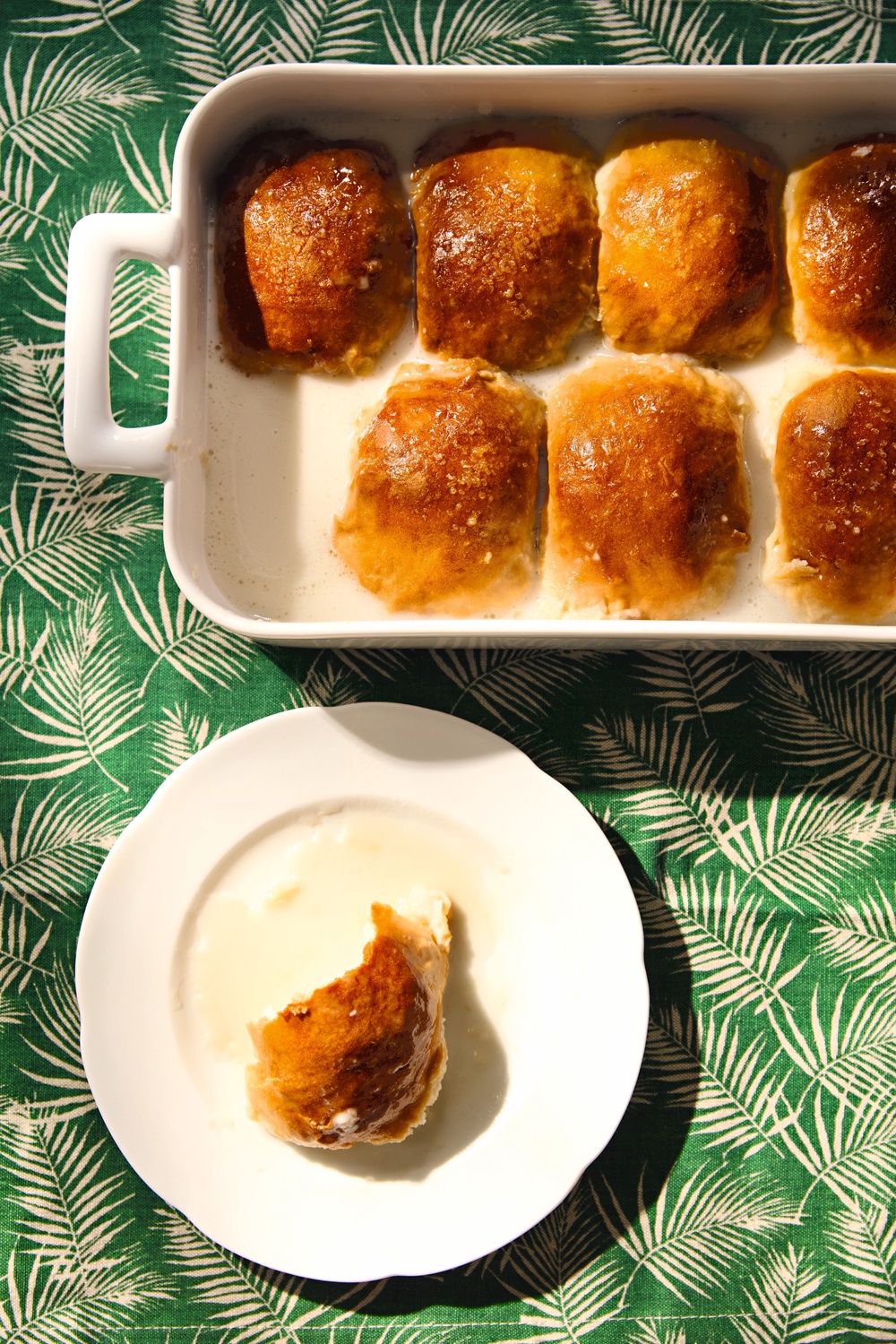
“Pani popo has to be my favourite sweet bun from Samoa. Traditionally baked in large trays – perfect for big families – I only started making them after moving to the UK, when I realised I’d miss that steady supply of buns from aunties back home,” says Galetti.
“I’ve adapted the recipe over time, even serving them at our restaurant flambéed with rum, and recently brought a batch to church for International Sunday, which went down a treat.
“There’s something about the soft, coconut-scented buns that instantly takes me back to Samoa – though now, thankfully, I don’t have to eat a whole tray on my own!”
Makes: 8
Ingredients:
1½ tbsp caster sugar
150ml warm milk
1 tbsp instant yeast
2 pinches of fine sea salt
250g strong white bread flour plus extra for dusting
60g demerara sugar
400ml good quality, thick coconut milk
100ml water
2 tbsp desiccated coconut, toasted
50g unsalted butter, melted
Method:
1. In a jug, mix together the caster sugar, warm milk and yeast.
2. In a large bowl, mix together the salt and flour. Make a well in the centre and pour in the milk mixture. Stir to combine until it comes together, then tip out onto a lightly floured worktop and knead the dough to a smooth ball. Return to the bowl, cover and leave in a warm place to rest for 1 hour or until doubled in size.
3. In another jug, mix together 50g of the demerara sugar, the coconut milk and the water. Pour half into a 32cm x 26cm x 5cm baking tin or dish, and sprinkle with the desiccated coconut.
4. Tip the dough onto a lightly floured worktop and knead for a few minutes to knock back the dough. Divide and shape the dough into 8 rolls. Place them seam-side down onto the coconut milk, leaving about 3cm space in between each roll. Cover and leave to rise in a warm place for another 40 minutes or until the rolls have risen enough to fill the gaps and touch each other.
5. Preheat the oven to 180C/160C fan/350F/gas 4. Brush the tops of the rolls with the butter and sprinkle with the remaining 10g demerara sugar. Bake in the oven for 30 minutes or until golden and risen.
6. Remove from the oven, pour over the reserved sugary coconut milk and allow to sit for 30 minutes before serving.
‘Gathering: A Celebration Of Flavours From Polynesia & Beyond’ by Monica Galetti (Pavilion Books, £26).
Read More3D-printed food may soon be coming to your grocery store
London restaurants news: Rules joins the National Trust
Why your Sunday roast may be less nutritious than it was 80 years ago
‘When I started, there wasn’t even avocado’: Mary Berry on how cooking has changed
The secret to a proper Indian feast? Try these recipes from a Michelin-starred chef
Forget going out – these comforting autumn recipes are worth staying in for