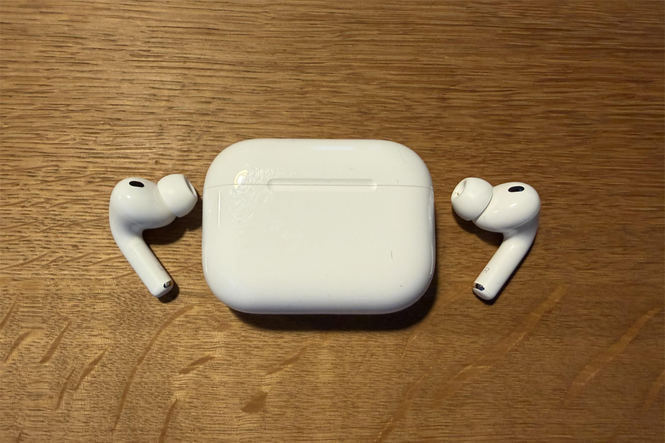
For more than a year now, rumours that Apple has been busy working on a pair of AirPods with miniature cameras built into the stems have been making the rounds, with insiders claiming they could launch as early as next year.
But while they’re still very much in rumour territory, I’ve been given an early look at how earbuds equipped with cameras might actually work. Snapdragon flew me out to Snapdragon Summit to see its latest Sound Elite Gen 2 platform, which will eventually become the workhorse behind AI-enabled and camera-equipped earbuds.
At Snapdragon Summit, audio brand Cleer announced it was working with Qualcomm to develop a pair of camera-equipped earbuds. As well as providing crisp audio, Cleer’s earbuds will also boast on-device AI and built-in cameras, basically letting your AI assistant see the world around you.
They’re not designed to take pictures or record footage from your face like a pair of smart glasses. Qualcomm says the cameras are there to give an AI assistant visual context to help it understand not only what you’re saying but what you’re looking at, as well as what’s happening around you.
Like smart glasses, you’ll be able to ask the Cleer earbuds about sites of interest when walking around a new city, all without having to take out your phone. Qualcomm also suggests that an AI agent could check facts for you, remind you where you need to be, summarise messages and emails or provide other information based on the context it has from its cameras.
Read more: Best smart glasses, reviewed
Qualcomm claims the Snapdragon Sound Elite Gen 2 platform offers up to twice the on-device AI capability of its predecessor and consumes up to 40 per cent less power. Because it takes up 30 per cent less space, it seems ideal for the earbuds form factor. Qualcomm says it can perform a mind-boggling 128 billion operations per second when it comes to AI workloads, despite being so small.

The cameras themselves don’t need to be particularly high resolution either – which should ease concerns for those worried about always-on cameras. Andy Laister, product manager at Qualcomm, envisages sensors being roughly 0.5MP to 1MP, which he says is enough to give an AI assistant useful visual context.
Ziad Asghar, Qualcomm’s senior vice president and general manager of XR, wearables and personal AI, also says its always-sensing camera technology can deliberately operate at such a low resolution that it can detect a face without actually recognising one.
The annoying thing about AI right now is that you have to tell it where you are and what’s around you – whether you’re outside, inside or standing in a shopping centre – but soon it’ll just know. “Actually describing that is burdensome, and I’ll just stop using it,” explains Laister.
There are also other interesting use cases. Laister gives the example of being in the office and wearing earbuds with active noise cancellation turned on. “If I was to look and someone was there to talk to me, I actually have to pull out my earbuds at the moment, or I switch off the ANC function,” he says.
Camera-equipped earbuds would be automatically able to turn off ANC by recognising that someone is approaching you to talk to you, without needing to know who that person is. “You don’t need to know what someone’s face looks like to know that someone is walking towards you to talk,” Laister says, potentially helping preserve privacy.
Having cameras in your buds would just get rid of those moments where you have to reach up to your earbuds to squeeze the stems in order to stop your music, or proactively boost the sound of voices with an accessibility feature.
The biggest limitation with such low-resolution cameras is that they might only really be useful for very specific tasks. They might not be able to read a menu, for example, which is where higher-quality cameras in smart glasses might be slightly more beneficial.
What’s interesting is that this might be the same approach that Apple looks to take with its camera-equipped AirPods. Earlier this year, Bloomberg’s Mark Gurman reported that Apple’s AirPods with built-in cameras had reached an advanced stage in its testing.
Like Cleer’s concept, the cameras on the AirPods reportedly aren’t intended for taking photos or videos. They’ll act as computer-vision sensors and will feed information about your surroundings into Siri, so you could ask questions about objects and places around you.
Apple accidentally gave us a look at how the feature could work in August, when a demo video for camera-equipped AirPods from a release of macOS Tahoe 26.7 leaked online.
Here is your first look at AirPods with Cameras in action using Visual Intelligence.
— Aaron (@aaronp613) August 18, 2026
This video file came from macOS 26.7 RC pic.twitter.com/yo7RI4MCeu
The video showed someone holding up a book and asking Siri to save it for later. In the demo, it appeared the AirPods had used Visual Intelligence to recognise what the wearer was looking at in order to complete the task. Bloomberg reports that the camera-equipped AirPods could arrive in 2027.
For Qualcomm though, it’s not just cameras that could change the future of earbuds. The Snapdragon Sound Elite Gen 2 is kitted out with a super tiny micro-power wifi chip, which will let compatible earbuds connect to cloud services, so you don’t have to keep your buds tethered to your phone. They’ll just work on their own.
At Snapdragon Summit, Qualcomm also announced it was launching something it calls Snapdragon Sound Apps and Agents, which will essentially let companies build services that work on the earbuds – no smartphone required. The earbuds themselves will have their own IP address, letting you connect to the cloud. They’ll eventually work like mini computers.
When I first heard Apple was working on camera-equipped earbuds, my first thought was: why? But it makes a heck of a lot more sense now that I’ve seen the direction Qualcomm and Cleer have gone with the Snapdragon Sound Elite Gen 2.
It’s another way of ambiently augmenting the world around you without having to pull out your phone. Cleer’s earbuds are still a concept, of course, but we’ve now got a pretty good idea of what camera-equipped AirPods could actually be useful for when they launch.
Read more: Best wireless earbuds, reviewed