Grocery prices remain a major strain on Americans’ household budgets - but where people live can make a big difference.
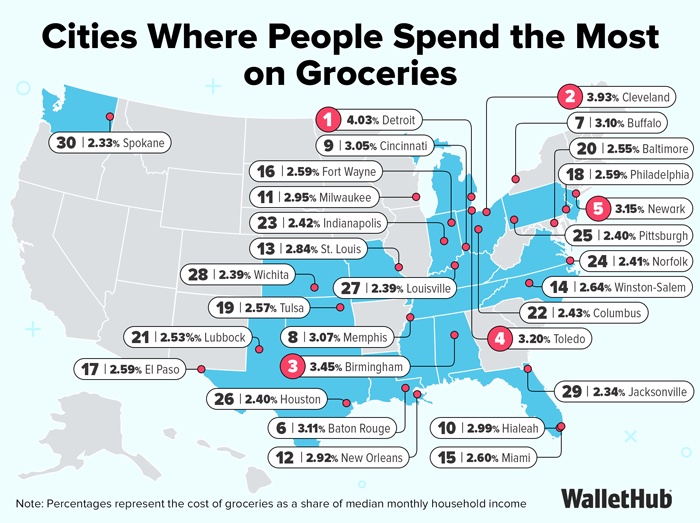
A new analysis, from personal finance website WalletHub, ranked 100 of the largest U.S. cities based on cost of groceries as a share of median household income. The results show that residents in some places spend significantly more of their income on groceries than other parts of the country.
Detroit, Michigan, ranked No. 1, with grocery costs accounting for an average of 3.78 percent of the city's median monthly household income. Cleveland, Ohio, followed closely at 3.77 percent, while Birmingham, Alabama, ranked third at 3.28 percent.
The ranking does not necessarily mean residents in these cities pay the highest prices for every grocery item. Instead, WalletHub's analysis considers grocery costs relative to local household incomes.
That distinction is particularly important in Detroit, which has one of the lowest median household incomes among the cities analyzed.
Detroit's median annual household income was about $39,575, according to WalletHub. Residents also face relatively high prices for some staples, including lettuce, sugar and whole milk. Despite this, the city has some of the lowest prices in the country for items such as ground beef, tuna and peaches.
The widespread issue comes as Americans continue to feel the effects of years of food price increases. Grocery prices have risen sharply since the pandemic.
Americans were paying about 33 percent more for groceries in July 2026 than at the beginning of 2019, according to federal data cited by the Associated Press. Rising food costs have pushed many shoppers to compare prices more closely, use coupons, switch brands and cut back on certain foods.
The burden can be particularly significant for lower-income households. The Department of Agriculture found that Americans spent an average of 12.9 percent of their pretax income on food, including groceries and restaurant meals, in 2024. For households in the lowest income fifth, that figure was about 33 percent.
The 15 cities where grocery costs make up the largest share of median household income, according to WalletHub's analysis, are as follows:
- Detroit, Michigan – 3.78 percent
- Cleveland, Ohio – 3.77 percent
- Birmingham, Alabama – 3.28 percent
- Newark, New Jersey – 3.16 percent
- Toledo, Ohio – 3.09 percent
- Hialeah, Florida – 3.00 percent
- Buffalo, New York – 2.98 percent
- Cincinnati, Ohio – 2.90 percent
- Milwaukee, Wisconsin – 2.89 percent
- Memphis, Tennessee – 2.87 percent
- Baton Rouge, Louisiana – 2.86 percent
- Miami, Florida – 2.68 percent
- St. Louis, Missouri – 2.64 percent
- New Orleans, Louisiana – 2.62 percent
- Baltimore, Maryland – 2.54 percent.
At the other end of the ranking, Fremont, California, had the lowest grocery-cost share among the 100 cities analyzed, at 0.96 percent. Other California cities, San Jose (1.07 percent), San Francisco (1.10 percent) and Irvine (1.21 percent) also ranked near the bottom.
Read MoreThis is how much Gen Z needs to save each month to fund a comfortable retirement
Costly ‘buy now, pay later’ mistakes to avoid as Americans sink $160bn into plans
Target joins growing list of stores slashing prices ahead of the holidays