.png)
I ONCE understood something at Santubong. I just wish I knew what it was. And still, I knew.
I went back to Sarawak whenever I could.
There were official reasons, of course. There usually are. But somewhere along the way, Sarawak had become one of those places I no longer needed much persuading to visit.
I loved Kuching. I loved the rivers, the improbable distances, the longhouses, the forests and that particular sensation of having travelled somewhere considerably farther than the number of kilometres suggested. And I loved the Rainforest World Music Festival.
The festival takes place at the Sarawak Cultural Village, at the foot of Mount Santubong. For a few days, musicians arrive from across the world. Instruments, languages and traditions collide happily beneath the rainforest. Thousands come to listen.
One morning, very early, I went for a walk. The music had stopped, the crowds had disappeared, and the village was almost empty.
Santubong was still there.
For a few moments, I had the strangest sensation that the mountain was speaking to me. That sentence requires immediate qualification. I heard no voice. I saw no spirits. Nothing supernatural occurred, and I returned from my walk entirely capable of eating breakfast.
What I remember is something more difficult to describe.
I remember the feeling of understanding. There was no message I could have written down afterwards. It was closer to the sensation that something normally inaccessible had, very briefly, become comprehensible. As though I was not looking at the place but, for an instant, allowing it to pass through me.
Then it was gone. Years later, I no longer remember what I thought I understood. I remember only the extraordinary certainty that, for a moment, I did.
The curious thing is what I discovered later.
People had been living, working, trading and telling stories around Santubong for a very long time. Archaeology tells part of that story. Centuries ago, the area was connected to trading worlds far beyond Borneo.
Iron was worked there, ceramics arrived from distant shores and human forms were carved into stone.
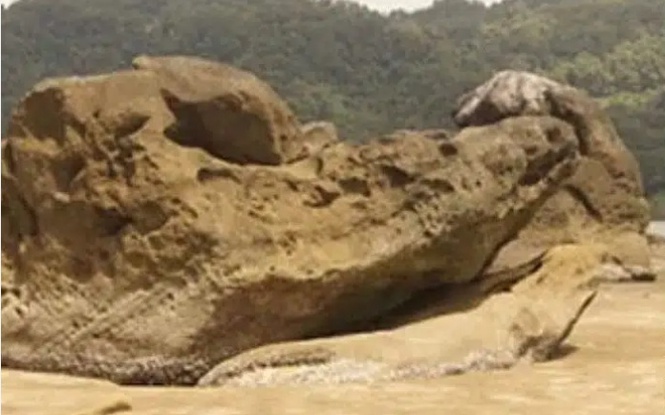
But archaeology is only one layer. Batu Buaya, a sandstone formation near the water, was associated in documented local tradition with offerings and with a spirit believed to inhabit the stone.
Historical accounts from Santubong also record Melanau practices involving offerings to the sea. Separately, Iban oral tradition attached supernatural figures to the mountain.
And then there is the story most Sarawakians know: Puteri Santubong and Puteri Sejinjang, the two princesses whose quarrel ended with their transformation into the landscape.
These are different traditions, from different communities and different periods, and that distinction matters. A trading settlement is not a legend. An archaeological carving is not an Iban story.
A Melanau offering is not a Malay tale about two princesses. Putting them together and calling the result “the spirituality of Borneo” would tell us considerably more about the visitor than about Sarawak.
None of this explains what happened to me that morning. Nor does it need to. I learned about much of it only later; the sensation came before the information.
What interested me when I eventually learned more about Santubong was something simpler. People had been attaching meaning to this landscape for a very long time — not the same meaning, and sometimes separated by centuries.
The Sarawak Cultural Village adds another layer. It was created to bring together, in one place, houses and traditions representing Sarawak’s remarkable cultural diversity — Iban, Bidayuh, Orang Ulu, Penan, Melanau, Malay and Chinese.
There is an obvious danger in doing that. Put enough traditional houses together and you can end up with a very attractive catalogue. Yet this place was never quite that. When the buildings were completed, traditional ceremonies accompanied the process of bringing them into use.
Decades later, musicians from Sarawak and around the world arrive every year and fill the village with another kind of life.
Which brings me back to that morning.
The night before, Santubong had been surrounded by music. By early morning, almost everyone had gone. Perhaps that mattered.
But occasionally a place reaches us before the information does.
That is the part I still cannot explain about Santubong. At the time, much of what had happened around that mountain was unknown to me: the archaeology, and certainly the distinctions between the different traditions attached to it.
I wasn't walking through the village conducting an ethnographic inquiry before breakfast.
I was simply walking. And for a moment, something about the place made complete sense.
What, exactly? I have no idea.
I am still resolutely unconvinced that mountains speak. But I have become less certain that places are silent. - September 14, 2026
Pascal H. Grégoire is a career diplomat and essayist who served as Belgium's Ambassador to Malaysia from 2018 to 2022. He is the editor of Contre-Jour and currently the ambassador of Belgium to the Kingdom of Saudi Arabia.

