
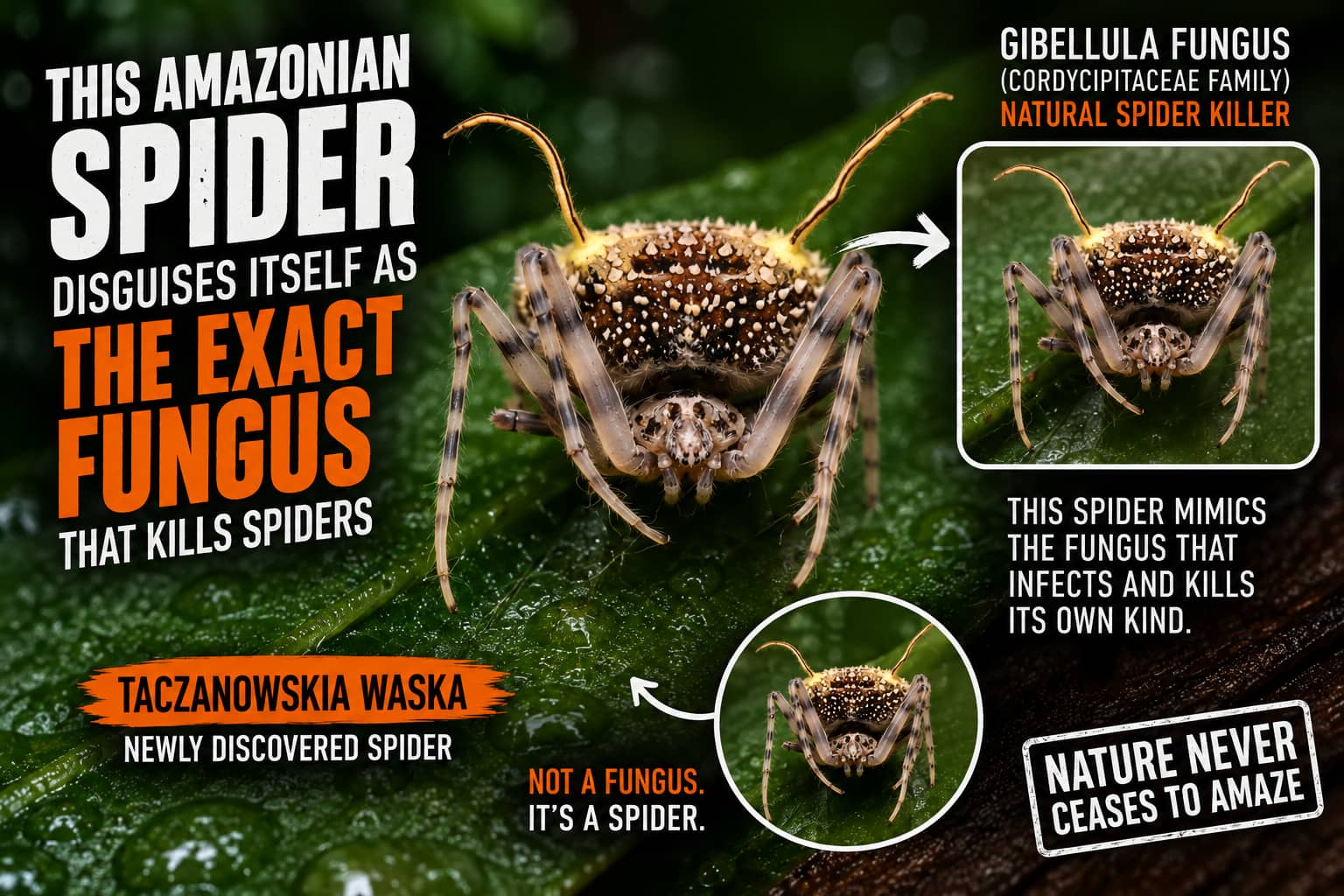
On a rainy night in Ecuador's Amazon rainforest, a conservationist reached out to prod what looked like a clump of parasitic fungus growing on the underside of a leaf. The kind that infects and kills spiders, takes over their bodies, and sprouts from their corpses. He poked it.
It moved.
What he had found was not a fungus. It was a spider. And not just any spider. It was a species nobody had ever documented before, one that had evolved to look exactly like the thing that kills its own kind. The discovery, published in the journal Zootaxa, describes the newly named Taczanowskia waska, an arachnid that mimics the fruiting body of a Gibellula fungus. This fungus belongs to the Cordycipitaceae family, the same group that inspired the zombie infections in The Last of Us.
The spider doesn't just look the part. It also acts the part. It stays completely motionless on the undersides of leaves, the exact spot where Gibellula fungi are typically found growing on dead spider hosts. Its abdomen carries elongated, pale structures that closely resemble fungal growths. Under field conditions, at night, the resemblance was convincing enough to fool trained researchers on first look.
What makes this case particularly strange is the nature of the disguise itself. In most known examples of animal mimicry, the model is something dangerous to the predator. A harmless fly mimics a wasp. A non-venomous snake copies the markings of a venomous one. The mimic pretends to be something that would hurt whatever might try to eat it.
This spider does the opposite. It copies something that would normally signal its own death. A spider covered in Gibellula is a dead spider. Any predator seeing what appears to be a fungus-covered corpse would likely move on. Why eat something that is already infected and decaying? The disguise doesn't say "I'm dangerous." It says "I'm already dead. Nothing to see here."
The research team, which included scientists from the Leibniz Institute for the Analysis of Biodiversity Change, noted that the discovery traces back to an observation posted on the citizen science platform iNaturalist. Users flagged what appeared to be a mushroom as a possible spider, which prompted the research team to collect a specimen from the Llanganates-Sangay Corridor, one of the richest biodiversity hotspots on Earth.
My Opinion
This is evolution at its most creative and most disturbing. A spider that pretends to be a zombie version of itself just to avoid getting eaten. If nature had a horror film division, this would be the pitch that gets greenlit immediately. And the fact that it was first spotted by a regular person on iNaturalist, not a lab team, makes it even better. We are still discovering creatures that rewrite what we think we know about survival. And we found this one because someone on the internet said, "Hey, that mushroom looks weird."
Ronny M (ronny76netstuff@gmail.com) is a content creator under the Newswav Creator programme, where you get to express yourself, be a citizen journalist, and at the same time monetize your content & reach millions of users on Newswav. Log in to creator.newswav.com and become a Newswav Creator now!
The User Content (as defined on Newswav Terms of Use) above including the views expressed and media (pictures, videos, citations etc) were submitted & posted by the author. Newswav is solely an aggregation platform that hosts the User Content. If you have any questions about the content, copyright or other issues of the work, please contact creator@newswav.com.