
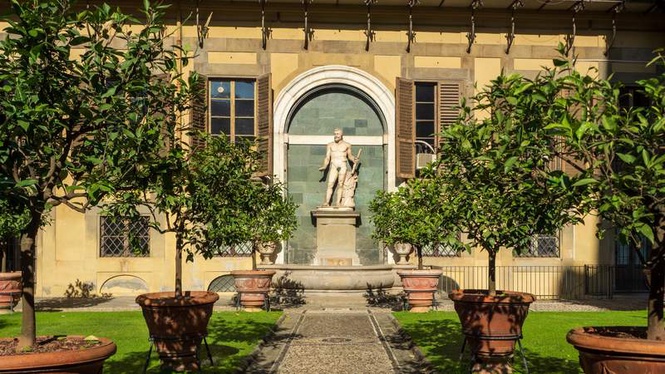
One has to push open a door of pietra forte to step into five centuries of history. On the other side stands the Palazzo Medici Riccardi, the first unmistakably Renaissance palace in Florence: commissioned in 1444 by Cosimo de’ Medici from the architect Michelozzo, it laid the foundations for an architectural language that an entire city would soon rush to adopt.
On Via Cavour, amid the bustle of Florence, the façade is austere, almost cold. Nothing gives away what lies behind it. Yet for a century this palace housed the greatest minds of the Florentine Renaissance, before reinventing itself in the Baroque style.
A Renaissance begins
In 1444, Cosimo de’ Medici dreamed of a palace on Florence’s widest thoroughfare. Brunelleschi designed one for him, but it was far too magnificent for a man recently returned from exile, wary of arousing the envy of his neighbours. The banker wanted power, not trouble.
So he turned instead to Michelozzo, steeped in the principles of classical proportion, and the result was extraordinary: a new kind of architecture, a courtyard that became a model for generations, and later, over the centuries, an illuminated chapel and a Baroque gallery lavishly adorned with gold and frescoes by his successors.
A deceptive façade
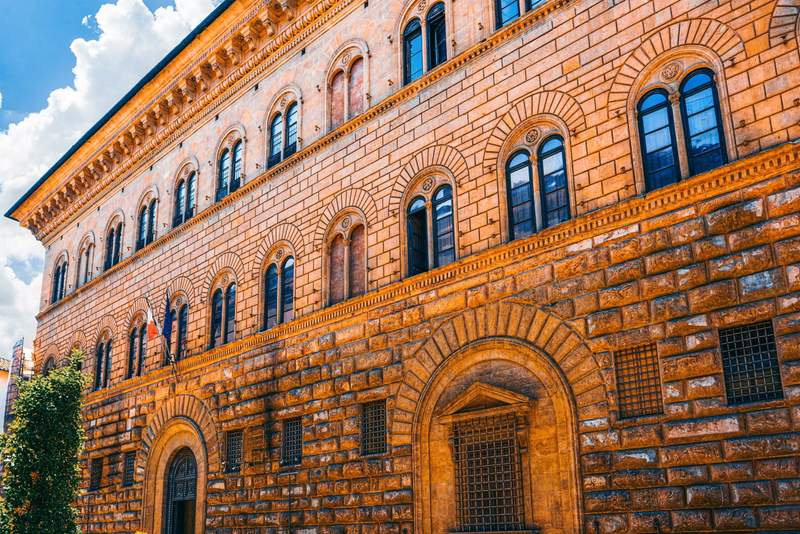
Three tiers of stone rise across the façade on Via Cavour: rough and severe rustication on the ground floor, finer masonry on the first floor, then smooth ashlar beneath the projecting cornice. The effect is carefully calculated: the higher the eye travels, the softer the stone appears. Framed by mullioned windows and two asymmetrical doorways, Michelozzo’s façade is almost intimidating.
Seventy years later, Michelangelo discreetly added his finestre inginocchiate — 'kneeling windows' — the first of their kind in Florence. And yet nothing on the exterior hints at the richness within.
The cortile, beating heart of the palace
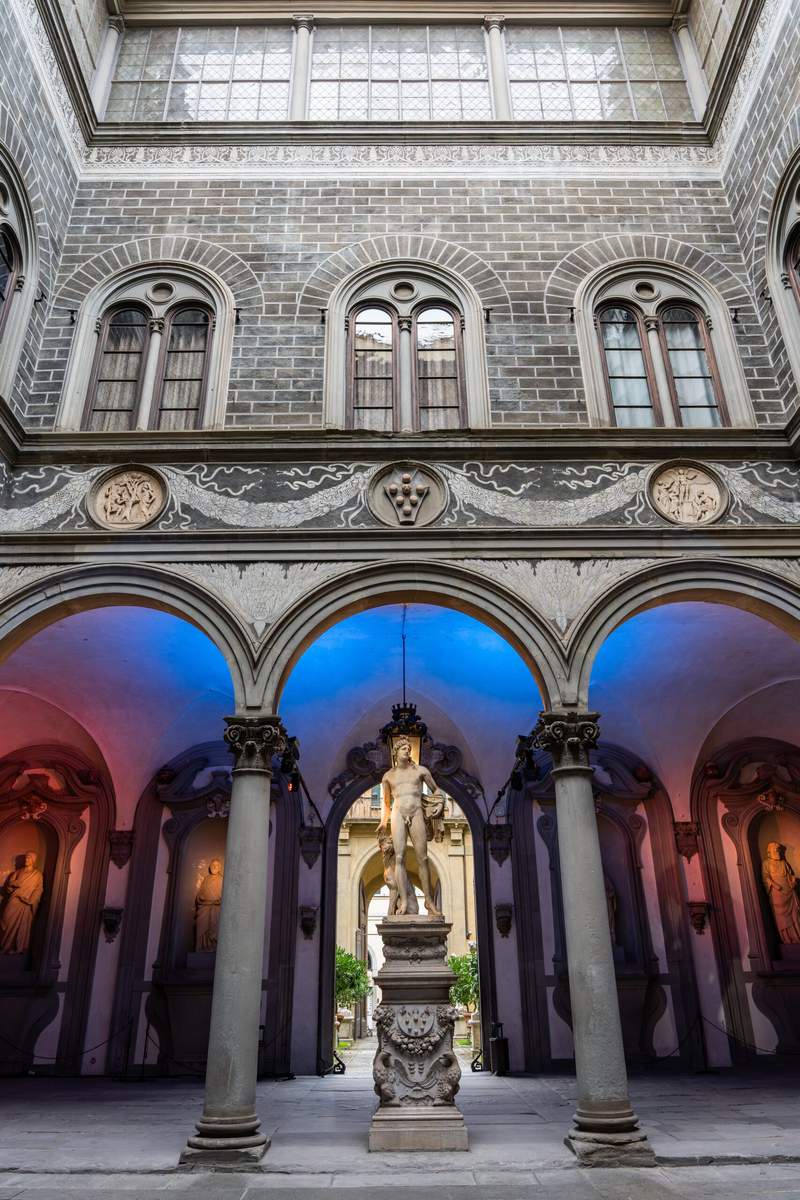
Beyond the gateway, Michelozzo’s courtyard opens like a sigh of relief. Slender Corinthian columns support rounded arches decorated with antique medallions. Tuscan light falls from above, vertical and gentle.
At the centre stands Baccio Bandinelli’s Orpheus (1519), seemingly searching for an audience. It was here that Lorenzo the Magnificent held banquets and philosophical tournaments. Inspired by Brunelleschi’s architectural modules, this cortile was the first of its kind in Florence.
The Medici procession
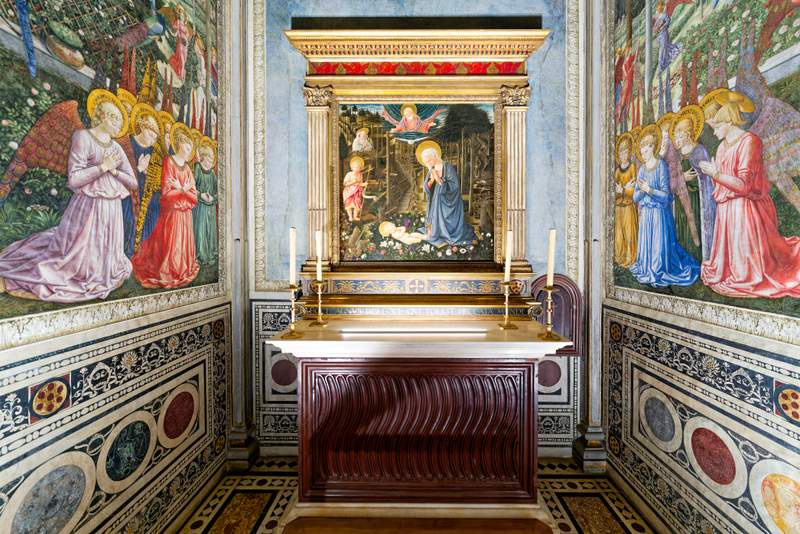
On the first floor, the Chapel of the Magi is a revelation. This small square room, entirely covered in frescoes, was the first private chapel authorised within a Florentine palace. Across three walls, Benozzo Gozzoli painted The Procession of the Magi from 1459 onwards — in reality a court portrait in which Cosimo the Elder himself appears among the pages.
Leopards and monkeys populate an idealised Tuscan landscape beneath a blue-and-gold coffered ceiling. Even Stendhal, in his History of Painting in Italy (1817), praised its haunting charm.
The gallery, Riccardi style
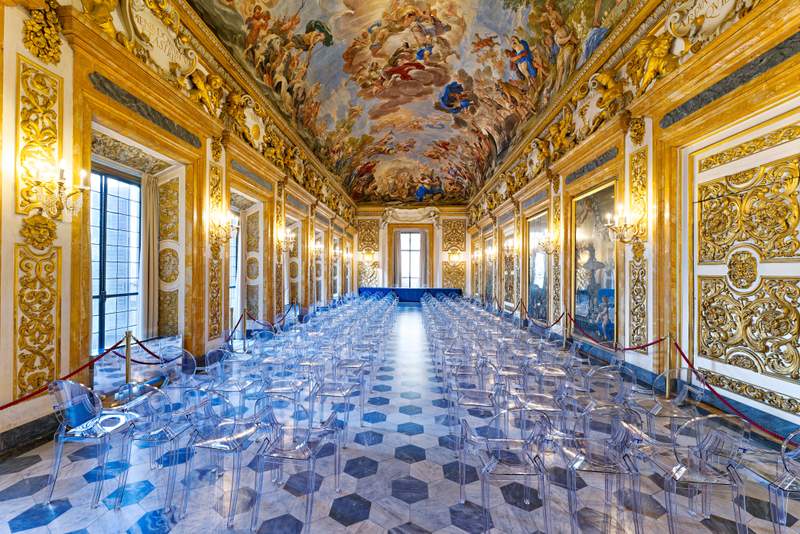
Two centuries later, the palace changed hands — and character. The Riccardi marquises purchased it for forty thousand scudi and embarked upon extensive renovations. Their most spectacular achievement was the Gallery of Mirrors, whose vaulted ceiling was painted from 1682 onwards by Luca Giordano, nicknamed Fa Presto ('Work Quickly') for the speed of his execution.
Golden stucco, vast mirrors, mythological scenes suspended in mid-air: this is Baroque at its most flamboyant, the complete opposite of Medici restraint — and an utterly guilty pleasure.
The scholars’ library
Less familiar to hurried visitors, the Moreniana Library deserves a pause. Founded in the seventeenth century by the marquises, it now houses rare manuscripts and antique volumes. Its main hall, lined with towering dark-wood shelves, inspires a hushed sense of awe. The books slumber beneath painted ceilings.
It is the palace’s final secret — and perhaps its most precious one.
https://www.youtube.com/watch?v=Gua-JaVaXl0
Palazzo Medici Riccardi
Via Camillo Cavour, 3
50129 Florence
Italy
Tel +39 055 276 0552
Open Monday-Sunday from 9am to 7pm, except on Wednesdays
Are you planning a trip to Italy? Find inspiration in these articles:
- The 5 most beautiful mountain villages in Italy to escape the summer heat
- Sardinia or Sicily: Which Mediterranean island to choose for your next holiday?
- This large turquoise lake in Italy is a worthy contender to Lake Como (like an Italian fjord!)
- This is the oldest museum in the world (it houses an impressive collection of ancient art!)