
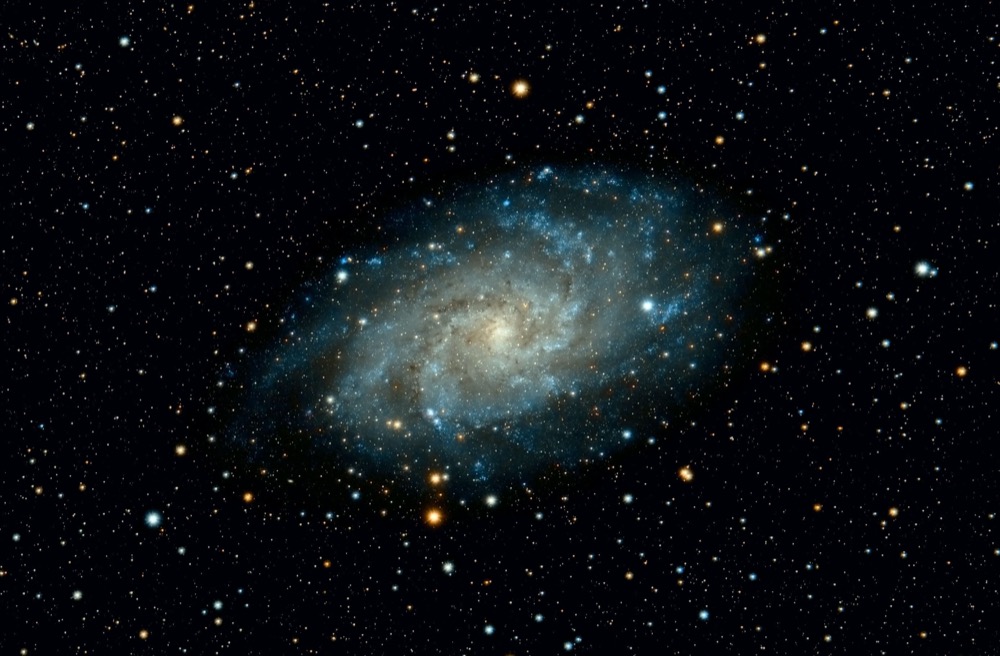
The Dark Energy Spectroscopic Instrument (DESI) has completed the most detailed survey of the universe ever produced, mapping more than 47 million galaxies and quasars across the sky. Scientists believe the unprecedented dataset could help answer one of cosmology’s biggest questions: whether dark energy is changing over time.
The project, conducted at theKitt Peak National Observatory in Arizona, has been scanning the sky since 2021. According to a release published by Lawrence Berkeley National Laboratory (Berkeley Lab), researchers originally expected DESI to collect data on around 34 million galaxies and quasars. The final total surpassed that target by a large margin, reflecting the instrument’s efficiency during observations.
DESI was designed to create a three-dimensional map of the cosmos by measuring the positions and distances of galaxies across billions of light years. Researchers say the survey will allow them to compare how matter was distributed in the distant past with the structure of the universe observed today.
The completed map now covers approximately 14,000 square degrees of the sky. Scientists involved in the survey hope to increase that figure to 17,000 square degrees in future observations, though parts of the sky remain difficult to study because of bright nearby objects such as the Milky Way.
DESI Expands the Largest Cosmic Survey Yet
As explained by David Schlegelof the Lawrence Berkeley National Laboratory, previous maps of the universe contained data for roughly 5 million galaxies. Dark Energy Spectroscopic Instrument (DESI) increases that number almost tenfold, making it the largest spectroscopic survey ever completed. He told New Scientistthat astronomy has followed a steady trend of producing dramatically larger maps every decade. He noted that:
“We’ve actually been on this curve now for my whole career where, every 10 years, we’re making 10-times-larger maps,” he said. “You can ask the question, at what point have you mapped every observable galaxy within 10 billion light years… and if we stayed on the curve, we would do that by 2061.”
Some of the galaxies observed during the DESI survey were extremely faint. Scientists reconstructed several distant objects using as few as 100 to 200 photons detected by the instrument. The observations required precise measurements because of the enormous distances involved.
Although the main five-year survey is now complete, researchers said the data still requires extensive processing. The scientific community is expected to gain broader access to the results after another year of analysis.
Dark Energy Results Shake the Standard Model
One of the primary objectives of DESI is to study dark energy, the poorly understood phenomenon believed to account for around 70 percent of the universe. As mentioned in the statement, an earlier DESI dataset released in 2024 suggested that dark energy may be weakening over time instead of remaining constant. That possibility would directly challenge the current standard model of cosmology, known as Lambda-CDM.
Researchers plan to use the completed map to investigate the issue more thoroughly by comparing galaxy distributions from different periods in cosmic history. The larger dataset is expected to improve the statistical accuracy of those studies. Scientists involved in the project have not yet reached a final conclusion regarding the behavior of dark energy. The new observations are expected to provide stronger evidence for future analysis.
Researchers Adapt To An Era Flooded With Astronomical Data
For astronomers, the scale of the project also reflects how rapidly observational science has changed over recent decades. Ofer Lahav of University College London described the contrast between earlier galaxy surveys and modern datasets. Speaking to New Scientist, Lahav said that when he was a PhD student in Cambridge around 40 years ago, astronomers worked with samples containing only thousands of galaxies. At the time, researchers lacked sufficient observational data for many large-scale cosmological studies.
Today, the situation is very different. Massive surveys such as DESI generate enormous volumes of information that require advanced methods of analysis and data management. Lahav noted that younger scientists may now face the opposite problem: having access to more data than can easily be processed.
“We’ve built a remarkable piece of equipment that met all our expectations and then some,” stated Michael Levi, DESI director and a scientist at Berkeley Lab. “Now we’re pushing beyond our original plan. We don’t know what we’ll find, but we think it’ll be pretty exciting.”
The DESI collaboration will continue collecting observations for at least another two and a half years. Researchers are also considering upgrades that could allow the instrument to operate into the 2030s, extending one of the largest mapping efforts ever undertaken in astronomy.
Enjoyed this article? Subscribe to our free newsletter for engaging stories, exclusive content, and the latest news.

