.jpg)
By Mihar Dias (C) Copyright August 2024
As the Nenggiri campaigns heat up, mudslinging has become the order of the day, with political parties turning to Facebook to score points against their rivals.
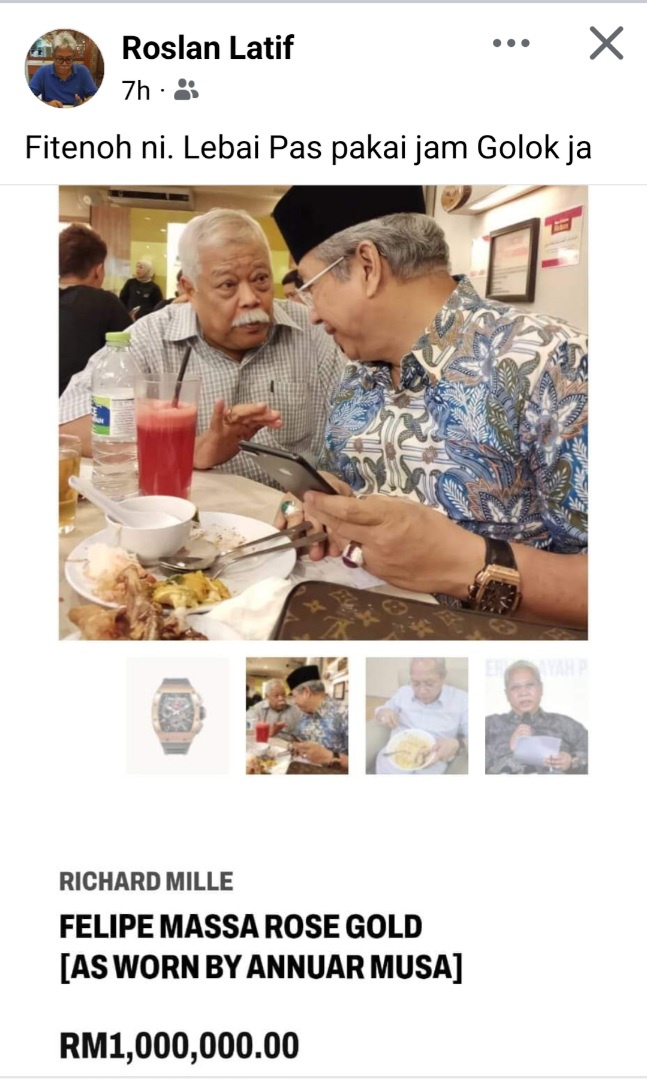
One particular Facebook post has caught the public’s attention, featuring a politician sporting a RM1 million Richard Mille watch. But in a twist of sarcasm, the caption suggests the watch might actually be a knockoff from the border town of Golok.
This spectacle of politicians flaunting expensive watches is nothing new. In fact, it has become almost synonymous with their careers. The longer they stay in power, the pricier the timepieces they parade on their wrists.
Political observers, armed with sharp eyes and quick fingers, are always ready to snap photos and appraise these luxury items online. And they’re quick to point out the absurdity of politicians—whose salaries supposedly don’t match the price tags—wearing such extravagant accessories.
It’s a phenomenon that both the public and the politicians are acutely aware of. Yet, it doesn’t stop these leaders from showcasing their worldly possessions as symbols of success.
It’s reminiscent of native leaders in distant lands, who wear elaborate plumes or bring their many wives on stage to remind the masses of their wealth and status.
For the last six decades, this has been the custom for a particular breed of politicians, those who seem more interested in personal gain than in the principles of statesmanship.
So, what then?
The answer lies in the very nature of these displays. They are not just about showing off wealth but are a form of signaling—a message to both supporters and rivals that they have 'made it.'
In a world where power and wealth are often intertwined, these symbols serve to consolidate their authority, reinforce their status, and, perhaps most importantly, distract from the issues that truly matter.
But in a country where the gap between the haves and the have-nots continues to widen, where ordinary people struggle with rising costs and stagnant wages, these displays of opulence are nothing short of a slap in the face. They highlight a disconnect between the political class and the people they are supposed to represent.
What’s worse is the normalisation of this behaviour. For decades, these politicians have gotten away with it, leading many to believe that this is just how things are. But it doesn’t have to be. A true statesman should be judged by their deeds, not their possessions. It’s time to demand more from our leaders—to ask why they need to flaunt wealth if their real wealth lies in serving the people.
As the campaigns in Nenggiri and beyond continue, let’s not be distracted by the glitter of gold and the tick of a pricey watch.
Instead, let’s focus on the real issues at hand—those that affect the everyday lives of ordinary Malaysians. And perhaps, just perhaps, we’ll see a shift away from this culture of excess and toward a politics of substance.

Mihar Dias is a content creator under the Newswav Creator programme, where you get to express yourself, be a citizen journalist, and at the same time monetize your content & reach millions of users on Newswav. Log in to creator.newswav.com and become a Newswav Creator now!
The User Content (as defined on Newswav Terms of Use) above including the views expressed and media (pictures, videos, citations etc) were submitted & posted by the author. Newswav is solely an aggregation platform that hosts the User Content. If you have any questions about the content, copyright or other issues of the work, please contact Newswav.
